As per our Shipping and Returns Policy, custom cuts and fabricated parts are non-returnable. If you need an over- or undersized item, note it under "Comments" during Checkout. Cut-to-size orders have an acceptable cut tolerance of 1/8" (0.125"), so clarify if the adjustment is to be made on the (+) or (-) side of the saw blade.Please review our full return and shipping policy here.
Measure Twice, Cut Once
Since custom cuts and fabricated parts are non-refundable, be very careful while measuring your dimensions. As each cut is nominal, even the slightest miscalculation could be costly.
How to Use a Measuring Tape
Extend your tape measure several inches to find the 1 and 2 inch markers. In between the inch markers you’ll find 16 equally spaced tick marks.
Measure by counting the increments beyond the nearest inch. As the increments decrease, so does the length of the mark. For example, 1/2" has a bigger mark than 1/4" which has a bigger mark than 1/8". The smallest mark follows at 1/16". Please be aware that some measuring tapes may have even smaller increments.
Features of a Measuring Tape: Sliding End Hook
The sliding end hook is designed for two different types of measurements. An outside measurement (where the hook of the tape hangs over an edge), requires the hook to slide out a bit to account for the thickness of the material. When making an inside measurement (where the hook will push up against a surface), the clip slides in, again, accounting for its thickness. The measuring tape self-adjusts to guarantee an accurate measurement (as far as the tape is concerned).
Sanitizing Acrylic and Polycarbonate Sheet [X]
Acrylic and Polycarbonate Sneeze Guards and like products require special care while cleaning and disinfecting. To maintain the optical clarity of sneeze guards and other acrylic or polycarbonate items, use an acrylic or polycarbonate safe cleaner like Novus Plastic Polish #1, Brillianize Plastic Cleaner, or a mild soap solution.
Please reference the following compatible cleaners when DISINFECTING acrylic and polycarbonate items. The use of commonly available commercial alcohol or ammonia-based disinfectants may cause crazing and damage.
Food-Safe HDPE Cutting Board Sheet for Prep & Industrial Surfaces
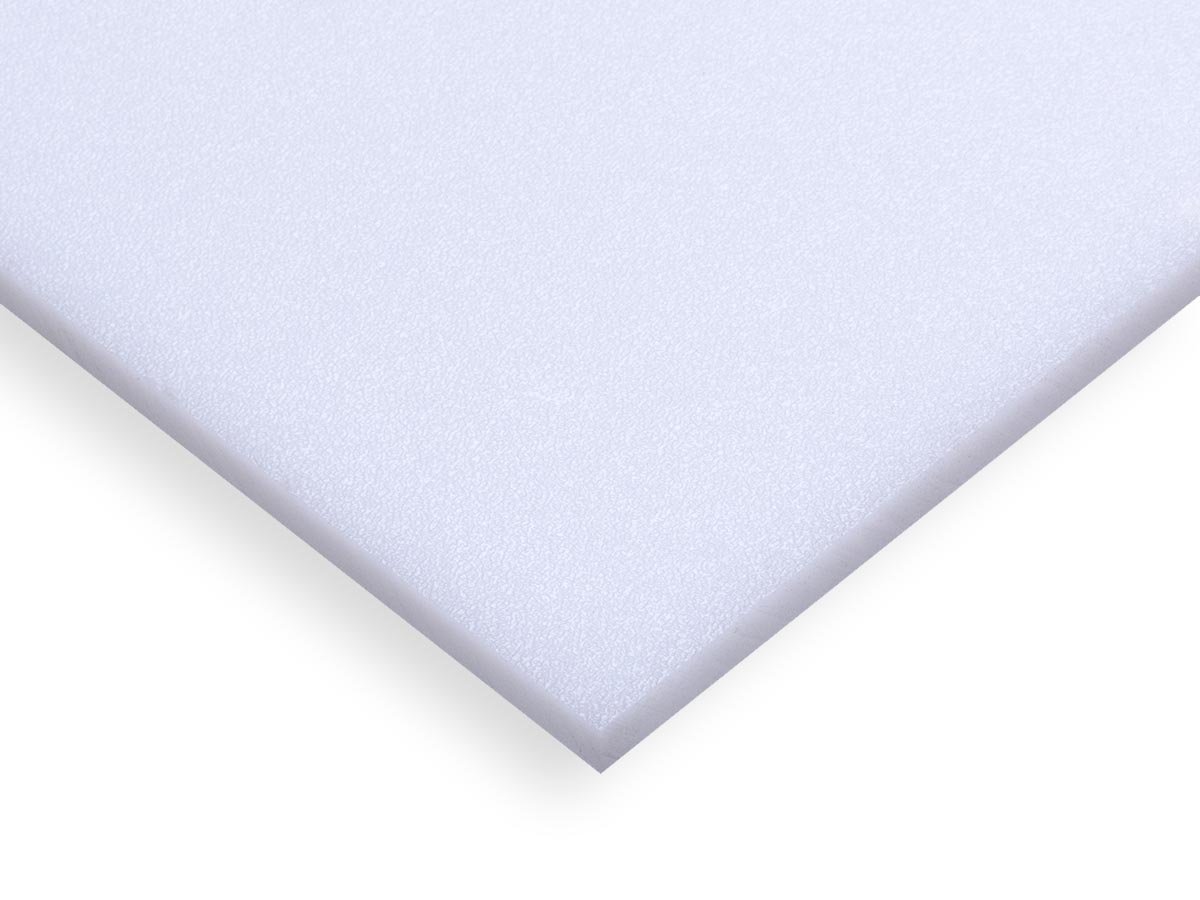
Natural HDPE (High Density Polyethylene) Cutting Board sheet is engineered for durability, low maintenance, and safety. It features a textured, matte surface designed to safely hold food in place without slipping.
Unlike wood and other materials that are prone to absorb bacteria, splinter, chip, swell, peel, rot, warp, bend, and crack, this HDPE cutting board is designed to reduce or eliminate those problems, offering extended longevity. The "natural" bright white color is typically recommended for environments requiring a clean, sanitary appearance.
This is a highly reliable material for food processing and containment. It is the correct choice if you need:
Regulatory Compliance:
FDA and USDA compliant for food applications and NSF certified under NSF/ANSI Standard 51 for food equipment materials.
Sanitary Surface:
Resistant to acids, odors, moisture, and mildew, ensuring a clean preparation area.
Moisture Resistance:
Features very low moisture absorption to help resist swelling, odors, mildew, and degradation in wet food-preparation environments.
Chemical Resistance:
Offers excellent chemical resistance to acids, alcohols, and bases.
Machinability:
Easily machined material for custom shapes and handle cutouts.
HDPE Cutting Board vs. Wood
While both materials are staples in food preparation, cutting board grade HDPE is uniquely formulated for minimal-maintenance commercial environments.
Choose HDPE Cutting Board (This Sheet) if a non-porous, dishwasher-safe surface that resists stains, odors, and moisture without requiring regular oiling is your primary priority.
Choose Wood only if your application requires the traditional, rustic aesthetic of natural timber and your staff can handle the rigorous manual upkeep—including regular mineral oiling, immediate hand-washing, and strict sanitization—necessary to prevent warping and hinder bacterial growth.
Fabrication & Machining
HDPE cutting board sheet is highly machinable and can be easily worked using standard woodworking tools. It can be seamlessly cut, routed, and drilled to create custom shapes, add juice grooves, or bore handle cutouts without splintering, chipping, or excessively dulling cutting equipment.
Handling: Cut sheets may have sharp edges. We recommend wearing protective gloves when unpacking and handling this material to ensure safety.
Suitability: We take pride in the quality of our materials as they leave our facility. However, because every project is unique, we cannot account for how materials are modified, stored, or used after delivery. Please perform the necessary tests to ensure this material is right for your specific application and end-use conditions.
HDPNEC SH
Technical Performance
Cutting Board Grade High Density Polyethylene (HDPE) is a highly resilient, non-porous material engineered specifically for rigorous culinary environments. It features near-zero moisture absorption to resist food liquids and odors, withstands harsh commercial sanitizers, and utilizes a textured finish to provide reliable grip while offering a knife-friendly cutting surface.
Many commercial kitchens use color-coded cutting boards as part of HACCP-style food safety programs to help separate food types and reduce the risk of cross-contamination. Color assignments may vary by facility, but the chart below reflects a commonly used system.
Cutting Board Color Coding Chart
Color
Food Type
Natural/White
Dairy/Bakery Products
Red
Raw Meat
Green
Fruits/Vegetables
Yellow
Raw Poultry
Brown/Black
Cooked Meat
Blue
Raw Fish/Seafood
Key Properties
Regulatory Compliance:
FDA and USDA compliant for food applications, significantly reducing sanitation risks.
NSF Certified:
Certified under NSF/ANSI Standard 51 for food equipment materials.
Sanitary Surface:
Acid, odor, moisture, and mildew resistant.
Chemical Resistance:
Displays excellent chemical resistance to acids, alcohols, and bases.
Moisture Resilience:
Offers near-zero moisture absorption, making it highly resistant to mildew and degradation in wet environments.
Common Food Service Applications
Commercial kitchen prep stations and butcher blocks
Meat, poultry, and fish processing facility tables
Replacement tops for buffet lines and salad bars
Custom-fit food truck workspaces
Residential carving stations and heavy-duty cutting boards
Cutting Board Limitations & Alternatives
Natural HDPE cutting board sheet is an excellent choice for food preparation, processing surfaces, and sanitary work areas, but some applications may call for a different material or product configuration:
Color-Coded Food Prep: Natural white is ideal for a clean, sanitary appearance, but facilities that separate prep areas by food type may need colored boards for visual organization and cross-contamination control. Better Alternative: For HACCP-style color coding, choose from our available colored HDPE cutting boards.
High-Heat Contact: HDPE cutting board sheet is not intended for direct contact with hot pans, ovens, grills, or other high-temperature equipment. Better Alternative: For applications involving higher temperatures, consider Polypropylene (up to 212°F), Tivar H.O.T. (up to 275°F), or PTFE (up to 500°F).
Knife-Heavy Commercial Use: HDPE is durable and knife-friendly, but deep scoring can develop over time in heavy-use prep areas and should be resurfaced or replaced when grooves become difficult to clean. Better Alternative: For very high-volume prep stations, consider using thicker HDPE cutting board sheet to extend service life and allow for resurfacing.