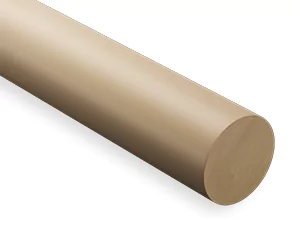
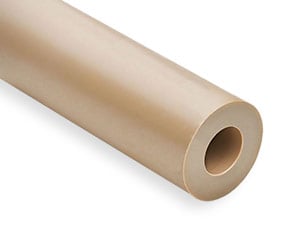
As per our Shipping and Returns Policy, custom cuts and fabricated parts are non-returnable. If you need an over- or undersized item, note it under "Comments" during Checkout. Cut-to-size orders have an acceptable cut tolerance of 1/8" (0.125"), so clarify if the adjustment is to be made on the (+) or (-) side of the saw blade.Please review our full return and shipping policy here.
Measure Twice, Cut Once
Since custom cuts and fabricated parts are non-refundable, be very careful while measuring your dimensions. As each cut is nominal, even the slightest miscalculation could be costly.
How to Use a Measuring Tape
Extend your tape measure several inches to find the 1 and 2 inch markers. In between the inch markers you’ll find 16 equally spaced tick marks.
Measure by counting the increments beyond the nearest inch. As the increments decrease, so does the length of the mark. For example, 1/2" has a bigger mark than 1/4" which has a bigger mark than 1/8". The smallest mark follows at 1/16". Please be aware that some measuring tapes may have even smaller increments.
Features of a Measuring Tape: Sliding End Hook
The sliding end hook is designed for two different types of measurements. An outside measurement (where the hook of the tape hangs over an edge), requires the hook to slide out a bit to account for the thickness of the material. When making an inside measurement (where the hook will push up against a surface), the clip slides in, again, accounting for its thickness. The measuring tape self-adjusts to guarantee an accurate measurement (as far as the tape is concerned).
Sanitizing Acrylic and Polycarbonate Sheet [X]
Acrylic and Polycarbonate Sneeze Guards and like products require special care while cleaning and disinfecting. To maintain the optical clarity of sneeze guards and other acrylic or polycarbonate items, use an acrylic or polycarbonate safe cleaner like Novus Plastic Polish #1, Brillianize Plastic Cleaner, or a mild soap solution.
Please reference the following compatible cleaners when DISINFECTING acrylic and polycarbonate items. The use of commonly available commercial alcohol or ammonia-based disinfectants may cause crazing and damage.
Ultra-High Performance Metal Replacement for High Temperatures
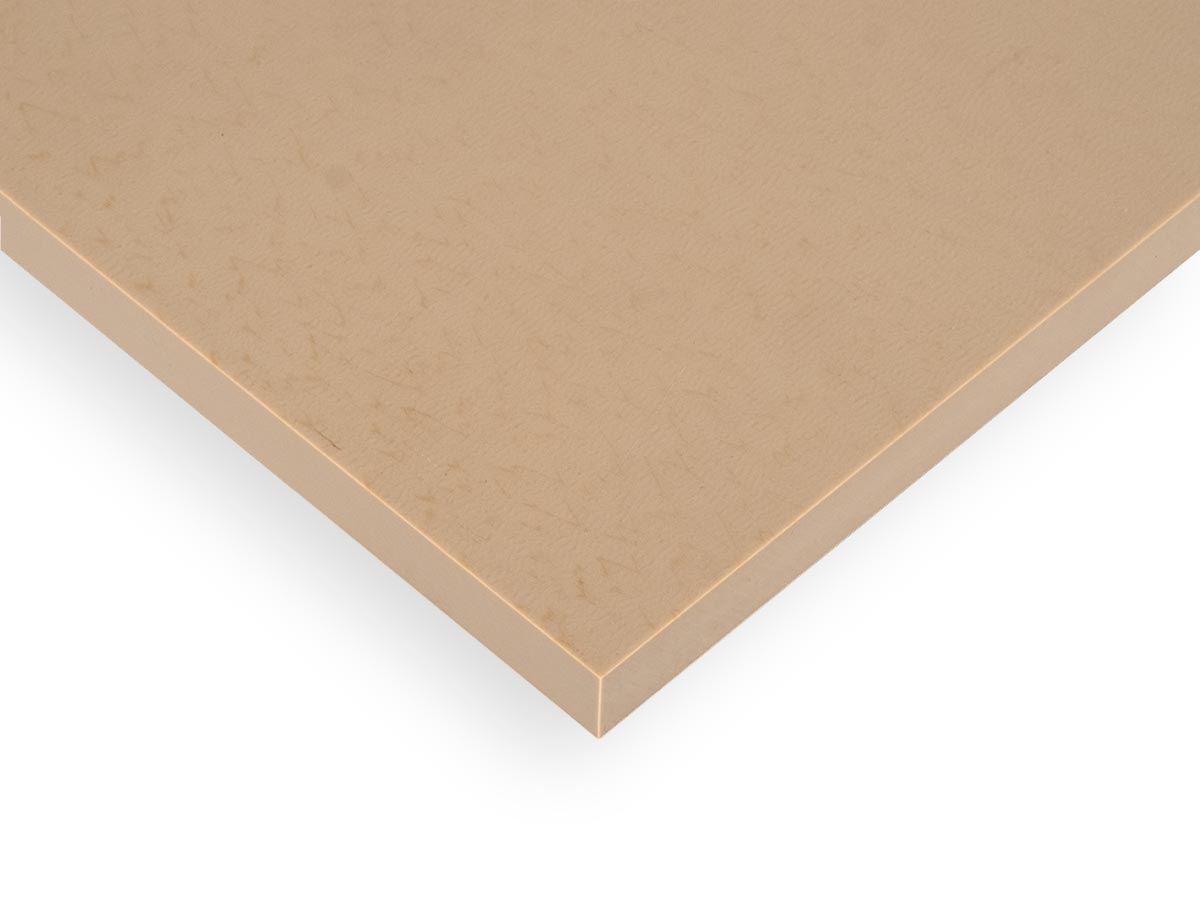
PEEK (Polyether Ether Ketone) sheet is a versatile, high-performance thermoplastic known for its excellent chemical resistance, thermal stability, and fatigue resistance. It is recommended for demanding applications where extreme heat, pressure, and chemicals come into play.
PEEK has a maximum continuous working temperature of 480°F and is a reliable metal and stainless steel replacement in harsh environments. Robust mechanical and electrical properties allow it to perform effectively while serving as an alternative to metals and specialty materials in applications where weight reduction, corrosion resistance, and long-term performance are priorities.
Looking for enhanced structural properties? We also stock Glass-Filled PEEK and Bearing Grade PEEK for specialized high-load wear applications.
Why Choose This Specific Sheet?
PEEK is one of the most established high-performance engineering thermoplastics and is engineered to reduce the risk of failure in severe operating conditions. It is the correct choice if your application requires:
Extreme Temperature Resilience:
Maintains a continuous working temperature of 480°F and offers excellent retention of mechanical properties up to 570°F in steam or high-pressure water environments.
Broad Chemical Resistance:
Excellent resistance to a broad range of chemicals and hydrolysis; insoluble in most common solvents.
High Strength-to-Weight Ratio:
Lightweight compared to steel, aluminum, and titanium, while still providing excellent strength, stiffness, and dimensional stability.
High Wear Resistance:
Offers good wear resistance and sliding performance; bearing-grade PEEK may be preferred for demanding wear or PV applications.
Thermal Degradation Resistance:
Highly resistant to thermal breakdown, ensuring stable performance over an extended lifecycle.
PEEK vs. PTFE: Which Do You Need?
While both are high-performance plastics capable of withstanding extreme temperatures and harsh chemicals, their structural characteristics differ significantly.
Choose PEEK (This Sheet) if you require mechanical strength, stiffness, and the ability to bear heavy static or dynamic loads at elevated temperatures.
Choose PTFE if your application requires a very low coefficient of friction or outstanding chemical resistance, but does not rely on the material for structural support or high rigidity. PTFE is relatively soft in its unfilled form, though fillers can be added to improve rigidity, wear resistance, and dimensional stability.
Fabrication & Machining
PEEK is highly machinable but requires attention to thermal management. For high-tolerance components, use carbide or diamond-tipped sharp tooling and flood coolants.
Handling: Cut sheets may have sharp edges. We recommend wearing protective gloves when unpacking and handling this material to ensure safety.
Suitability: We take pride in the quality of our materials as they leave our facility. However, because every project is unique, we cannot account for how materials are modified, stored, or used after delivery. Please perform the necessary tests to ensure this material is right for your specific application and end-use conditions.
PEKNE SH
Technical Performance
PEEK is a high-performance material engineered for applications requiring superior mechanical, thermal, and electrical properties. It is highly resistant to thermal degradation and provides excellent dimensional stability under stress.
Rated for a maximum continuous working temperature of 480°F and retains mechanical properties effectively up to 570°F in steam or high-pressure water.
Wear Resistance:
Features a low coefficient of friction and high wear resistance.
Strength-to-Weight:
Functions as a lightweight alternative to steel, aluminum, and titanium while maintaining excellent strength and stiffness.
Key Properties
Chemical Resistance:
Superior chemical resistance allows PEEK to work effectively as a metal replacement in harsh environments. It is resistant to a broad range of organic and inorganic liquids and insoluble in most common solvents.
Hydrolysis Resistance:
Designed to reduce the risk of degradation from prolonged exposure to high-pressure steam environments.
Fatigue Resistance:
Excellent fatigue resistance ensures mechanical longevity when components are subjected to cyclic mechanical loading.
Electrical Insulation:
Possesses superior electrical properties, making it a popular choice for demanding electrical insulators, connectors, and precision components.
Common Industrial Applications
Mechanical Components: Bearings, piston parts, and compressor plate valves designed for continuous severe-duty operation.
Scientific & Medical: Medical device components and implantable applications (only when an appropriate medical-grade PEEK is specified).
Electrical & Aerospace: Electrical insulators, connectors, and components requiring high dielectric performance.
Industrial Processing: Utilized extensively in general chemical process applications and fluid handling.
Engineering Limitations & Alternatives
While PEEK is a robust, high-performance material, specific operating environments or budget requirements may necessitate the use of alternative materials. Users should verify compatibility for their specific operating conditions:
Cost Constraints: PEEK is a premium engineering material designed for extreme environments. For lower-temperature applications where standard strength and chemical resistance are sufficient, PEEK may be over-engineered for the task. Better Alternative: For cost-effective mechanical and structural parts operating consistently under 180°F, consider Acetal (Delrin®).
High Impact Requirements: While exceptionally strong and stiff, PEEK can be notch-sensitive and may not be the optimal choice for high-impact barriers or guards. Better Alternative: For structural applications prioritizing ultimate "no-break" impact strength, consider Polycarbonate.
Extreme Low Friction at Moderate Temps: If load-bearing structural strength is not required and the sole design priority is chemical inertness alongside low sliding friction, other materials may be more cost-effective. Better Alternative: For applications requiring extreme low friction properties, consider PTFE (Teflon®).