As per our Shipping and Returns Policy, custom cuts and fabricated parts are non-returnable. If you need an over- or undersized item, note it under "Comments" during Checkout. Cut-to-size orders have an acceptable cut tolerance of 1/8" (0.125"), so clarify if the adjustment is to be made on the (+) or (-) side of the saw blade.Please review our full return and shipping policy here.
Measure Twice, Cut Once
Since custom cuts and fabricated parts are non-refundable, be very careful while measuring your dimensions. As each cut is nominal, even the slightest miscalculation could be costly.
How to Use a Measuring Tape
Extend your tape measure several inches to find the 1 and 2 inch markers. In between the inch markers you’ll find 16 equally spaced tick marks.
Measure by counting the increments beyond the nearest inch. As the increments decrease, so does the length of the mark. For example, 1/2" has a bigger mark than 1/4" which has a bigger mark than 1/8". The smallest mark follows at 1/16". Please be aware that some measuring tapes may have even smaller increments.
Features of a Measuring Tape: Sliding End Hook
The sliding end hook is designed for two different types of measurements. An outside measurement (where the hook of the tape hangs over an edge), requires the hook to slide out a bit to account for the thickness of the material. When making an inside measurement (where the hook will push up against a surface), the clip slides in, again, accounting for its thickness. The measuring tape self-adjusts to guarantee an accurate measurement (as far as the tape is concerned).
Sanitizing Acrylic and Polycarbonate Sheet [X]
Acrylic and Polycarbonate Sneeze Guards and like products require special care while cleaning and disinfecting. To maintain the optical clarity of sneeze guards and other acrylic or polycarbonate items, use an acrylic or polycarbonate safe cleaner like Novus Plastic Polish #1, Brillianize Plastic Cleaner, or a mild soap solution.
Please reference the following compatible cleaners when DISINFECTING acrylic and polycarbonate items. The use of commonly available commercial alcohol or ammonia-based disinfectants may cause crazing and damage.
Linen LE Phenolic (NEMA LE) for Precision Machining & Low-Wear Parts
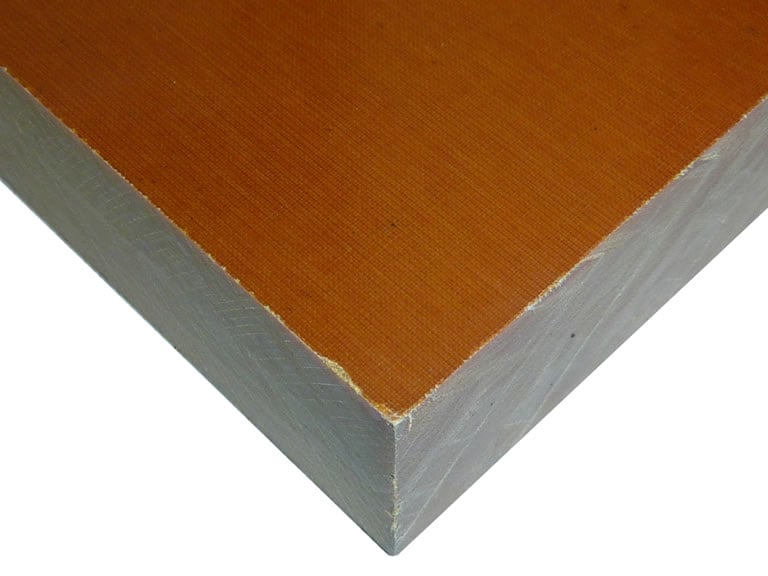
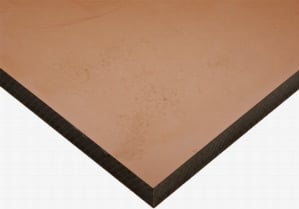
Linen LE Phenolic consists of a fine-weave linen fabric and an electrical-grade phenolic resin. A popular choice for applications requiring reliable wear resistance and superior machinability, this material operates with less noise than traditional metal components and does not spark when struck.
Linen LE reduces abrasive wear on mating parts and is less abrasive than fiberglass alternatives when used in wear applications.
Looking for a grade suited for larger parts? For applications that do not require intricate detailing, we offer Canvas CE Phenolic (a widely used alternative for larger mechanical shapes).
Why Choose This Specific Sheet?
Linen LE grade's characteristics make it well suited for precise machining, electrical insulation, and non-sparking applications. It is the correct choice if you need:
Easy Machining:
Offers better machining compared to canvas grades, making it highly suitable for smaller and more intricate shapes.
Noise Reduction:
Helps components operate with less noise than metal components in moving systems.
Low Abrasiveness:
Not as abrasive as fiberglass alternatives, helping to protect mating surfaces in wear applications.
Non-Sparking Performance:
Does not spark when struck, making Linen LE an alternative to metal for components in explosion-proof environments.
Linen LE vs. Canvas Phenolic: Which Do You Need?
While both are fabric-reinforced phenolic plastics, they excel in different machining environments.
Choose Linen LE (This Sheet) if intricate shapes and easy machining are your #1 priorities. Its fine-weave linen fabric allows for tight-tolerance fabrication, cleaner machined edges, and better dimensional stability than coarser grades.
Choose Canvas Phenolic if you are manufacturing larger structural parts where the fine machinability of linen is not strictly required.
This material is fabrication-friendly. Thanks to its fine-weave linen fabric and electrical grade phenolic resin construction, Linen LE provides easy machining. It is structurally suited for smaller and more intricate shapes than those typically made with canvas phenolic, allowing for precise milling, drilling, and routing.
Cutting, drilling, sanding, or machining phenolic materials can generate dust. Use appropriate PPE, including safety glasses, gloves, and a properly fitted dust mask or respirator, and machine in a well-ventilated area with dust collection where possible.
Handling: Cut sheets may have sharp edges. We recommend wearing protective gloves when unpacking and handling this material to ensure safety.
Suitability: We take pride in the quality of our materials as they leave our facility. However, because every project is unique, we cannot account for how materials are modified, stored, or used after delivery. Please perform the necessary tests to ensure this material is right for your specific application and end-use conditions.
PHENM SH
Technical Performance
Linen LE Phenolic is a composite engineered for applications requiring reliable wear resistance and precision machinability. It is manufactured using a fine-weave linen fabric impregnated with an electrical grade phenolic resin.
Acoustic Damping:
Material composition helps components operate with less noise than comparable metal components.
Wear Surface Compatibility:
Not as abrasive as fiberglass alternatives when utilized in wear-surface applications.
Machinability Rating:
Offers better machining than canvas grades, making it well-suited for precise detailing.
Key Properties
Standard Compliance:
Meets NEMA LE and MIL-I-24768/13 Type FBE specifications; offers good moisture resistance, creep resistance, and dimensional stability.
Non-Sparking:
Formulated so that it does not spark when struck.
Dimensional Adaptability:
Highly suitable for smaller and more intricate shapes than those made with standard canvas phenolic.
Common Industrial Applications
Gears: Commonly specified for mechanical gears to reduce system noise.
Pulleys: Utilized in power transmission settings requiring intricate machining.
Rollers: Machined for material handling systems where low abrasiveness is critical.
Guides: Designed to safely guide components without the abrasive wear caused by fiberglass materials.
Engineering Limitations & Alternatives
While Linen LE Phenolic provides excellent machinability for intricate parts, specific environments may require different composite structures:
Large-Scale Components: If your application involves larger, less intricate shapes, the fine-weave fabric of Linen LE may not be required. Better Alternative: For larger, heavier structural components, choose Canvas CE Phenolic.
Advanced Electrical Insulation Environments: Linen LE is an electrical-grade phenolic with good insulating properties, but applications requiring higher dielectric strength, arc resistance, or glass-reinforced epoxy performance may require a different material. Better Alternative: For strict electrical applications, consider G10/FR4 Garolite or Paper XX Phenolic depending on design requirements.