As per our Shipping and Returns Policy, custom cuts and fabricated parts are non-returnable. If you need an over- or undersized item, note it under "Comments" during Checkout. Cut-to-size orders have an acceptable cut tolerance of 1/8" (0.125"), so clarify if the adjustment is to be made on the (+) or (-) side of the saw blade.Please review our full return and shipping policy here.
Measure Twice, Cut Once
Since custom cuts and fabricated parts are non-refundable, be very careful while measuring your dimensions. As each cut is nominal, even the slightest miscalculation could be costly.
How to Use a Measuring Tape
Extend your tape measure several inches to find the 1 and 2 inch markers. In between the inch markers you’ll find 16 equally spaced tick marks.
Measure by counting the increments beyond the nearest inch. As the increments decrease, so does the length of the mark. For example, 1/2" has a bigger mark than 1/4" which has a bigger mark than 1/8". The smallest mark follows at 1/16". Please be aware that some measuring tapes may have even smaller increments.
Features of a Measuring Tape: Sliding End Hook
The sliding end hook is designed for two different types of measurements. An outside measurement (where the hook of the tape hangs over an edge), requires the hook to slide out a bit to account for the thickness of the material. When making an inside measurement (where the hook will push up against a surface), the clip slides in, again, accounting for its thickness. The measuring tape self-adjusts to guarantee an accurate measurement (as far as the tape is concerned).
Sanitizing Acrylic and Polycarbonate Sheet [X]
Acrylic and Polycarbonate Sneeze Guards and like products require special care while cleaning and disinfecting. To maintain the optical clarity of sneeze guards and other acrylic or polycarbonate items, use an acrylic or polycarbonate safe cleaner like Novus Plastic Polish #1, Brillianize Plastic Cleaner, or a mild soap solution.
Please reference the following compatible cleaners when DISINFECTING acrylic and polycarbonate items. The use of commonly available commercial alcohol or ammonia-based disinfectants may cause crazing and damage.
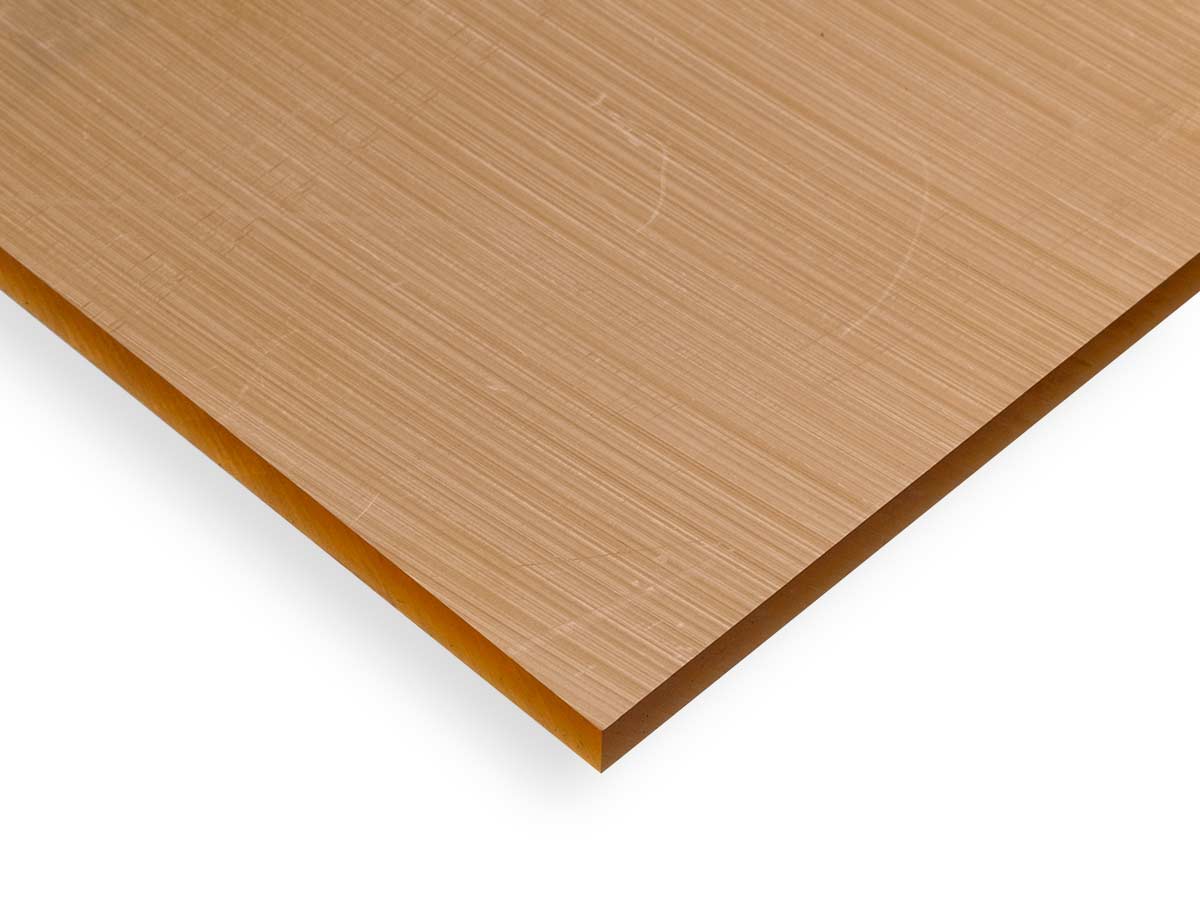
Ultem® (PEI) 1000 is an amorphous high-performance polymer engineered for applications requiring elevated thermal resistance, high strength and stiffness, rigidity, and creep resistance.
Ultem® 1000 is a popular material in the medical, automotive, and aerospace industries due to its hydrolytic stability, transparency, elevated heat resistance, and radiation resistance. It serves as a reliable option for components exposed to rigorous environmental conditions.
Looking for enhanced strength? In addition to standard grades, we also offer glass-filled Ultem® designed for applications demanding even greater stiffness and structural rigidity.
Why Choose Ultem® (PEI) 1000?
Ultem® 1000 provides excellent stability of physical and mechanical properties at elevated temperatures. It is a strong choice when your application requires:
Heat & Radiation Resistance:
Features a high glass transition temperature of 217°C and relative thermal indices (RTI) up to 180°C, with inherent flame resistance in most grades.
Strength & Stiffness:
Maintains strength and stiffness at elevated temperatures up to 200°C (392°F) short term, and 170°C (338°F) long term.
Environmental Stress & Crack Resistance:
Resists stress cracking when exposed to automotive and aircraft fluids, aliphatic hydrocarbons, alcohols, acids, and weak aqueous solutions.
Hydrolytic Stability:
Highly stable in moist environments and withstands frequent sterilization, making specific grades highly suitable for reusable medical devices.
Transparency:
Available in numerous transparent and opaque colors, allowing for visual inspection in complex assemblies.
Ultem® 1000 vs. Polysulfone: Which Do You Need?
While both are amorphous thermoplastics capable of handling elevated heat, they excel in different specific criteria.
Choose Ultem® 1000 (This Sheet) for applications where high strength, stiffness, and elevated temperature resistance are strictly required. Unfilled grades match the strength of many other thermoplastics that require reinforcing fillers.
Choose Polysulfone (PSU) when you need a resilient material but the extreme temperature capabilities and specific chemical resistance of PEI are not necessary for your environment.
Fabrication & Machining
Ultem® 1000 delivers exceptional dimensional stability for close-tolerance machining, but its amorphous structure requires careful fluid control. To safeguard its environmental stress crack resistance, avoid aromatic, chlorinated, or hydrocarbon-based cutting fluids. Use non-aromatic, water-soluble coolants or air cooling where appropriate, paired with sharp carbide or diamond-tipped tools to minimize heat accumulation and ensure a smooth, burr-reduced finish.
Watch: What is Ultem®?
Material Warnings
WARNING: This product can expose you to chemicals including Carbon CAS 133-86-4, which are known to the State of California to cause cancer. For more information go to www.P65Warnings.ca.gov. WARNING: This product can expose you to chemicals including Bisphenol A, CAS 80-05-7, which are known to the State of California to cause birth defects or other reproductive harm. For more information go to www.P65Warnings.ca.gov.
Handling: Cut sheets may have sharp edges. We recommend wearing protective gloves when unpacking and handling this material to ensure safety.
Suitability: We take pride in the quality of our materials as they leave our facility. However, because every project is unique, we cannot account for how materials are modified, stored, or used after delivery. Please perform the necessary tests to ensure this material is right for your specific application and end-use conditions.
PEINE SH
Technical Performance
Ultem® (PEI) 1000 is engineered for applications requiring an exceptional combination of elevated thermal resistance, high tensile strength, and environmental stress crack resistance.
Glass transition temperature of 217°C with relative thermal indices (RTI) reaching up to 180°C. Because of its amorphousness, it has no true melting point.
Mechanical Strength:
Maintains outstanding strength, high stiffness, and dimensional stability at elevated temperatures up to 200°C (392°F) short term, and 170°C (338°F) long term.
Chemical Resistance:
Retains strength when exposed to automotive and aircraft fluids, aliphatic hydrocarbons, alcohols, acids, and weak aqueous solutions.
Key Properties
Dielectric Strength:
High tensile and dielectric strength make it highly suitable for sensitive electrical and telecommunications insulation.
Hydrolytic Stability:
Highly stable in moist environments, supporting extended lifespans in medical applications where frequent sterilization is required.
Wear Resistance:
High wear resistance coupled with exceptional dimensional stability prevents deformation and creep under load.
Flame Resistance:
Offers inherent flame resistance without the need for additives in most available grades.
While Ultem® 1000 provides exceptional thermal stability and strength, specific use cases may warrant alternative solutions:
Standard Temperature Requirements: Using Ultem® 1000 in room-temperature environments may be considered cost-prohibitive over-engineering. Better Alternative: For applications not requiring Ultem®'s combination of high heat resistance, stiffness, flame resistance, and dimensional stability, consider standard engineering plastics like Acetal (Delrin®) or Polycarbonate.
Extreme Structural Loads: Unfilled grades may not offer enough rigidity for maximum-load structural bearings. Better Alternative: For enhanced stiffness and maximum structural strength, choose Glass-Filled Ultem®.







 WARNING: This product can expose you to chemicals including Carbon CAS 133-86-4, which are known to the State of California to cause cancer. For more information go to
  WARNING: This product can expose you to chemicals including Bisphenol A, CAS 80-05-7, which are known to the State of California to cause birth defects or other reproductive harm. For more information go to