As per our Shipping and Returns Policy, custom cuts and fabricated parts are non-returnable. If you need an over- or undersized item, note it under "Comments" during Checkout. Cut-to-size orders have an acceptable cut tolerance of 1/8" (0.125"), so clarify if the adjustment is to be made on the (+) or (-) side of the saw blade.Please review our full return and shipping policy here.
Measure Twice, Cut Once
Since custom cuts and fabricated parts are non-refundable, be very careful while measuring your dimensions. As each cut is nominal, even the slightest miscalculation could be costly.
How to Use a Measuring Tape
Extend your tape measure several inches to find the 1 and 2 inch markers. In between the inch markers you’ll find 16 equally spaced tick marks.
Measure by counting the increments beyond the nearest inch. As the increments decrease, so does the length of the mark. For example, 1/2" has a bigger mark than 1/4" which has a bigger mark than 1/8". The smallest mark follows at 1/16". Please be aware that some measuring tapes may have even smaller increments.
Features of a Measuring Tape: Sliding End Hook
The sliding end hook is designed for two different types of measurements. An outside measurement (where the hook of the tape hangs over an edge), requires the hook to slide out a bit to account for the thickness of the material. When making an inside measurement (where the hook will push up against a surface), the clip slides in, again, accounting for its thickness. The measuring tape self-adjusts to guarantee an accurate measurement (as far as the tape is concerned).
Sanitizing Acrylic and Polycarbonate Sheet [X]
Acrylic and Polycarbonate Sneeze Guards and like products require special care while cleaning and disinfecting. To maintain the optical clarity of sneeze guards and other acrylic or polycarbonate items, use an acrylic or polycarbonate safe cleaner like Novus Plastic Polish #1, Brillianize Plastic Cleaner, or a mild soap solution.
Please reference the following compatible cleaners when DISINFECTING acrylic and polycarbonate items. The use of commonly available commercial alcohol or ammonia-based disinfectants may cause crazing and damage.
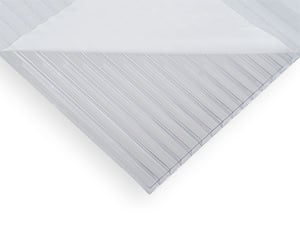
Clear Polycarbonate Twinwall is a versatile glazing and roofing material that combines weather resilience and light transmission with thermal efficiency. Its double-wall cellular structure traps air within internal flutes, helping reduce heat transfer in agricultural, commercial, and residential structures.
With an impact strength up to 200 times greater than glass and 8 times that of acrylic, twinwall polycarbonate offers lightweight resistance to hail and incidental impacts. A co-extruded UV-protective surface layer helps limit yellowing and weathering during long-term outdoor exposure while allowing high levels of visible light transmission for greenhouse and daylighting applications.
Important Notice:All sales on twinwall polycarbonate sheets are FINAL; no returns or refunds are accepted once the material ships. For proper installation, Interstate Plastics recommends using compatible end-sealing tapes, edge profiles, and joining or glazing systems.
Why Choose Polycarbonate Twinwall?
Polycarbonate twinwall is typically recommended for glazing and roofing projects where lightweight durability, UV shielding, and insulation are required:
Trapped Air Insulation:
Double-wall fluted channels create insulating air spaces. Thermal performance varies with sheet thickness, wall geometry, and the complete glazing system.
High Impact Resilience:
Offers impact resistance up to 200 times that of glass, helping reduce breakage from hail and incidental impacts when properly supported and installed.
UV-Protective Layer:
A co-extruded UV-protective surface layer helps resist yellowing and degradation caused by long-term outdoor exposure.
Lightweight Structure:
Its hollow multiwall construction weighs substantially less than conventional glass glazing, simplifying handling and reducing loads on supporting frames.
Twinwall vs. Monolithic Polycarbonate: Which Do You Need?
Selecting the appropriate polycarbonate sheet depends on your requirements for thermal insulation versus optical clarity.
Choose Twinwall Polycarbonate (This Sheet) if you require thermal insulation, light diffusion, and a lightweight fluted structure for greenhouse roofs, skylights, or outdoor canopies.
Choose Monolithic Solid Polycarbonate if your application requires better optical clarity, clearer window sightlines, or solid non-fluted impact barriers.
Fabrication & Installation Guidance
Twinwall polycarbonate is easily fabricated on-site using standard woodworking tools. Cutting can be performed using a circular, jig, or table saw equipped with a fine blade (8–12 teeth per inch), while thinner gauges can be trimmed with a utility knife. Sheets can be cold-curved with the flutes following the curve, without exceeding the specified curvature or bending below the minimum radius.
Before installation, peel the protective film back approximately 10 cm and seal the flute ends using the tapes and edge profiles specified for the supplied glazing system. Install the UV-protected face toward sunlight, orient the flutes for drainage, and provide the manufacturer's required allowances for thermal expansion and contraction. Weld-On 55, a two-component polyurethane adhesive, can bond polycarbonate in suitable fabricated joints, but compatibility and joint performance should be verified through testing.
WARNING: This product can expose you to chemicals including Bisphenol A, CAS 80-05-7 , which are known to the State of California to cause birth defects or other reproductive harm. For more information go to www.P65Warnings.ca.gov.
Handling: Cut sheets may have sharp edges. We recommend wearing protective gloves when unpacking and handling this material to ensure safety.
Suitability: We take pride in the quality of our materials as they leave our facility. However, because every project is unique, we cannot account for how materials are modified, stored, or used after delivery. Please perform the necessary tests to ensure this material is right for your specific application and end-use conditions.
POLCE SW
Technical Performance
Clear Polycarbonate Twinwall is engineered for applications requiring daylight transmission, thermal insulation, and impact-resistant weather protection across broad operating temperature ranges.
Demonstrates an impact strength up to 200 times greater than standard glass and up to 8 times greater than acrylic, significantly reducing the risk of storm damage.
Temperature Performance:
Suitable for a broad range of operating temperatures, subject to the specific panel grade, loading conditions, support spacing, and manufacturer-published service limits.
Light Transmission & UV Protection:
A co-extruded UV-protective layer helps limit weathering and yellowing while maintaining high visible-light transmission.
Key Properties
Double-Wall Cellular Insulation:
Internal air spaces reduce heat transfer compared with single-layer glazing.
Lightweight Construction:
Hollow multiwall construction weighs substantially less than conventional glass glazing.
Cold Forming Ability:
Can be cold-curved on-site along the direction of internal flutes to accommodate vaulted or arched roofs.
Standard Tool Machining:
Easily cut, drilled with drill bits, and sealed using aluminum vent tapes and profile systems.
Common Industrial & Architectural Applications
Greenhouse Glazing & Roofing: Lets sunlight pass through while retaining interior heat to reduce heat loss.
Architectural Skylights & Canopies: Provides lightweight, shatter-resistant daylighting for commercial walkways, outdoor shelters, and patio roofs.
Weather-Resistant Glazing: Provides impact-resistant glazing for properly designed windows, skylights, and roof assemblies.
Light Dispersion & Interior Partitions: Serves as decorative wall panels, office dividers, and light distribution covers where reduced clarity and visible flutes are acceptable.
Data Center Containment: Used for hot- and cold-aisle barriers where lightweight panels with reduced heat transfer help maintain separation between conditioned air streams.
Engineering Limitations & Alternatives
While polycarbonate twinwall offers exceptional thermal insulation and impact resistance, specific optical or structural conditions may require alternative materials:
Optical Clarity & Sightlines: The internal flute walls introduce optical distortion and reduce see-through clarity compared to monolithic sheet. Better Alternative: For clear, window-grade optical transparency without internal flutes, choose Monolithic Solid Polycarbonate Sheet.
Chemical Washdowns & Scratch Resistance: Standard polycarbonate surfaces can scratch, and incompatible cleaners or solvents may cause crazing or other damage. Better Alternative: For frequent cleaning or improved surface durability, consider Abrasion-Resistant (AR) Polycarbonate Sheet.





 WARNING: This product can expose you to chemicals including Bisphenol A, CAS 80-05-7 , which are known to the State of California to cause birth defects or other reproductive harm. For more information go to