As per our Shipping and Returns Policy, custom cuts and fabricated parts are non-returnable. If you need an over- or undersized item, note it under "Comments" during Checkout. Cut-to-size orders have an acceptable cut tolerance of 1/8" (0.125"), so clarify if the adjustment is to be made on the (+) or (-) side of the saw blade.Please review our full return and shipping policy here.
Measure Twice, Cut Once
Since custom cuts and fabricated parts are non-refundable, be very careful while measuring your dimensions. As each cut is nominal, even the slightest miscalculation could be costly.
How to Use a Measuring Tape
Extend your tape measure several inches to find the 1 and 2 inch markers. In between the inch markers you’ll find 16 equally spaced tick marks.
Measure by counting the increments beyond the nearest inch. As the increments decrease, so does the length of the mark. For example, 1/2" has a bigger mark than 1/4" which has a bigger mark than 1/8". The smallest mark follows at 1/16". Please be aware that some measuring tapes may have even smaller increments.
Features of a Measuring Tape: Sliding End Hook
The sliding end hook is designed for two different types of measurements. An outside measurement (where the hook of the tape hangs over an edge), requires the hook to slide out a bit to account for the thickness of the material. When making an inside measurement (where the hook will push up against a surface), the clip slides in, again, accounting for its thickness. The measuring tape self-adjusts to guarantee an accurate measurement (as far as the tape is concerned).
Sanitizing Acrylic and Polycarbonate Sheet [X]
Acrylic and Polycarbonate Sneeze Guards and like products require special care while cleaning and disinfecting. To maintain the optical clarity of sneeze guards and other acrylic or polycarbonate items, use an acrylic or polycarbonate safe cleaner like Novus Plastic Polish #1, Brillianize Plastic Cleaner, or a mild soap solution.
Please reference the following compatible cleaners when DISINFECTING acrylic and polycarbonate items. The use of commonly available commercial alcohol or ammonia-based disinfectants may cause crazing and damage.
Glass-Silicone Laminate for High-Heat & Arc-Resistant Electrical Applications
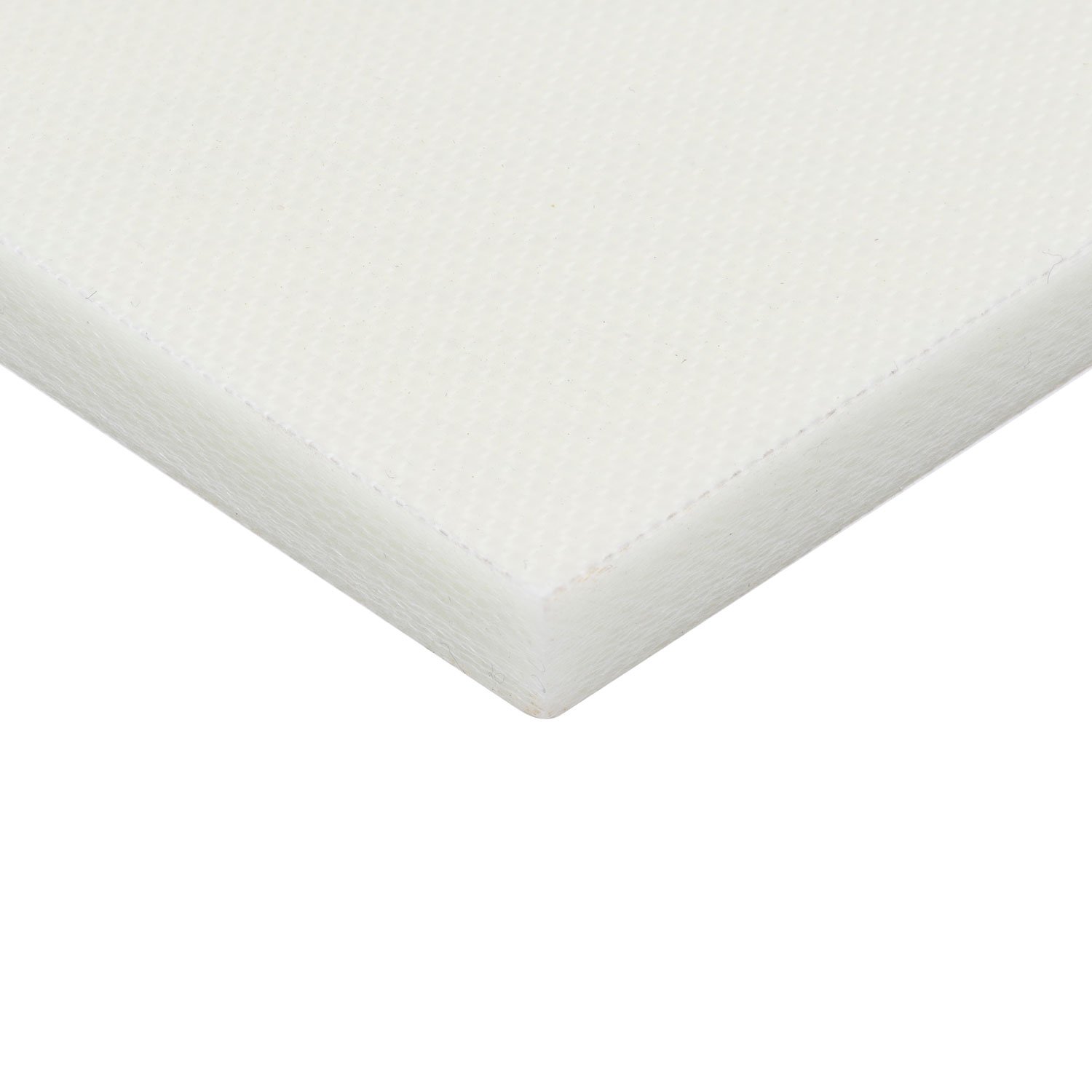
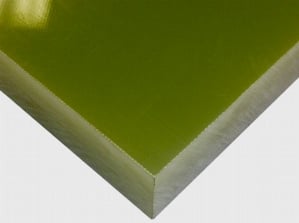
G-7 glass-silicone laminate sheet is a thermoset composite that combines continuous woven glass fabric with a silicone resin system for electrical insulation applications that require arc resistance, dielectric performance, and elevated-temperature capability.
With a maximum operating temperature of 428°F (220°C), a UL 94 V-0 flammability rating, and compliance with MIL-I-24768/17 Type GSG, G-7 is typically selected for electrical, heating, appliance, transformer, and other insulation components used in dry or humid environments.
Need the same material family in round stock? See G-7 Glass-Silicone Laminate Rod. If greater structural strength is more important than G-7's temperature and arc-resistance profile, compare G-10/FR4 Glass Epoxy.
Why Choose G-7?
G-7 sheet is designed for electrical and thermal insulation components where silicone-based glass laminate properties are preferred over the higher room-temperature structural strength of common glass-epoxy grades. Key characteristics include:
Elevated-Temperature Capability:
Maximum operating temperature of 428°F (220°C) is ideal for applications involving prolonged exposure to elevated heat.
Arc Resistance:
Glass-silicone combination is suited to arc barriers, arc plates, welding components, and related electrical insulation uses.
Low Dissipation Factor:
Its dissipation factor of 0.003 (1 MHz Condition A) supports insulating applications where low electrical loss is an important design consideration.
Flame Resistance:
Features a UL 94 V-0 flammability rating and exhibits self-extinguishing behavior.
Military Specification:
Complies with MIL-I-24768/17, Type GSG requirements.
G-7 vs. G-10/FR4 & G-11: Which Do You Need?
These glass-reinforced thermoset laminates address different combinations of heat resistance, electrical insulation, and structural strength.
Choose G-7 (This Sheet) when high-temperature electrical insulation, arc resistance, low dielectric loss, and performance in humid conditions are primary requirements.
Consider G-10/FR4 or G-11 when greater room-temperature tensile and flexural strength are more important. G-10/FR4 is commonly specified for structural and electrical applications, while G-11 is preferred when greater mechanical-property retention at elevated temperatures is required.
Fabrication & Machining
G-7 sheet can be machined and fabricated into electrical and thermal insulation components such as spacers, terminal boards, arc plates, sleeves, and wedges. Machining produces glass and resin dust, so suitable dust collection, ventilation, and personal protective equipment (PPE) should be used during fabrication.
Handling: Cut sheets may have sharp edges. We recommend wearing protective gloves when unpacking and handling this material to ensure safety.
Suitability: We take pride in the quality of our materials as they leave our facility. However, because every project is unique, we cannot account for how materials are modified, stored, or used after delivery. Please perform the necessary tests to ensure this material is right for your specific application and end-use conditions.
PHEE7 SH
Technical Performance
G-7 is a woven glass-fabric laminate bonded with a silicone resin system. Its properties make it a good choice for electrical insulation components exposed to elevated temperatures, electrical arcing, and humid operating conditions.
Performs in elevated-temperature environments up to 428°F, making it well suited for electrical insulation near heating elements and other heat-generating equipment.
Arc Resistance:
Designed for electrical applications where resistance to arcing is important, including arc barriers, terminal boards, and welding equipment.
Electrical Insulation:
Maintains strong dielectric properties with low electrical loss, supporting reliable insulation in demanding electrical assemblies.
Key Properties
Heat Resistance:
Withstands substantially higher service temperatures than many common glass-reinforced laminate grades.
Mechanical Stability:
Glass-fabric reinforcement provides useful strength and dimensional support for spacers, sleeves, wedges, and other machined insulating components.
Humidity Resistance:
Retains useful electrical properties in humid environments, making it suitable for equipment exposed to moisture in the surrounding air.
Flame Resistance:
UL94 V-0 rated for applications where flame resistance and self-extinguishing behavior are important design considerations.
Specification Compliance:
Meets MIL-I-24768/17, Type GSG requirements for G-7 glass-silicone laminate.
Common Industrial Applications
Electrical Insulation: Terminal boards, transformer components, telecom equipment, and insulating parts exposed to elevated temperatures or humidity.
Arc & Welding Equipment: Arc plates and barriers where electrical insulation and resistance to arcing are important.
Heating & Appliances: Thermal and electrical insulation components used around heating systems and appliance assemblies.
Machined Insulating Components: Spacers, wedges, and other fabricated parts requiring a combination of electrical and mechanical properties.
Engineering Limitations & Alternatives
While G-7 is well suited for high-heat electrical insulation and arc-resistant applications, specific environments may require greater structural strength or elevated-temperature load performance:
Structural Strength: G-7 has lower tensile and flexural strength compared with glass-epoxy grades such as G-10 and G-11. Better Alternative: When greater mechanical strength is required and G-7's temperature profile is unnecessary, consider G-10/FR4 Glass Epoxy.
Elevated-Temperature Structural Loads: A 428°F maximum operating temperature should not be interpreted as a guarantee that room-temperature mechanical strength is retained at that temperature; application-specific testing is recommended. Better Alternative: For applications emphasizing structural strength retention at elevated temperatures, evaluate G-11 Glass Epoxy against the required temperature and load conditions.