As per our Shipping and Returns Policy, custom cuts and fabricated parts are non-returnable. If you need an over- or undersized item, note it under "Comments" during Checkout. Cut-to-size orders have an acceptable cut tolerance of 1/8" (0.125"), so clarify if the adjustment is to be made on the (+) or (-) side of the saw blade.Please review our full return and shipping policy here.
Measure Twice, Cut Once
Since custom cuts and fabricated parts are non-refundable, be very careful while measuring your dimensions. As each cut is nominal, even the slightest miscalculation could be costly.
How to Use a Measuring Tape
Extend your tape measure several inches to find the 1 and 2 inch markers. In between the inch markers you’ll find 16 equally spaced tick marks.
Measure by counting the increments beyond the nearest inch. As the increments decrease, so does the length of the mark. For example, 1/2" has a bigger mark than 1/4" which has a bigger mark than 1/8". The smallest mark follows at 1/16". Please be aware that some measuring tapes may have even smaller increments.
Features of a Measuring Tape: Sliding End Hook
The sliding end hook is designed for two different types of measurements. An outside measurement (where the hook of the tape hangs over an edge), requires the hook to slide out a bit to account for the thickness of the material. When making an inside measurement (where the hook will push up against a surface), the clip slides in, again, accounting for its thickness. The measuring tape self-adjusts to guarantee an accurate measurement (as far as the tape is concerned).
Sanitizing Acrylic and Polycarbonate Sheet [X]
Acrylic and Polycarbonate Sneeze Guards and like products require special care while cleaning and disinfecting. To maintain the optical clarity of sneeze guards and other acrylic or polycarbonate items, use an acrylic or polycarbonate safe cleaner like Novus Plastic Polish #1, Brillianize Plastic Cleaner, or a mild soap solution.
Please reference the following compatible cleaners when DISINFECTING acrylic and polycarbonate items. The use of commonly available commercial alcohol or ammonia-based disinfectants may cause crazing and damage.
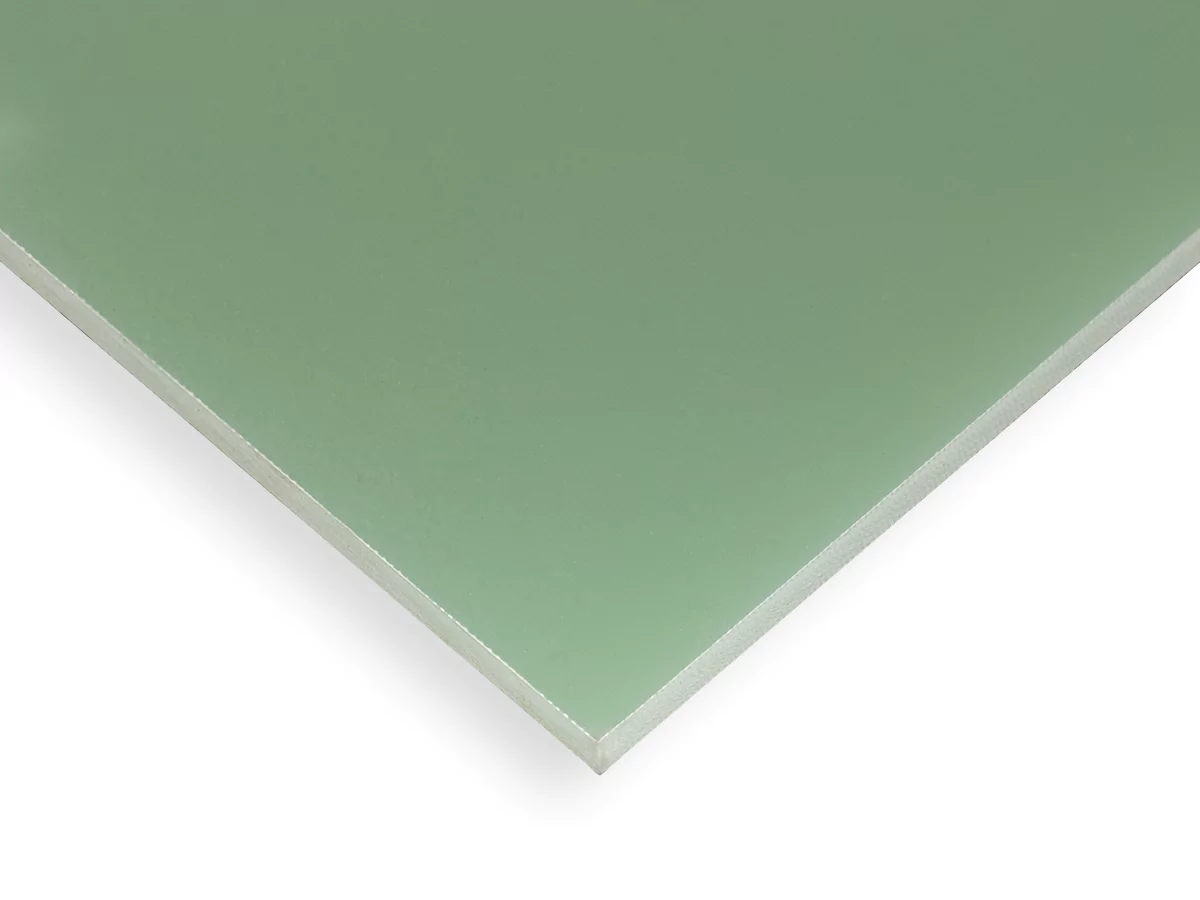
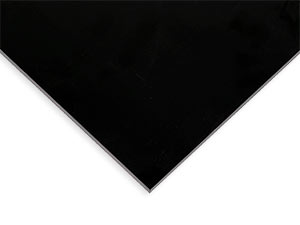
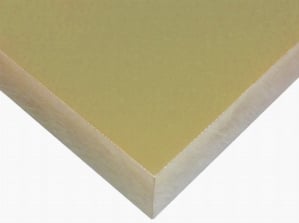
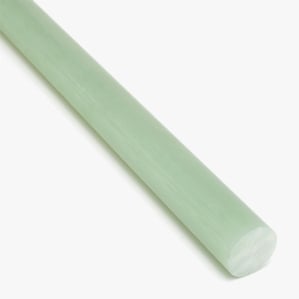
G10 Glass Epoxy is the time-tested thermoset material for structural applications where dimensional stability and electrical insulation are non-negotiable. This high-pressure laminate combines a continuous filament glass cloth with a specialized epoxy resin, creating a material that excels where standard thermoplastics fail.
Standard G10 (Non-FR) is the cost-effective choice for mechanical spacers, chemical-resistant shims, and high-voltage barriers where UL 94 V-0 flame retardancy is not required.
Need flame retardant properties? For applications requiring a UL 94 V-0 rating, we carry G10/FR4 Glass Epoxy (the flame-retardant alternative to G10).
Why Choose G10 Glass Epoxy?
G10 is the reliable standard for non-FR glass-base laminates. It is the correct choice if you need:
High Mechanical Integrity: Offers exceptional tensile, compressive, and flexural strength for structural load-bearing applications.
Superior Dielectric Strength: Excellent electrical insulating properties with low dissipation factors, ideal for high-voltage enclosures and terminal boards.
Moisture & Chemical Resistance: Virtually impervious to moisture (absorption <0.10%) and resistant to most acids, solvents, and cleaning agents.
Thermal Stability: Maintains physical properties and dimensional tolerances at continuous operating temperatures up to 285°F (140°C).
Abrasive & Wear Resistance: The glass-cloth substrate provides a hard, durable surface resistant to mechanical wear in rugged industrial environments.
G10 vs. G10/FR4: Which Do You Need?
While both materials share the same glass-epoxy construction and mechanical specs, their fire safety certifications differ.
Choose G10 (This Sheet) for chemical processing equipment, structural spacers, or electrical insulation where flame retardancy (UL 94 V-0) is not a requirement.
Choose G10/FR4 if your application involves consumer electronics, aerospace, or transit components that must meet strict self-extinguishing safety standards.
G10 is a very hard and abrasive material. It can be machined using standard metalworking equipment, but carbide-tipped or diamond-coated tools are highly recommended to prevent rapid tool wear. Due to the glass-cloth substrate, proper dust collection and PPE are essential during cutting, drilling, and routing to manage glass fibers and dust.
Trusted Industry Expertise
When you order from Interstate Plastics, you're accessing an expansive nationwide network of material expertise. We source our G10 from premier industrial laminators to ensure our sheets meet or exceed specifications for MIL-I-24768/2 (Type GEE) and NEMA standards for consistency and performance.
Watch: G10 Glass Epoxy Overview
Handling: Cut sheets may have sharp edges. We recommend wearing protective gloves when unpacking and handling this material to ensure safety.
Suitability: We take pride in the quality of our materials as they leave our facility. However, because every project is unique, we cannot account for how materials are modified, stored, or used after delivery. Please perform the necessary tests to ensure this material is right for your specific application and end-use conditions.
PHEEG SHTRUE
Technical Performance
Engineered for high-stress environments, G10 Glass Epoxy (MIL-I-24768/2, Type GEE) is designed to maintain its electrical and mechanical properties where other laminates fail. Its high glass-to-resin ratio ensures it remains dimensionally stable under extreme torque and compressive loads, even in saturated or high-humidity conditions.
Mechanical Strength: Features extreme flexural, tensile, and compressive strength (up to 75,000 psi flexural). It is designed to resist deformation and "creep" under constant mechanical stress.
Low Moisture Absorption: Extremely hydrophobic with an absorption rate of <0.10%. Unlike phenolic grades, G10 will not swell or lose electrical insulation properties when exposed to moisture or high humidity.
Dielectric Integrity: Provides high dielectric strength (800 Vpm) and low dissipation factors, making it a premier choice for high-voltage electrical barriers and structural insulators.
Regulatory Compliance & Specifications
MIL-I-24768/2 (Type GEE)
NEMA LI 1-1998 (Grade G-10)
IPC 4101/20 | IEC 60893-3-1 (EP GC 201)
ASTM D709 (Type IV Grade G-10)
ANSI/NEMA G-10
Key Properties
Thermal Stability: Maintains mechanical integrity at continuous operating temperatures up to 285°F (140°C). It does not soften or melt like standard thermoplastics when subjected to heat.
Chemical Immunity: Highly resistant to a broad spectrum of industrial chemicals, including most acids, solvents, and cleaning reagents used in chemical processing.
Dimensional Accuracy: Low coefficient of thermal expansion allows machined G10 parts to maintain extremely tight tolerances across fluctuating temperature ranges.
Machinability: While hard and abrasive, G10 can be precision machined, drilled, and routed to complex geometries using carbide or diamond-tipped tooling.
Common Industrial Applications
Industrial Tooling & Fixtures: High-precision drill jigs, assembly fixtures, and master templates that must maintain tight tolerances and resist surface wear.
Chemical Processing Hardware: Structural supports for plating tanks, chemical-resistant scraper blades, and laboratory equipment exposed to harsh solvents.
Marine Components: Corrosion-proof structural spacers, gaskets, and underwater mounting brackets where zero-rot and moisture resistance are critical.
Precision Spacers & Shims: High-compressive strength blocks (Type GEE) used in heavy machinery to maintain alignment under extreme torque or mechanical load.
NEMA Grade G-10 Electrical Insulation: High-voltage terminal boards, bus bar insulation, and structural barriers where NEMA G-10 performance is required but UL 94 V-0 flame retardancy is not a mandate.
Engineering Limitations & Alternatives
While G10 is a premier structural laminate, specific safety or environmental requirements may necessitate a different grade:
Flame Retardancy (Fire Safety): Standard G10 is non-flame retardant and does not meet UL 94 V-0 requirements. Better Alternative: For electronics, aerospace, or transit applications, choose G10/FR4 Glass Epoxy.
Cryogenic & Sub-Zero Use: While G10 is naturally stable, this specific grade of G10 is not rated for cryogenic or extreme sub-zero applications. Better Alternative: For liquid nitrogen or oxygen systems, consult our sales team for available cryogenic grades.
Impact Flexibility: G10 is extremely rigid and brittle; it will not "give" or flex under sudden high-impact shocks like some polyethylenes. Better Alternative: For high-impact shock absorption, consider UHMW Sheet or Nylon.
Tool Wear & Fabrication: G10 is highly abrasive and will rapidly dull standard high-speed steel (HSS) tools. Requirement: Must use Carbide or Diamond Tooling and proper dust extraction to manage glass fibers.