As per our Shipping and Returns Policy, custom cuts and fabricated parts are non-returnable. If you need an over- or undersized item, note it under "Comments" during Checkout. Cut-to-size orders have an acceptable cut tolerance of 1/8" (0.125"), so clarify if the adjustment is to be made on the (+) or (-) side of the saw blade.Please review our full return and shipping policy here.
Measure Twice, Cut Once
Since custom cuts and fabricated parts are non-refundable, be very careful while measuring your dimensions. As each cut is nominal, even the slightest miscalculation could be costly.
How to Use a Measuring Tape
Extend your tape measure several inches to find the 1 and 2 inch markers. In between the inch markers you’ll find 16 equally spaced tick marks.
Measure by counting the increments beyond the nearest inch. As the increments decrease, so does the length of the mark. For example, 1/2" has a bigger mark than 1/4" which has a bigger mark than 1/8". The smallest mark follows at 1/16". Please be aware that some measuring tapes may have even smaller increments.
Features of a Measuring Tape: Sliding End Hook
The sliding end hook is designed for two different types of measurements. An outside measurement (where the hook of the tape hangs over an edge), requires the hook to slide out a bit to account for the thickness of the material. When making an inside measurement (where the hook will push up against a surface), the clip slides in, again, accounting for its thickness. The measuring tape self-adjusts to guarantee an accurate measurement (as far as the tape is concerned).
Sanitizing Acrylic and Polycarbonate Sheet [X]
Acrylic and Polycarbonate Sneeze Guards and like products require special care while cleaning and disinfecting. To maintain the optical clarity of sneeze guards and other acrylic or polycarbonate items, use an acrylic or polycarbonate safe cleaner like Novus Plastic Polish #1, Brillianize Plastic Cleaner, or a mild soap solution.
Please reference the following compatible cleaners when DISINFECTING acrylic and polycarbonate items. The use of commonly available commercial alcohol or ammonia-based disinfectants may cause crazing and damage.
Industrial Black HDPE for Impact, Moisture & Chemical Resistance
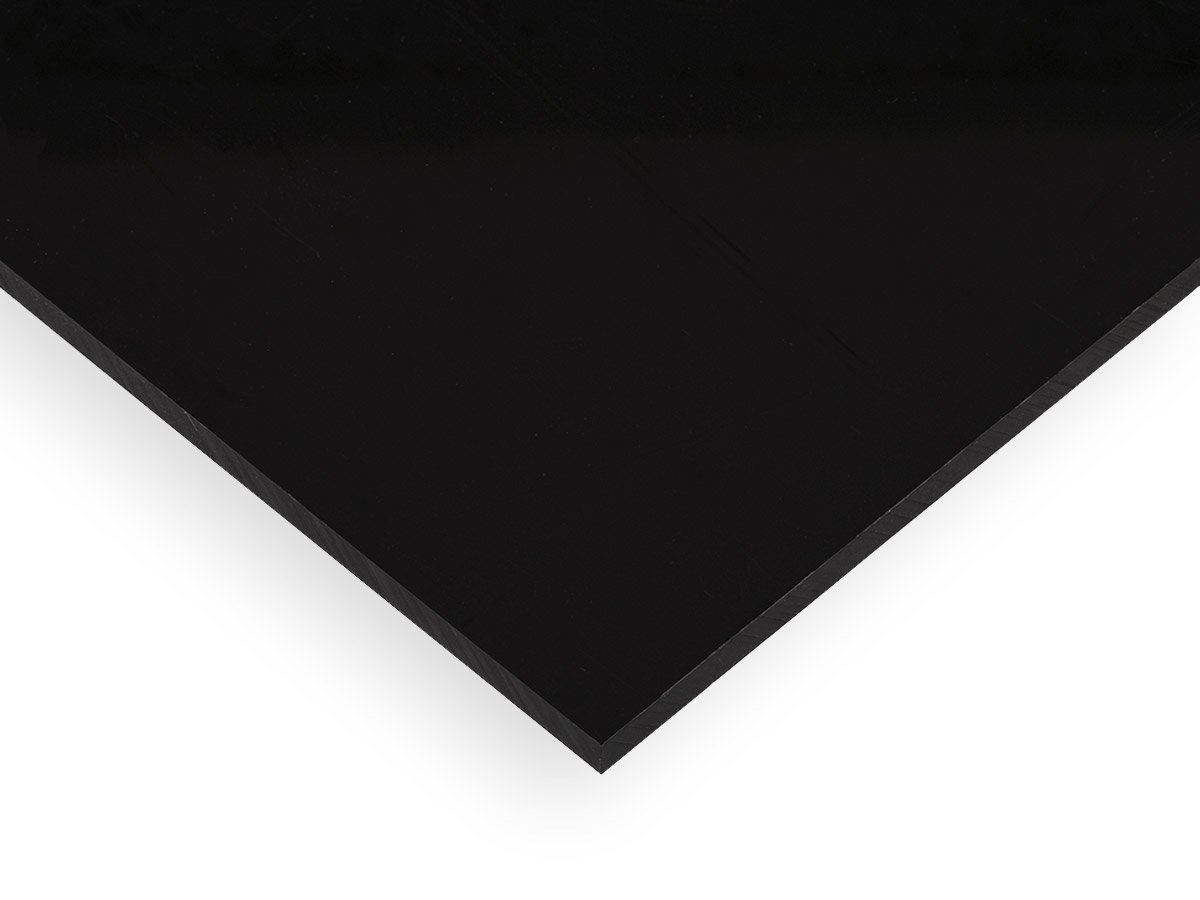
Black HDPE is a durable engineering plastic commonly used in industrial, fabrication, and utility applications. Compared to Natural HDPE, the opaque black color helps conceal dirt, grease, oil, and handling marks in demanding work environments.
It offers strong impact resistance, low moisture absorption, and broad chemical resistance, making it well-suited for wear liners, fabricated trays, machine guards, spacers, equipment components, and general-purpose industrial parts.
Note on Surface Finish: This is an unmasked, industrial-grade plastic sheet. Minor scuffs and handling marks are normal and do not affect material performance. If you require a pristine, textured cosmetic finish for visible boat cabinetry or finished marine components, we recommend King StarBoard®.
Why Choose Black HDPE?
This sheet is a practical choice for demanding industrial, fabrication, and utility applications. It is the correct choice if your project requires:
Impact Resistance: HDPE absorbs impact well and resists cracking or shattering in many fabricated parts, guards, liners, and handling components.
Aesthetic Maintenance: The opaque black color helps hide grease, oil, dirt, and handling marks. This is useful in factory, maintenance, and equipment environments where lighter-colored sheets can show stains quickly.
Broad Chemical Resistance: Resists many acids, alkalis, solvents, and detergents, depending on concentration, temperature, and exposure time. Its non-porous surface also helps reduce moisture absorption and odor retention.
Thermoforming: Unlike UHMW, HDPE can be heated and vacuum-formed. This makes it useful for manufacturing complex 3D shapes like automotive dunnage, custom trays, and equipment housings.
Material Selection: Which Polyethylene Do You Need?
Polyethylenes look similar but perform differently. Choose the right grade for your application:
Choose Black HDPE (This Sheet) for industrial, fabrication, or dirty work environments. Black HDPE is a strong choice for liners, trays, guards, spacers, fabricated parts, and applications where a dark, grime-hiding material is preferred.
Choose Natural (White) HDPE for sanitary or food-contact environments where FDA compliance is required. Best for cutting boards, food chutes, and food-processing components. Confirm compliance before use in regulated food-contact applications.
Choose Pipe Grade HDPE for applications that require higher-density HDPE sheet with improved stiffness, strength, UV resistance, and durability for fabricated parts, tank components, liners, and industrial equipment applications.
Choose UHMW for sliding wear. If you need extreme abrasion resistance, a lower coefficient of friction, or longer wear life in conveyor guides, chute liners, or snow plow edges, UHMW is usually the better choice.
HDPE is non-abrasive and easy to machine using common woodworking tools. It can be cut with standard carbide-tipped saw blades and drilled with standard bits. Due to its low surface energy and chemical resistance, HDPE is difficult to bond with standard adhesives or solvent cements. It is typically mechanically fastened, heat-welded, or bonded only with specialty adhesive systems designed for polyethylene.
When you order from Interstate Plastics, you're accessing an expansive nationwide network of material expertise. We supply Black High Density Polyethylene sheets for industrial, fabrication, and utility applications where reliable performance, consistent material quality, and practical part production are essential.
Watch: What is Black High Density Polyethylene (HDPE)?
Handling: Cut sheets may have sharp edges. We recommend wearing protective gloves when unpacking and handling this material to ensure safety.
Suitability: We take pride in the quality of our materials as they leave our facility. However, because every project is unique, we cannot account for how materials are modified, stored, or used after delivery. Please perform the necessary tests to ensure this material is right for your specific application and end-use conditions.
HDPBE SH
Technical Performance
Black HDPE is a semi-crystalline thermoplastic used for industrial parts, fabricated components, liners, guards, trays, and general-purpose utility applications. It offers a strong balance of impact resistance, low moisture absorption, chemical resistance, and machinability. With a density of approximately 0.95 g/cm3, HDPE is lighter than water and will float, but remains rigid enough to serve as a corrosion-resistant alternative for many non-load-bearing components, liners, guards, and fabricated parts.
Impact Resistance: HDPE offers high toughness and impact resistance, making it useful for guards, liners, spacers, trays, and fabricated components subject to handling or repeated contact.
Moisture Resistance: HDPE has very low water absorption and does not readily absorb moisture, helping it maintain dimensional stability in many wet or washdown environments.
Chemical Resistance: Resists many acids, alkalis, cleaning agents, and industrial chemicals. Chemical compatibility should be confirmed based on the specific chemical, concentration, temperature, and exposure time.
Density: Approximately 0.95 g/cm³, allowing HDPE to float in water.
Regulatory Compliance & Specifications
ASTM Standard: Commonly supplied to ASTM D4976 classifications for polyethylene plastics. Confirm grade-specific requirements before specifying for regulated or engineered applications.
RoHS & REACH Compliant: Free from heavy metals and Substances of Very High Concern (SVHC), making it safe for global supply chains and strict environmental audits.
Premium Sourcing: Available from industry-leading manufacturers such as Röchling, Simona, and Vycom, supporting consistent sheet quality for machining and fabrication.
Key Properties
Thermoformability: Unlike UHMW, HDPE can be heated and vacuum-formed. This makes it useful for manufacturing complex 3D shapes like automotive dunnage, custom trays, and equipment housings.
Weldability: While difficult to glue, HDPE can be fabricated using thermoplastic welding equipment, allowing for the creation of tanks, fittings, guards, trays, and other welded assemblies.
Chemical Resistance: HDPE resists many corrosive chemicals and is commonly used in industrial environments where metal corrosion or moisture exposure is a concern. It is widely used for containing chemicals that would dissolve other plastics or corrode metal.
Electrical Insulation: Good dielectric properties make HDPE suitable for many electrical insulators, spacers, and non-conductive components.
Common Industrial Applications
Liquid Containment: Welded tanks, water storage linings, secondary containment components, and agricultural chute liners.
Recreation & Facility Use: Hockey rink dasher boards, gymnasium kick plates, playground components, and facility protection panels.
Engineering Limitations & Alternatives
While Black HDPE is versatile, specific applications may require specialized grades:
Food Contact Compliance: Standard Black HDPE is generally not specified for direct food contact unless the specific grade is documented for that use. Better Alternative: For cutting boards and food chutes, choose Natural White HDPE (FDA Compliant).
Decorative Marine Finish: Industrial Black HDPE has a functional smooth or matte finish and may show scuffs, scratches, or handling marks. Better Alternative: For visible boat hatches or cabinetry requiring a textured finish, choose King StarBoard® (Marine Grade).
Bonding & Adhesion: HDPE has low surface energy and is difficult to bond with standard epoxies or solvent cements. Better Alternative: Use Plastic Welding, mechanical fasteners, or specialty adhesive systems designed for polyethylene. If gluing is required, consider PVC or ABS.
High Heat Applications: HDPE has a relatively low melting point. Continuous service temperature is commonly around 160°F, with short-duration exposure up to approximately 180°F depending on the application. Better Alternative: For higher temperature resistance, consider Pipe Grade HDPE, Polypropylene or Nylon.
Extreme Abrasion: HDPE wears faster than Ultra High Molecular Weight polyethylene in many sliding, conveyor, and high-wear applications. Better Alternative: For wear strips, chain guides, conveyor components, and high-abrasion liners, choose UHMW Sheet.