As per our Shipping and Returns Policy, custom cuts and fabricated parts are non-returnable. If you need an over- or undersized item, note it under "Comments" during Checkout. Cut-to-size orders have an acceptable cut tolerance of 1/8" (0.125"), so clarify if the adjustment is to be made on the (+) or (-) side of the saw blade.Please review our full return and shipping policy here.
Measure Twice, Cut Once
Since custom cuts and fabricated parts are non-refundable, be very careful while measuring your dimensions. As each cut is nominal, even the slightest miscalculation could be costly.
How to Use a Measuring Tape
Extend your tape measure several inches to find the 1 and 2 inch markers. In between the inch markers you’ll find 16 equally spaced tick marks.
Measure by counting the increments beyond the nearest inch. As the increments decrease, so does the length of the mark. For example, 1/2" has a bigger mark than 1/4" which has a bigger mark than 1/8". The smallest mark follows at 1/16". Please be aware that some measuring tapes may have even smaller increments.
Features of a Measuring Tape: Sliding End Hook
The sliding end hook is designed for two different types of measurements. An outside measurement (where the hook of the tape hangs over an edge), requires the hook to slide out a bit to account for the thickness of the material. When making an inside measurement (where the hook will push up against a surface), the clip slides in, again, accounting for its thickness. The measuring tape self-adjusts to guarantee an accurate measurement (as far as the tape is concerned).
LDPE (Low Density Polyethylene)-the first developed polyethylene-is characterized by its toughness and flexibility, low heat resistance, low-temperature impact resistance, and transparency. Like the medium and high-density grades, LDPE has good resistance to chemical attack. At room temperature, it is insoluble in most organic solvents but is attacked by strong oxidizing acids. At higher temperatures, it becomes increasingly more susceptible to attack by aromatic, chlorinated and aliphatic hydrocarbons. LDPE is used for prosthetic devices and in manufacturing containers, dispensing bottles, wash bottles, tubing, plastic bags and computer components.
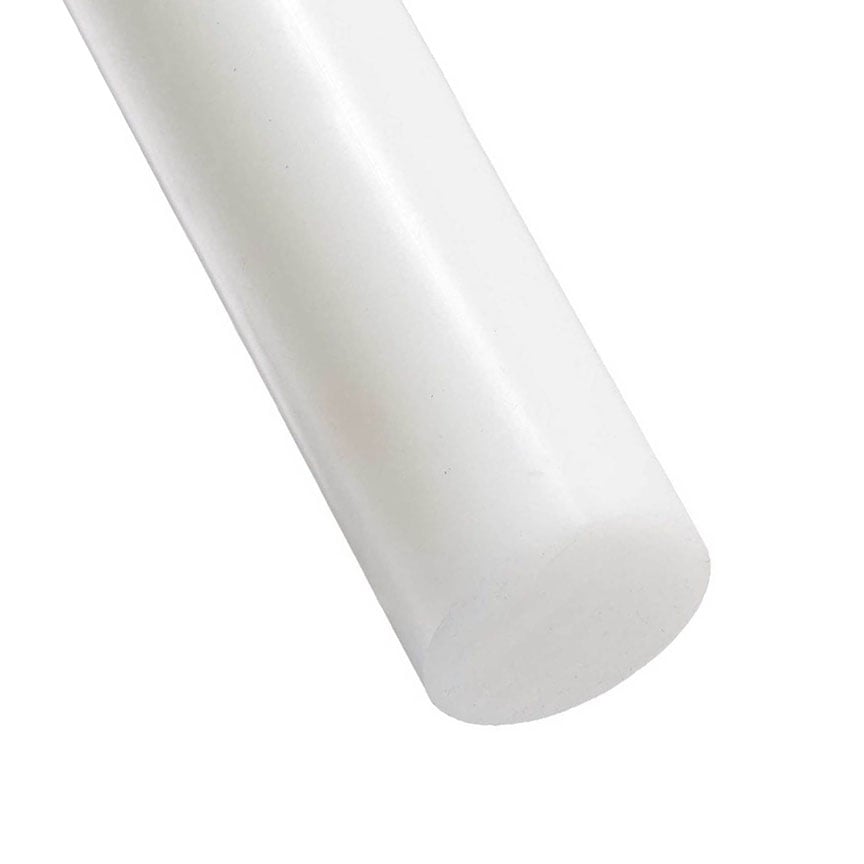
LDPE rods are known for low temperature flexibility, toughness and corrosion resistance. Ease of fabrication and a low cost factor make this material the ideal choice for many applications. It is not suited for applications where stiffness, high temperature resistance and structural strength are required. Polyethylene is susceptible to stress cracking when exposed to ultraviolet light and some chemicals. Wetting agents such as detergents accelerate stress cracking. Some copolymers of LDPE are available with improved stress-crack resistance.
FDA and NSF approval for food contact
Durable
No moisture absorption
Good for parts that require flexibility
Corrosion and abrasion resistant
Very soft and pliable
Lightweight
Stain, odor and moisture resistant
Handling: Cut materials may have sharp edges. We recommend wearing protective gloves when unpacking and handling this material to ensure safety.
Suitability: We take pride in the quality of our materials as they leave our facility. However, because every project is unique, we cannot account for how materials are modified, stored, or used after delivery. Please perform the necessary tests to ensure this material is right for your specific application and end-use conditions.