As per our Shipping and Returns Policy, custom cuts and fabricated parts are non-returnable. If you need an over- or undersized item, note it under "Comments" during Checkout. Cut-to-size orders have an acceptable cut tolerance of 1/8" (0.125"), so clarify if the adjustment is to be made on the (+) or (-) side of the saw blade.Please review our full return and shipping policy here.
Measure Twice, Cut Once
Since custom cuts and fabricated parts are non-refundable, be very careful while measuring your dimensions. As each cut is nominal, even the slightest miscalculation could be costly.
How to Use a Measuring Tape
Extend your tape measure several inches to find the 1 and 2 inch markers. In between the inch markers you’ll find 16 equally spaced tick marks.
Measure by counting the increments beyond the nearest inch. As the increments decrease, so does the length of the mark. For example, 1/2" has a bigger mark than 1/4" which has a bigger mark than 1/8". The smallest mark follows at 1/16". Please be aware that some measuring tapes may have even smaller increments.
Features of a Measuring Tape: Sliding End Hook
The sliding end hook is designed for two different types of measurements. An outside measurement (where the hook of the tape hangs over an edge), requires the hook to slide out a bit to account for the thickness of the material. When making an inside measurement (where the hook will push up against a surface), the clip slides in, again, accounting for its thickness. The measuring tape self-adjusts to guarantee an accurate measurement (as far as the tape is concerned).
Sanitizing Acrylic and Polycarbonate Sheet [X]
Acrylic and Polycarbonate Sneeze Guards and like products require special care while cleaning and disinfecting. To maintain the optical clarity of sneeze guards and other acrylic or polycarbonate items, use an acrylic or polycarbonate safe cleaner like Novus Plastic Polish #1, Brillianize Plastic Cleaner, or a mild soap solution.
Please reference the following compatible cleaners when DISINFECTING acrylic and polycarbonate items. The use of commonly available commercial alcohol or ammonia-based disinfectants may cause crazing and damage.
Extruded Nylon 66: The Industry Standard for High-Load Machined Parts
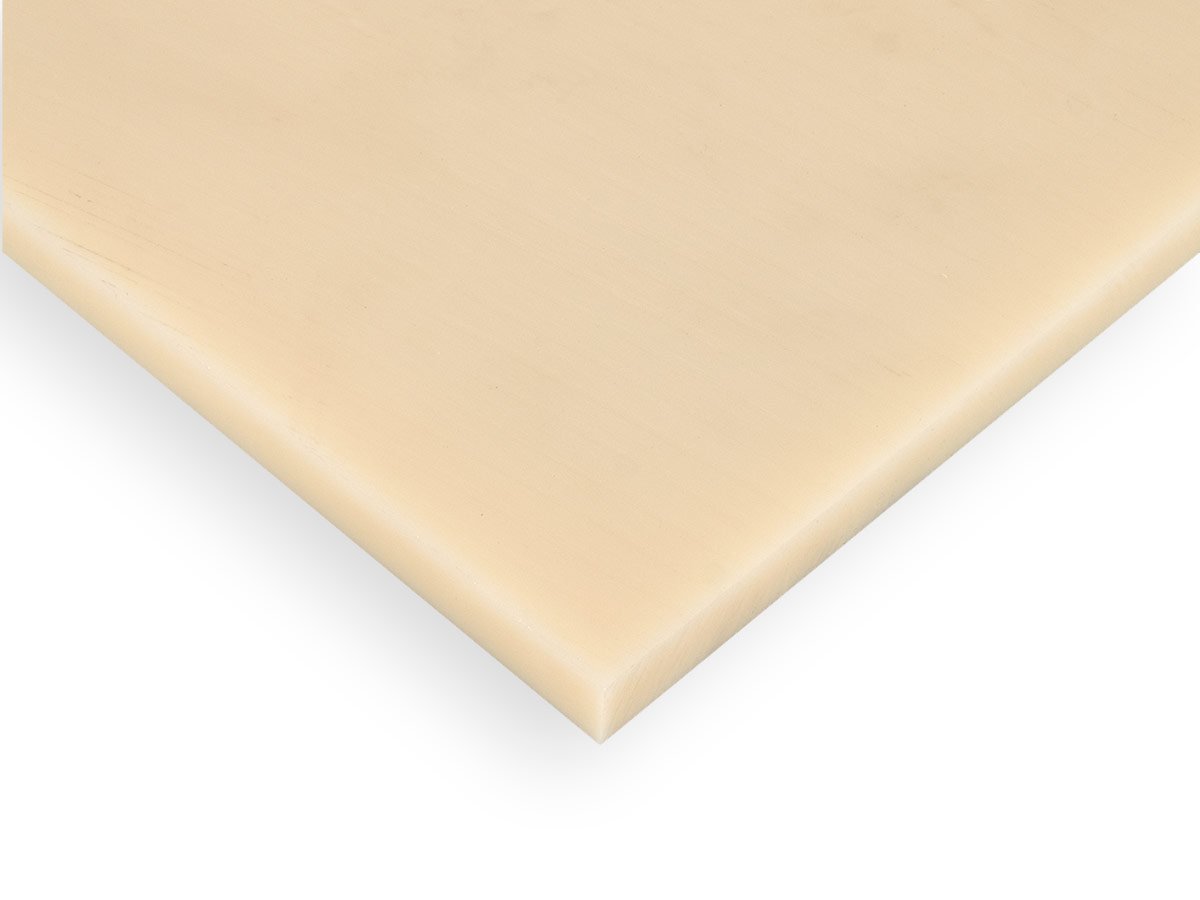
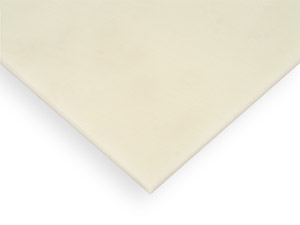
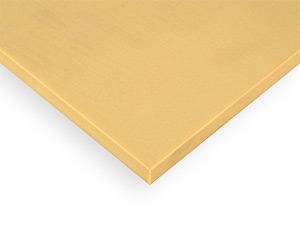
Natural extruded Nylon 66 sheet is a highly versatile and tough engineering thermoplastic for high-stress mechanical components. It provides a superior balance of high strength and wear resistance, making it a natural choice for parts that require tight toleranes and dimensional stability in dry environments.
With a naturally low coefficient of friction and excellent wear resistance, Nylon 66 frequently replaces metal components like gears and bearings. This reduces operational noise, decreases part weight, eliminates the need for external lubrication, and extends the lifespan of mating parts.
Looking for self-lubricating or larger-scale options? For highly specialized environments, we also offer Cast Nylon and MD-Filled Nylon.
Why Choose Extruded Nylon 66?
Extruded Nylon 66 is the go-to material for high-stress mechanical components. It offers superior fatigue endurance and elongation at yield compared to standard copolymers. It is the correct choice if you need:
High Modulus of Elasticity:
Maintains its shape and provides excellent rigidity under heavy mechanical loads.
Wear & Friction Resistance:
Self-lubricating properties make it ideal for close-tolerance bearings, rollers, and sliding components.
Chemical Resistance:
Highly resistant to solvents, hydrocarbons, and many common industrial chemicals.
Noise Reduction:
Absorbs shock and vibration, operating significantly quieter than metal counterparts.
Temperature Stability:
Maintains mechanical integrity across extreme temperatures and performs well in hot water environments.
Extruded (Nylon 66) vs. Cast (Nylon 6): Which Do You Need?
While both forms share similar core properties, their manufacturing methods dictate their best use cases.
Choose Extruded Nylon 66 (This Sheet) if you need smaller parts, tighter tolerances, and higher impact resistance. Extrusion provides a slightly higher density and better moisture resistance.
Choose Cast Nylon 6 if you need massive, near-net-shape parts or extremely thick cross-sections. Casting introduces less internal stress, allowing for thicker blocks without voids.
Fabrication & Machining
Extruded Nylon 66 offers excellent chip control and rigidity for close-tolerance milling and turning. However, because it is hygroscopic, parts may "move" or swell after machining if exposed to humidity. Use carbide tooling and high-speed steel with positive rake angles to minimize localized heating, which can lead to surface deformation.
WARNING: This product can expose you to chemicals including N,N-Dimethylformamide, CAS 68-12-2, which are known to the State of California to cause cancer. For more information go to www.P65Warnings.ca.gov.
WARNING: This product can expose you to chemicals including METHYLPYRROLIDONE, CAS 872-50-4, which are known to the State of California to cause birth defects or other reproductive harm. For more information go to www.P65Warnings.ca.gov.
Handling: Cut sheets may have sharp edges. We recommend wearing protective gloves when unpacking and handling this material to ensure safety.
Suitability: We take pride in the quality of our materials as they leave our facility. However, because every project is unique, we cannot account for how materials are modified, stored, or used after delivery. Please perform the necessary tests to ensure this material is right for your specific application and end-use conditions.
NYLNE SH
Technical Performance
Extruded Nylon 66 is a highly versatile engineering thermoplastic, specifically chosen for structural applications requiring an exceptional balance of mechanical strength, high modulus of elasticity, and excellent fatigue endurance.
Boasts a high modulus of elasticity and superior elongation at yield, allowing it to withstand high-stress mechanical loads without permanent deformation.
Fatigue Endurance:
Performs significantly better than standard copolymers in environments with repeated cyclical stress or vibration.
Friction Coefficient:
Naturally low friction provides a self-lubricating surface, extending the wear life of mating parts and eliminating the need for external lubricants.
Key Properties
Excellent Machinability:
High rigidity allows for crisp chip formation, making it ideal for close-tolerance turning, milling, and routing operations.
Chemical Resistance:
Highly resistant to many industrial solvents, hydrocarbons, and alkalis (though susceptible to strong acids).
Thermal Stability:
Maintains its mechanical toughness and fatigue endurance across extreme temperature ranges, including hot water environments.
Electrical Insulation:
Excellent dielectric properties make it a reliable choice for electrical engineering insulators and housings.
Acoustic Dampening:
Absorbs shock and vibration, operating significantly quieter than metal gears and structural components.
Common Industrial Applications
Power Transmission: Precision-machined gears, sprockets, and bearings that require tight tolerances and quiet operation.
Electrical Components: Insulators, terminal blocks, and non-conductive housings for high-voltage environments.
Wear Components: Rollers, thrust washers, and sliding guides where metal-on-metal wear is a concern.
Engineering Limitations & Alternatives
While Extruded Nylon 66 is incredibly tough, certain environmental factors may require alternative materials:
Moisture Absorption: Nylon is hygroscopic and will absorb moisture in wet environments, causing slight dimensional swelling and a reduction in tensile strength. Better Alternative: For precision parts in continuously wet or submerged environments, choose Acetal (Delrin®).
Extreme Cross-Sections: Extruding very thick cross-sections of Nylon can introduce internal stresses and voids. Better Alternative: For massive structural parts or heavy blocks, choose Cast Nylon.
High-Performance Heat Needs: Nylon 66 is not rated for continuous extreme high-heat environments. Better Alternative: For high-performance, extreme temperature requirements, consider PEEK or PTFE (Teflon®).
Nylon Plastic Material - Nylon 6 6 Extruded Sheet Questions?




 WARNING: This product can expose you to chemicals including N,N-Dimethylformamide, CAS 68-12-2, which are known to the State of California to cause cancer. For more information go to
  WARNING: This product can expose you to chemicals including METHYLPYRROLIDONE, CAS 872-50-4, which are known to the State of California to cause birth defects or other reproductive harm. For more information go to