As per our Shipping and Returns Policy, custom cuts and fabricated parts are non-returnable. If you need an over- or undersized item, note it under "Comments" during Checkout. Cut-to-size orders have an acceptable cut tolerance of 1/8" (0.125"), so clarify if the adjustment is to be made on the (+) or (-) side of the saw blade.Please review our full return and shipping policy here.
Measure Twice, Cut Once
Since custom cuts and fabricated parts are non-refundable, be very careful while measuring your dimensions. As each cut is nominal, even the slightest miscalculation could be costly.
How to Use a Measuring Tape
Extend your tape measure several inches to find the 1 and 2 inch markers. In between the inch markers you’ll find 16 equally spaced tick marks.
Measure by counting the increments beyond the nearest inch. As the increments decrease, so does the length of the mark. For example, 1/2" has a bigger mark than 1/4" which has a bigger mark than 1/8". The smallest mark follows at 1/16". Please be aware that some measuring tapes may have even smaller increments.
Features of a Measuring Tape: Sliding End Hook
The sliding end hook is designed for two different types of measurements. An outside measurement (where the hook of the tape hangs over an edge), requires the hook to slide out a bit to account for the thickness of the material. When making an inside measurement (where the hook will push up against a surface), the clip slides in, again, accounting for its thickness. The measuring tape self-adjusts to guarantee an accurate measurement (as far as the tape is concerned).
Sanitizing Acrylic and Polycarbonate Sheet [X]
Acrylic and Polycarbonate Sneeze Guards and like products require special care while cleaning and disinfecting. To maintain the optical clarity of sneeze guards and other acrylic or polycarbonate items, use an acrylic or polycarbonate safe cleaner like Novus Plastic Polish #1, Brillianize Plastic Cleaner, or a mild soap solution.
Please reference the following compatible cleaners when DISINFECTING acrylic and polycarbonate items. The use of commonly available commercial alcohol or ammonia-based disinfectants may cause crazing and damage.
The Industrial Standard for Chemical Resistance & Structural Integrity
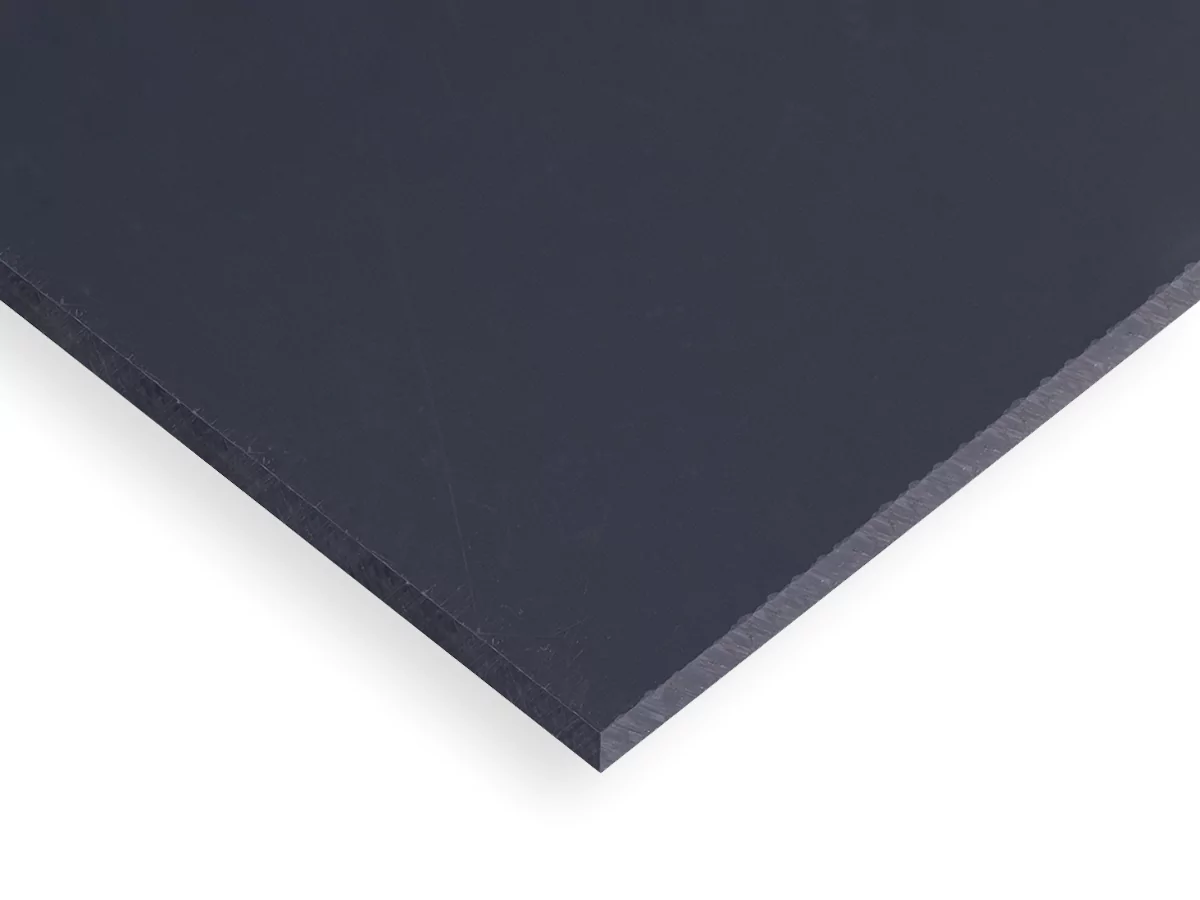
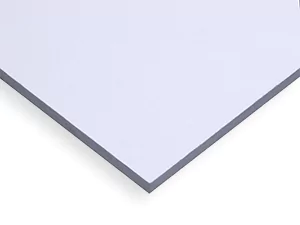
Gray PVC Type 1 (Grade 1) sheet is the definitive workhorse solution for chemical processing. Engineered for maximum chemical resistance and structural rigidity, this high-strength thermoplastic is the industry standard for self-supporting tanks, plating systems, and corrosive-environment ducting.
Type 1 PVC is manufactured without plasticizers or fillers, ensuring it meets strict ASTM D-1784-95 Class 12454-B standards. It is easily fabricated, welded, and machined, making it a great choice for valve bodies and industrial ducting systems.
Looking for higher temperature resistance? For applications exceeding 140°F, see our CPVC Gray Sheet, which maintains structural integrity up to 200°F.
Why Choose PVC Type 1 Sheet?
PVC Type 1 is the industry benchmark for corrosive environments. It is the correct choice if your application requires:
Maximum Chemical Resistance: Ideally suited for acids, alkalis, and alcohols. It offers low permeability to gases and excellent resistance to oils.
High Rigidity: Maintains excellent tensile strength and modulus of elasticity for self-supporting structures up to 140°F.
Superior Fire Safety: Features an impressive UL 94 V-0 flame rating and a flame spread under 20 (per ASTM E-84), making it safer for enclosed industrial spaces.
Easy Fabrication: PVC is highly versatile; it can be thermoformed, vacuum formed, and easily welded to produce leak-proof tanks, trays, and troughs.
Electrical Insulation: Naturally high dielectric strength makes it an effective solution for electrical housing and wire coating components.
PVC Type 1 vs. CPVC: Which Do You Need?
Both materials offer similar chemical resistance, but temperature is the deciding factor.
Choose PVC Type 1 (This Sheet) for general industrial use where temperatures stay below 140°F (60°C). It is more cost-effective and provides the best impact strength for standard tanks and liners.
Choose CPVC if your application involves hot corrosive liquids. CPVC (Chlorinated Polyvinyl Chloride) extends the working temperature range up to 200°F (93°C).
Engineering-Grade Surface Finish
Built for Performance, Not Aesthetics: Gray PVC Type 1 is shipped without protective masking. Surface scuffs or minor abrasions are normal for this industrial material and won't impact its structural and chemical integrity. Scuffs, scratches, and minor abrasions are not considered valid reasons for return.
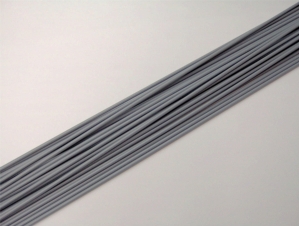
Need a Sample?Test PVC's chemical resistance and weldability yourself:
When you order from Interstate Plastics, you're accessing an expansive nationwide network of material expertise. We source exclusively from premium manufacturers like Simona, GEHR, and MCAM to ensure consistency and quality in every sheet.
Watch: What is Type 1 PVC?
Material Warnings
WARNING: This product can expose you to chemicals including Polyvinyl Chloride, CAS 9002-86, which are known to the State of California to cause cancer and birth defects or other reproductive harm. For more information go to www.P65Warnings.ca.gov .
Handling: Cut sheets may have sharp edges. We recommend wearing protective gloves when unpacking and handling this material to ensure safety.
Suitability: We take pride in the quality of our materials as they leave our facility. However, because every project is unique, we cannot account for how materials are modified, stored, or used after delivery. Please perform the necessary tests to ensure this material is right for your specific application and end-use conditions.
PVCGE SH
Technical Performance
PVC Type 1 (Gray) is a high-rigidity thermoplastic engineered specifically for corrosive industrial environments. It offers the best balance of chemical resistance, mechanical strength, and cost-efficiency in the vinyl family.
Chemical Inertness: Exceptional resistance to most acids, alkalis, salts, and oxidizing agents. Consult our plastic chemical resistance chart for additional details.
Thermal Operating Range: Maintains structural integrity up to 140°F (60°C). Ideal for ambient temperature chemical processing.
Fire Safety (Self-Extinguishing): Rated UL 94 V-0 with a very high "Limiting Oxygen Index" (LOI), meaning it will not support combustion once the flame source is removed.
Key Properties
High Dielectric Strength: Excellent electrical insulation properties make it a safe choice for electrical enclosures and junction boxes.
Low Moisture Absorption: Near-zero water absorption ensures dimensional stability in high-humidity or submerged applications.
Weldability: Can be hot-air welded or solvent cemented to create 100% leak-proof structural joints for tanks and sumps.
Machinability: Holds tight tolerances and is easily cut, routed, or turned using standard high-speed steel (HSS) tooling.
ASTM D-1784 Class 12454-B: Formulated without plasticizers or fillers to ensure maximum purity and consistent mechanical properties.
Common Industrial Applications
Chemical Processing: Fabricated acid tanks, scrubbers, plating barrels, and chemical distribution systems.
Water Treatment: Components for wastewater management, including pump housings, manifold systems, and weir plates.
Laboratory Equipment: Fume hoods, workstations, and cabinetry where splash resistance to aggressive reagents is required.
Semiconductor & Cleanroom: Wet benches, specialized furniture, and airflow ducting where flame retardancy is a safety requirement.
Engineering Limitations & Alternatives
While PVC Type 1 is a versatile material, applications outdoors or in extreme environments may require a different polymer:
High-Heat Corrosives: PVC Type 1 begins to soften at 140°F and is not recommended for boiling or high-pressure steam environments. Better Alternative: For heat resistance up to 200°F, choose CPVC Gray Sheet.
Cold Temperature & Impact: PVC can become brittle at temperatures below 32°F and may crack under heavy localized impact. Better Alternative: For extreme impact resistance or low-temp use, consider HDPE.
Outdoor UV Exposure: Standard Gray PVC may experience surface "chalking" or brittleness under prolonged, direct UV exposure. Better Alternative: For long-term outdoor use, consider UV-Stabilized Marine Board HDPE (King StarBoard®).
Gray PVC Sheet - Rigid PVC Type 1 Sheet Questions?





 WARNING: This product can expose you to chemicals including Polyvinyl Chloride, CAS 9002-86, which are known to the State of California to cause cancer and birth defects or other reproductive harm. For more information go to