As per our Shipping and Returns Policy, custom cuts and fabricated parts are non-returnable. If you need an over- or undersized item, note it under "Comments" during Checkout. Cut-to-size orders have an acceptable cut tolerance of 1/8" (0.125"), so clarify if the adjustment is to be made on the (+) or (-) side of the saw blade.Please review our full return and shipping policy here.
Measure Twice, Cut Once
Since custom cuts and fabricated parts are non-refundable, be very careful while measuring your dimensions. As each cut is nominal, even the slightest miscalculation could be costly.
How to Use a Measuring Tape
Extend your tape measure several inches to find the 1 and 2 inch markers. In between the inch markers you’ll find 16 equally spaced tick marks.
Measure by counting the increments beyond the nearest inch. As the increments decrease, so does the length of the mark. For example, 1/2" has a bigger mark than 1/4" which has a bigger mark than 1/8". The smallest mark follows at 1/16". Please be aware that some measuring tapes may have even smaller increments.
Features of a Measuring Tape: Sliding End Hook
The sliding end hook is designed for two different types of measurements. An outside measurement (where the hook of the tape hangs over an edge), requires the hook to slide out a bit to account for the thickness of the material. When making an inside measurement (where the hook will push up against a surface), the clip slides in, again, accounting for its thickness. The measuring tape self-adjusts to guarantee an accurate measurement (as far as the tape is concerned).
Sanitizing Acrylic and Polycarbonate Sheet [X]
Acrylic and Polycarbonate Sneeze Guards and like products require special care while cleaning and disinfecting. To maintain the optical clarity of sneeze guards and other acrylic or polycarbonate items, use an acrylic or polycarbonate safe cleaner like Novus Plastic Polish #1, Brillianize Plastic Cleaner, or a mild soap solution.
Please reference the following compatible cleaners when DISINFECTING acrylic and polycarbonate items. The use of commonly available commercial alcohol or ammonia-based disinfectants may cause crazing and damage.
Static-Control UHMW for Wear, Conveying & Material-Handling Components
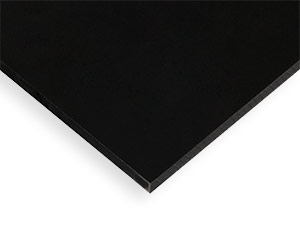
Anti-Static UHMW-PE (Ultra High Molecular Weight Polyethylene) sheet combines the wear resistance, impact strength, and low friction properties of UHMW with additives that help reduce reduce static charge accumulation on wear surfaces.
This material is designed for manufacturing environments where dust accumulation or static discharge pose operational challenges. It features reliable self-lubrication, zero moisture absorption, and excellent impact strength across a wide range of temperatures.
Looking for non-anti-static or FDA-compliant grades? For direct food contact or general sliding wear applications, explore our Natural Virgin UHMW Sheet or cost-effective Reprocessed UHMW Sheet.
Why Choose Anti-Static UHMW?
Anti-static UHMW handles static electricity buildup and dust adhesion in demanding industrial environments. It is the appropriate choice if you need:
Static Dissipation:
Helps reduce static charge accumulation on equipment surfaces and moving components.
Dust Accumulation Control:
Reduces static attraction to protect sensitive robotics, automation components, and sliding parts from fine particulate buildup.
Self-Lubricating Surface:
An extremely low coefficient of friction minimizes heat-generating drag without requiring the use of external grease or oil lubricants.
Severe Wear & Impact Resistance:
Absorbs high mechanical impact abd resists sliding abrasion and mechanical impact in wear components.
Very Low Moisture Absorption:
Resists moisture-related swelling and maintains dimensional stability in humid environments and compatible liquid processes.
Anti-Static UHMW vs. Virgin UHMW: Which Do You Need?
Both materials provide high impact strength, low friction, and excellent wear resistance, but their properties make them better suited to handle different applications.
Choose Anti-Static UHMW (This Sheet) for equipment handling fine powders or operating around sensitive electronics where static charge buildup or electrostatic dust attraction are concerns.
Choose Virgin UHMW if you require direct food contact compliance (FDA CFR 177.1520) or standard sliding wear protection where static control is not required.
Fabrication & Machining
Anti-Static UHMW machines readily using standard woodworking tools and conventional metalworking equipment. Sharp tooling can be used to cut, drill, plane, and rout the material. UHMW is relatively soft and subject to creep under sustained load - use coarse threads or threaded inserts when threaded fasteners are required.
Handling: Cut sheets may have sharp edges. We recommend wearing protective gloves when unpacking and handling this material to ensure safety.
Suitability: We take pride in the quality of our materials as they leave our facility. However, because every project is unique, we cannot account for how materials are modified, stored, or used after delivery. Please perform the necessary tests to ensure this material is right for your specific application and end-use conditions.
UHMBVE SH
Technical Performance
Anti-Static UHMW is designed to handle sliding wear applications requiring a combination of low surface friction, mechanical impact resistance, and static charge control.
Static Control:
Assists in safeguarding processes against static electrical accumulation.
Abrasion Resistance:
Provides dependable sliding-wear resistance for guides, liners, wear strips, and similar moving components.
Friction Coefficient:
Extremely low coefficient of friction with built-in lubrication, minimizing heat generation and component wear.
Key Properties
Electrostatic Dissipation:
Helps reduce static charge accumulation on equipment surfaces and moving components.
Self-Lubricating Surface:
UHMW's inherently low-friction surface reduces sliding drag and reduces or eliminates the need for external oils or greases.
Impact Strength:
Maintains high energy absorption and impact resistance across broad operating temperatures.
Very Low Moisture Absorption:
Resists moisture-related dimensional changes in humid environments and compatible liquid processes.
Chemical Resistance:
Resistant to many corrosive chemicals, alkalis, and acids (excluding strong oxidizing agents).
Common Industrial Applications
Powder Handling & Conveying: Chute liners, chain guides, and wear strips used where moving material can generate static charge.
Robotics & Automation: Protective covers, slide blocks, and guide shoes designed to minimize static buildup and dust accumulation on sensitive components.
Bulk Material Handling: Chute liners, augers, and hopper components handling dry powders susceptible to static charges.
While Anti-Static UHMW offers excellent wear life and static dissipation, specific applications may require alternate engineering plastics:
Structural Rigidity under Heavy Load: UHMW is subject to creep (cold flow) under sustained static loads. Better Alternative: For high-load bearings or heavy structural gears where static control is unnecessary, consider filled Cast Nylon.
Machining Tolerances: Thermal expansion rates make holding extremely tight machining tolerances challenging without strict thermal controls. Better Alternative: For high-precision machined components requiring static dissipation, explore static-control ESD Acetal Sheet.
High Operating Temperatures: For continuous service near or above 180°F, evaluate another grade based on operating load and exposure time. Better Alternative: For high-temperature static-control applications, evaluate purpose-designed static-dissipative PTFE, PEI, or PEEK grades.