As per our Shipping and Returns Policy, custom cuts and fabricated parts are non-returnable. If you need an over- or undersized item, note it under "Comments" during Checkout. Cut-to-size orders have an acceptable cut tolerance of 1/8" (0.125"), so clarify if the adjustment is to be made on the (+) or (-) side of the saw blade.Please review our full return and shipping policy here.
Measure Twice, Cut Once
Since custom cuts and fabricated parts are non-refundable, be very careful while measuring your dimensions. As each cut is nominal, even the slightest miscalculation could be costly.
How to Use a Measuring Tape
Extend your tape measure several inches to find the 1 and 2 inch markers. In between the inch markers you’ll find 16 equally spaced tick marks.
Measure by counting the increments beyond the nearest inch. As the increments decrease, so does the length of the mark. For example, 1/2" has a bigger mark than 1/4" which has a bigger mark than 1/8". The smallest mark follows at 1/16". Please be aware that some measuring tapes may have even smaller increments.
Features of a Measuring Tape: Sliding End Hook
The sliding end hook is designed for two different types of measurements. An outside measurement (where the hook of the tape hangs over an edge), requires the hook to slide out a bit to account for the thickness of the material. When making an inside measurement (where the hook will push up against a surface), the clip slides in, again, accounting for its thickness. The measuring tape self-adjusts to guarantee an accurate measurement (as far as the tape is concerned).
Sanitizing Acrylic and Polycarbonate Sheet [X]
Acrylic and Polycarbonate Sneeze Guards and like products require special care while cleaning and disinfecting. To maintain the optical clarity of sneeze guards and other acrylic or polycarbonate items, use an acrylic or polycarbonate safe cleaner like Novus Plastic Polish #1, Brillianize Plastic Cleaner, or a mild soap solution.
Please reference the following compatible cleaners when DISINFECTING acrylic and polycarbonate items. The use of commonly available commercial alcohol or ammonia-based disinfectants may cause crazing and damage.
Clear Extruded Acrylic Sheet for Cost-Effective Thermoforming & Fabrication
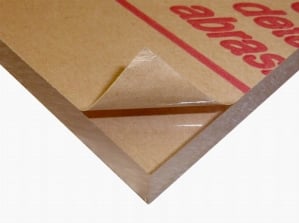
Extruded Film Masked Acrylic Sheet is a popular solution for applications that require optical clarity, more consistent thickness, and a competitive price point. Like Plexiglas®-brand acrylic, this sheet offers a reliable, lightweight alternative to glass and is used to create flat-panel displays, signage, and architectural glazing.
Extruded acrylic provides excellent weather resistance and UV stability, which helps maintain long-term transparency and resist yellowing in outdoor environments. Its easy-to-peel film masking protects the surface during handling and basic fabrication, making it a practical choice for large-scale production and installations.
Looking for maximum machining stability? For heavy CNC routing, we stock Clear Cast Acrylic (a premium alternative with higher thermal stability).
Why Choose Extruded Film Masked Acrylic?
Extruded acrylic features uniform thickness and excellent formability. It is a cost-effective choice if you need:
Excellent Optical Clarity:
Provides 92% light transmission, offering visibility comparable to glass.
More Consistent Thickness:
The extrusion process promotes tighter thickness tolerances across the sheet compared to cell-cast alternatives.
Film Masking:
Has a poly-film masking that is easy to remove and leaves no paper residue behind.
Superior Thermoforming:
Generally easier to vacuum form and line bend than cell-cast acrylic.
UV Resistance:
Inherently resistant to ultraviolet degradation, reducing the risk of yellowing in sunlight.
Extruded vs. Cast Acrylic: Which Do You Need?
While both are clear acrylic plastics, they perform differently during fabrication.
Choose Extruded Acrylic (This Sheet) if consistent thickness, thermoforming, and cost-efficiency are your priorities. Extruded acrylic is a good choice for clear panels, displays, signage, and covers.
Choose Cast Acrylic for complex machining, detailed engraving, or fabrication processes that need greater resistance to heat buildup and stress.
Fabrication & Machining
Extruded acrylic can be sawed, routed, drilled, laser cut, line bent, and thermoformed using standard equipment. This material is more sensitive to heat buildup than cast acrylic, so the use of sharp tooling, suitable feed rates, proper chip removal, and cooling may be necessary. Note: confirm that the protective film is compatible with the intended laser-cutting or heating process before fabrication.
WARNING: This product can expose you to chemicals including Ethyl acrylate, CAS 140-88-5, which are known to the State of California to cause cancer. For more information go to www.P65Warnings.ca.gov.
Handling: Cut sheets may have sharp edges. We recommend wearing protective gloves when unpacking and handling this material to ensure safety.
Suitability: We take pride in the quality of our materials as they leave our facility. However, because every project is unique, we cannot account for how materials are modified, stored, or used after delivery. Please perform the necessary tests to ensure this material is right for your specific application and end-use conditions.
ACRCLEFSH
Technical Performance
This extruded thermoplastic offers a balance of lightweight handling, tight thickness tolerances, and excellent visual clarity. Its UV-stable properties make it a reliable choice for both interior displays and long-term exterior applications.
Lighting & Illuminated Displays: Sign faces, light-box panels, protective lenses, equipment covers, and other components that benefit from high visible-light transmission.
Commercial Barriers: Sneeze guards, temporary protective shields, and lightweight partitions.
Engineering Limitations & Alternatives
While Extruded Acrylic is highly versatile and cost-effective, certain high-stress or heavy-fabrication environments may require specialized materials:
Machining Stability: Extruded acrylic can melt or gum up on tooling during high-speed CNC routing. Better Alternative: For complex fabrication or heavy machining, choose Cast Acrylic.
High-Impact Safety: Acrylic is shatter-resistant but is not unbreakable and can fail under high-velocity impact. Better Alternative: For safety glazing in sports arenas or protective machine guards, use Polycarbonate.
Chemical Exposure: This material is susceptible to stress-crazing if cleaned with ammonia-based products or exposed to certain industrial solvents. Better Alternative: For improved chemical resistance in clear applications, consider PETG.






 WARNING: This product can expose you to chemicals including Ethyl acrylate, CAS 140-88-5, which are known to the State of California to cause cancer. For more information go to