As per our Shipping and Returns Policy, custom cuts and fabricated parts are non-returnable. If you need an over- or undersized item, note it under "Comments" during Checkout. Cut-to-size orders have an acceptable cut tolerance of 1/8" (0.125"), so clarify if the adjustment is to be made on the (+) or (-) side of the saw blade.Please review our full return and shipping policy here.
Measure Twice, Cut Once
Since custom cuts and fabricated parts are non-refundable, be very careful while measuring your dimensions. As each cut is nominal, even the slightest miscalculation could be costly.
How to Use a Measuring Tape
Extend your tape measure several inches to find the 1 and 2 inch markers. In between the inch markers you’ll find 16 equally spaced tick marks.
Measure by counting the increments beyond the nearest inch. As the increments decrease, so does the length of the mark. For example, 1/2" has a bigger mark than 1/4" which has a bigger mark than 1/8". The smallest mark follows at 1/16". Please be aware that some measuring tapes may have even smaller increments.
Features of a Measuring Tape: Sliding End Hook
The sliding end hook is designed for two different types of measurements. An outside measurement (where the hook of the tape hangs over an edge), requires the hook to slide out a bit to account for the thickness of the material. When making an inside measurement (where the hook will push up against a surface), the clip slides in, again, accounting for its thickness. The measuring tape self-adjusts to guarantee an accurate measurement (as far as the tape is concerned).
Sanitizing Acrylic and Polycarbonate Sheet [X]
Acrylic and Polycarbonate Sneeze Guards and like products require special care while cleaning and disinfecting. To maintain the optical clarity of sneeze guards and other acrylic or polycarbonate items, use an acrylic or polycarbonate safe cleaner like Novus Plastic Polish #1, Brillianize Plastic Cleaner, or a mild soap solution.
Please reference the following compatible cleaners when DISINFECTING acrylic and polycarbonate items. The use of commonly available commercial alcohol or ammonia-based disinfectants may cause crazing and damage.
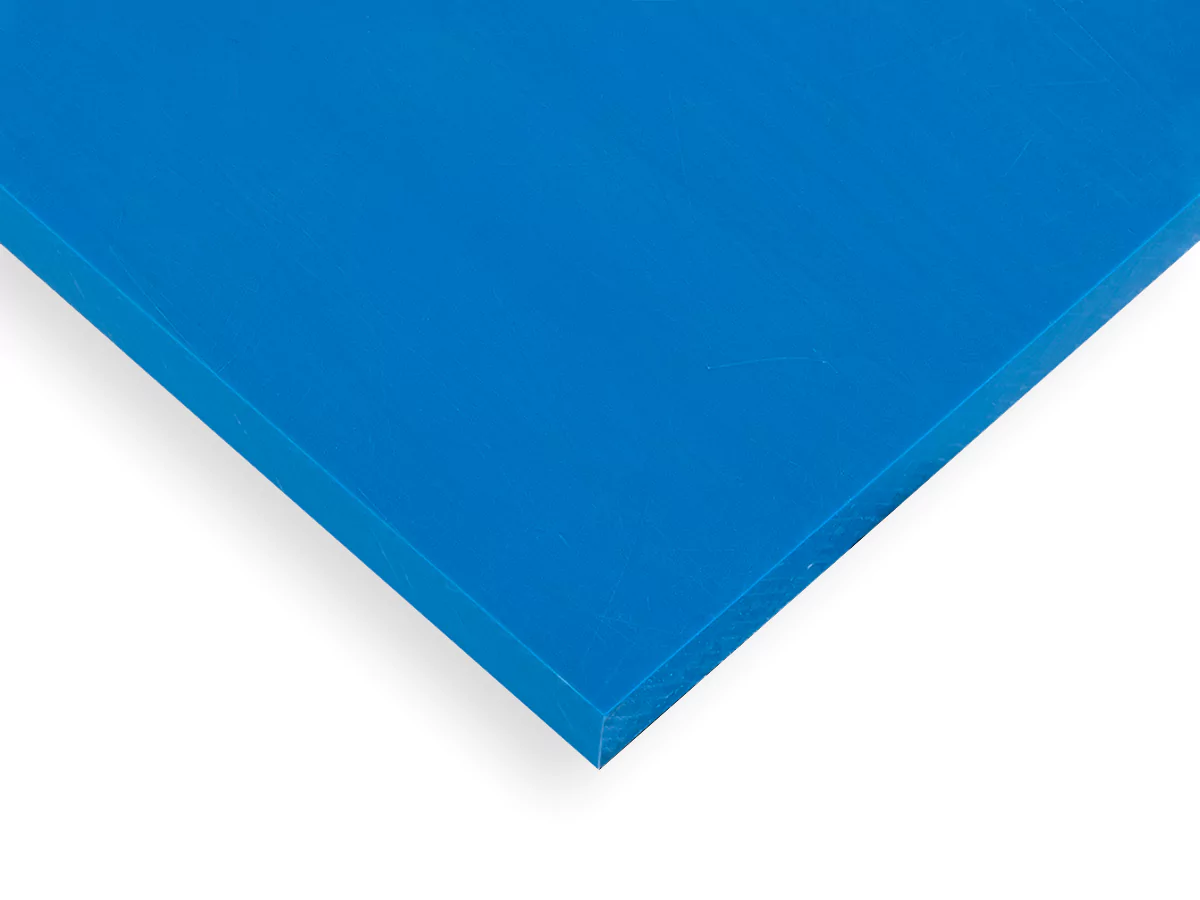
High-Visibility Blue POM-C for Food-Processing Components
Blue FDA- and USDA-compliant acetal copolymer sheet is a strong, stiff, low-friction engineering plastic for precision-machined parts and food-processing equipment. Also known as POM-C, it offers excellent dimensional stability, low moisture absorption, and clean machinability. Its blue color provides greater visual contrast than natural acetal, which can make potentially unwanted material fragments easier to identify during processing and inspection.
With low moisture absorption, good wear resistance, and resistance to many fuels, solvents, alkaline solutions, and other industrial chemicals, blue acetal sheet can replace metal in suitable mechanical components where lower weight and corrosion resistance are beneficial.
Blue FDA- and USDA-compliant acetal copolymer sheet is preferred for machined food-processing and mechanical components that require dimensional stability, strength, low friction, and greater visibility during processing. It is a practical choice if you need:
Enhanced Visual Contrast:
High-visibility blue color contrasts with many food products, helping personnel identify potential fragments during visual inspection.
Precision Machinability:
Machines cleanly into accurate parts using standard sawing, routing, milling, drilling, tapping, and related machining equipment.
Dimensional Stability:
Low moisture absorption helps components retain their dimensions in humid, wet, and intermittently submerged operating environments.
High Strength and Stiffness:
Provides dependable rigidity for guide rails, wear pads, star wheels, valve components, gears, mounting plates, and other machined parts.
Low Friction and Good Wear Resistance:
Supports smooth movement and reliable wear performance in guides, wear strips, bearings, rollers, and sliding components.
Food-Contact Compliance:
FDA- and USDA-compliant for food-processing applications.
Acetal vs. Delrin® vs. Nylon: Which Do You Need?
Acetal copolymer, Delrin® acetal homopolymer, and nylon are engineering plastics with different advantages for machined components.
Choose blue FDA- and USDA-compliant acetal copolymer (This Sheet) for food-processing and precision-machined parts that require greater visual contrast, low moisture absorption, hot-water or alkaline resistance, and reduced risk of centerline porosity.
Choose Delrin® acetal homopolymer when greater tensile strength, stiffness, hardness, or creep resistance is required.
Choose nylon when greater toughness, impact resistance, fatigue resistance, or load-bearing wear performance is more important than acetal's lower moisture absorption and dimensional stability. Confirm food-contact compliance for the selected nylon grade when required.
Fabrication & Machining
Acetal is well suited for sawing, CNC routing, milling, drilling, boring, tapping, and other precision-machining operations. Sharp tools, rigid workholding, adequate chip clearance, and controlled heat generation help produce accurate dimensions and smooth finishes.
Thick sheet or plate intended for close-tolerance components may benefit from rough machining followed by a stabilization period at a consistent room temperature and a final finishing pass. Acetal is difficult to bond using conventional adhesives, so mechanical fastening or a bonding system specifically developed for low-surface-energy plastics is generally preferred.
WARNING: This product can expose you to chemicals including Formaldehyde, CAS 50-00-0, which are known to the State of California to cause birth defects or other reproductive harm. For more information go to www.P65Warnings.ca.gov.
WARNING: This product can expose you to chemicals including Hexachlorobenzene, CAS 118-74-1, which are known to the State of California to cause cancer and birth defects or other reproductive harm. For more information go to www.P65Warnings.ca.gov.
Handling: Cut sheets may have sharp edges. We recommend wearing protective gloves when unpacking and handling this material to ensure safety.
Suitability: We take pride in the quality of our materials as they leave our facility. However, because every project is unique, we cannot account for how materials are modified, stored, or used after delivery. Please perform the necessary tests to ensure this material is right for your specific application and end-use conditions.
ACEUED SH
Technical Performance
Blue FDA- and USDA-compliant acetal copolymer sheet is designed for precision-machined components requiring strength, stiffness, dimensional stability, low friction, and reliable performance in wet or chemically exposed environments. Its blue color creates greater visual contrast than natural acetal, helping personnel identify potentially unwanted material fragments during food processing. Standard blue acetal should not be assumed to provide metal or X-ray detectability.
Mechanical Strength:
High strength and stiffness support rigid, precision-machined components such as guide rails, star wheels, gears, and mounting plates.
Wear and Friction:
A naturally low coefficient of friction and good wear resistance support smooth operation in gears, bearings, guides, wear strips, and sliding components.
Food-Processing Visibility:
The blue color creates greater visual contrast than natural acetal, helping personnel identify potential material fragments during processing and inspection.
Key Properties
Enhanced Visual Contrast:
The blue color supports visual inspection and color coding in food, beverage, dairy, and packaging equipment.
Dimensional Stability:
Low moisture absorption helps machined components retain close tolerances in humid, wet, and intermittently submerged environments.
Precision Machinability:
Machines cleanly using standard sawing, routing, milling, drilling, tapping, and other machining equipment.
Reduced Centerline Porosity:
Copolymer acetal generally has much less centerline porosity than acetal homopolymer, supporting more consistent machining through thick sheet and plate.
Chemical Resistance:
Resists hot water, many alkaline solutions, fuels, solvents, and other common industrial chemicals. Compatibility should be verified for the actual chemical, concentration, temperature, and exposure time.
FDA & USDA Compliance:
This grade is FDA- and USDA-compliant for food-contact applications. Confirm documentation and permitted conditions of use for the supplied material and finished component.
Electrical Insulation:
Provides good electrical-insulating properties for components such as insulators, connectors, bobbins, and equipment mounting parts.
Common Food-Processing Applications
Food Conveyor Systems: Guide rails, wear strips, star wheels, sprockets, chain guides, support plates, and other moving components that require low friction, dimensional stability, and greater visual contrast.
Beverage Processing Equipment: Valve plates, guide plates, filling-machine change parts, pump components, filter supports, and other parts exposed to moisture and repeated cleaning.
Dairy Processing Equipment: Scrapers, guides, wear pads, valve components, bearing blocks, and other documented food-contact parts used in wet processing environments.
Food Packaging Equipment: Change parts, guide rails, rollers, star wheels, wear strips, mounting plates, and positioning components used to move, organize, and package food products.
Filling and Bottling Equipment: Container guides, transfer plates, star wheels, valve components, machine plates, and other precision-machined parts used to control containers and product flow.
Food-Handling Machinery: Scrapers, guides, bearing blocks, wear components, mounting plates, and machine parts that benefit from good wear resistance and low friction.
Visual Inspection and Color Coding: Components where the blue color helps distinguish the material from many food products, making potential fragments easier to identify during visual inspection.
Engineering Limitations & Alternatives
While blue FDA- and USDA-compliant acetal copolymer offers an effective balance of strength, stability, machinability, food-contact compliance, and visual contrast, certain applications may require a specialized material:
High Heat: FDA compliant blue acetal's performance declines as temperature and load increase. Better Alternative: For higher-temperature components, consider PEEK Sheet, PPS Sheet, or Ultem® PEI Sheet. Verify food-contact compliance when required.
Detection Requirements: This standard blue grade improves visual contrast but is not designed for detection by metal detectors or X-ray systems. Better Alternative: For applications requiring optical, metal, and X-ray detectability, consider TECAFORM® AH UD Blue Plate.
Aggressive Chemicals: Acetal is not recommended for strong acids, powerful oxidizers, or other incompatible chemicals. Better Alternative: For demanding chemical environments, consider Virgin PTFE Sheet, PVDF Sheet, or PEEK Sheet after reviewing chemical compatibility and any applicable food-contact requirements.
Blue Acetal Sheet - FDA Compliant Copolymer Acetal Questions?




 WARNING: This product can expose you to chemicals including Formaldehyde, CAS 50-00-0, which are known to the State of California to cause birth defects or other reproductive harm. For more information go to
 WARNING: This product can expose you to chemicals including Hexachlorobenzene, CAS 118-74-1, which are known to the State of California to cause cancer and birth defects or other reproductive harm. For more information go to