Acetal vs Nylon: A Guide to Choosing the Right Plastic
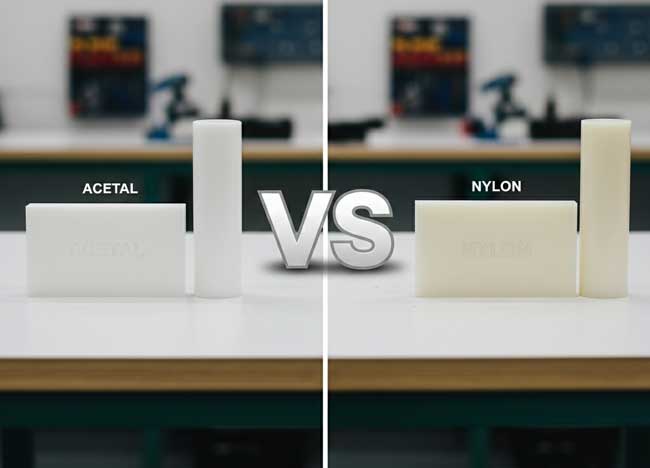 When choosing between Acetal (POM) and Nylon (PA), the decision often comes down to moisture and load.
Choose acetal for precision gears and fittings in humid environments where maintaining tight tolerances is crucial. Choose nylon for bearings and bushings that must withstand heavy loads, high heat, and impact without fracturing.
While both materials are industry standards for precision machining, their environmental behaviors differ significantly. Acetal (also known as polyoxymethylene, with Delrin® being a popular homopolymer brand) offers superior dimensional stability for parts that cannot expand or swell. Nylon (a family of polyamides available in cast or extruded grades) sacrifices some stability for sheer toughness and wear life.
In this Interstate Plastics guide, we examine these differences in depth, covering strength, stiffness, moisture resistance, and machinability, to help you select the right material for your high-performance application.
Acetal vs Delrin vs Nylon: Which Plastic is Better?
 When choosing between acetal vs nylon, both materials have multiple grades with distinct advantages. Below is a quick guide on when to pick cast nylon (nylon 6) vs. extruded nylon (nylon 6/6) vs. acetal copolymer vs. Delrin® acetal homopolymer for optimal results:
Cast Nylon (Nylon 6): Best for large or heavy-duty parts that need high strength and wear resistance in dry conditions. Cast nylon can be produced in massive shapes thanks to the casting process. It can handle a high combination of load and speed in bearing applications and provides excellent toughness and vibration dampening. However, it also has the highest moisture absorption of the group, so it may not be ideal for wet environments.
Extruded Nylon (Nylon 6/6): Ideal for slightly higher temperature applications and where a very stiff, durable plastic is needed. Extruded nylon 6/6 has a higher melting point and continuous service temperature than cast nylon. Its tensile strength is high and comparable to cast nylon. Nylon 6/6 tends to be a bit more resistant to certain chemicals (notably acids) than nylon 6. It is readily available in smaller rod and sheet sizes and in many formulations (lubricated, glass-filled, etc.), though large extrusions are limited by die sizes. Choose extruded nylon for high-strength parts that need slightly better heat resistance or when standard shapes in smaller dimensions suffice.
Acetal Copolymer (POM-C): Best for parts requiring tight tolerances, low friction, and excellent dimensional stability, especially in moist or chemically exposed environments. Acetal copolymer absorbs minimal moisture, which means it won't swell or lose properties in humid or wet conditions like nylon can. It offers good strength and hardness similar to nylon, but with superior resistance to hydrolysis and alkaline solutions compared to Delrin® homopolymer. Acetal copolymer is typically free of centerline porosity (solid throughout), making it preferred for thick parts in food, medical, or load-bearing uses. Use acetal copolymer for precision gears, valve components, and bearings that demand stability and chemical resistance over maximum strength.
Delrin® Acetal Homopolymer (POM-H): Choose Delrin for the highest strength and hardness in the acetal family, and when you need the absolute best machinability. Delrin has a slightly higher tensile strength than copolymer. It excels in heavy load applications and parts that see continuous friction or impact: for instance, Delrin is often used for small, high-precision gears, bushings, and wear pads where its extra strength and lower coefficient of friction are beneficial. Delrin machines beautifully with excellent surface finish and holds tight tolerances (many machinists consider it the most machinable plastic). Keep in mind Delrin is slightly less resistant to hot water and caustic chemicals than copolymer acetal, and large cross-sections of Delrin rod can contain a porous core (centerline porosity), so for thick parts POM-C might be preferable. Delrin is also a premium brand, so it can be a bit more expensive than generic copolymer acetal.
In summary (when looking at acetal vs delrin vs nylon), nylon (especially cast nylon) often wins for big, heavy-duty or dry-use parts requiring maximum toughness and wear life, while acetal (especially copolymer) wins for precision, stability, and wet or chemically exposed parts. Next, we'll compare these materials in specific property categories to further clarify their differences.
Acetal vs Nylon: Mechanical Strength and Stiffness
 Nylon generally reaches higher ultimate tensile strength and can be tougher under impact, while acetal delivers more predictable performance because its properties do not swing with humidity. Both are semi-crystalline with similar stiffness, but
Nylon offers higher peak tensile and flexural strength when dry and handles shock well, though very dry nylon can turn brittle in extreme cold. Cast nylon is often tougher and available in larger shapes, while extruded nylon provides more consistent dimensions in smaller stock.
Acetal maintains strength and stiffness regardless of humidity. Delrin® delivers higher mechanical strength, while acetal copolymer emphasizes dimensional and chemical stability.
Acetal vs Nylon: Wear and Friction Performance
Both materials are low-friction and self-lubricating, with small practical differences in slipperiness. The key distinction is environment:
In dry, unlubricated applications, nylon (particularly cast nylon) typically provides longer wear life and can reach very high limiting PV, especially in filled grades. Extruded nylon, though dimensionally tighter, does not handle as extreme loads as cast.
In wet or lubricated applications, acetal retains its wear resistance because it does not soften with moisture; Delrin® and copolymer both perform well, with copolymer being more stable long-term in aqueous environments.
Filled options extend performance: oil- or MoS2-filled cast nylons excel in aggressive dry wear, while PTFE-filled acetals such as Delrin® AF reduce friction for moderate PV.
Acetal vs Nylon: Moisture Absorption and Dimensional Stability
Nylon is hygroscopic and will absorb water, which causes swelling, lowers stiffness, and increases toughness; acetal absorbs very little water and holds size and properties in humidity or water.
Extruded nylon and cast nylon both absorb moisture, but cast nylon typically absorbs more due to its structure; PA12 absorbs less but sacrifices strength and cost efficiency.
Acetal copolymer is the most dimensionally stable option in humid or submerged conditions. Delrin® absorbs slightly more moisture than copolymer but still far less than nylon, and remains highly dimensionally stable for most uses.
Acetal vs Nylon Thermal Properties
Nylon 6/6 has a higher melting point and slightly higher continuous-use temperature than acetal, which favors nylon near sustained heat; both soften well below melt, and both perform in cold service with grade selection.
For components near engines or persistent heat sources, nylon (particularly extruded 6/6) is usually the safer choice for stiffness at temperature and long-term strength retention. Cast nylon can also be heat-stabilized for such use.
For room-to-moderate temperatures, both Delrin® and copolymer acetal work well; if temperatures go far beyond boiling for extended periods, consider higher-temperature plastics like PTFE, PEEK, or polyimides.
Acetal vs Nylon Chemical Resistance
Both resist fuels, oils, and many solvents. Differences show up at the extremes: acetal copolymer performs better in bases and hot water, while nylon is often selected for fuels and oils where mild acidity is present.
Acetal copolymer withstands alkaline cleaners, hot water, and many sanitation chemicals better than Delrin® homopolymer, which is more sensitive to hot water and caustic agents. Both should be avoided in strong oxidizers and concentrated acids.
Nylon generally holds up in fuels and oils but is attacked by strong acids and bases, and hydrolysis accelerates at elevated temperature; specialty nylons 11/12 can expand the usable envelope.
Acetal vs Nylon: Machinability and Fabrication
Both machine well, but acetal is notably easier: it produces clean chips, holds tight tolerances, and stays dimensionally stable. Nylon is more gummy and stringy, requiring sharp tools, chip control, and heat management.
For tight-tolerance parts, acetal minimizes post-machining movement and simplifies achieving fine finishes. Delrin® is especially free-cutting, while copolymer provides dimensional stability and freedom from centerline porosity.
Nylon parts may change size as they absorb moisture after machining; extruded nylon blanks provide consistent starting stock, while cast nylon allows larger shapes but can be more variable in finish. Pre-conditioning or finish-machining at equilibrium helps. For very large, cost-sensitive parts, cast nylon is often more economical.
For manufacturing routes, both mold well with proper handling; nylon is the practical option for SLS/FDM 3D printing, while POM is challenging to print.
Applications and When to Choose Nylon or Acetal
Gears and Power Transmission: Both acetal and nylon are used for gears. Small, precision gears (e.g., in appliances or instruments) often favor acetal/Delrin because of its dimensional stability and precise machining — the gear will hold its pitch over time and won't swell. Large or heavily loaded gears (e.g., industrial machinery, winch gears) might favor cast nylon, which can handle shock and has superior load-bearing capacity without deformation. Nylon's toughness also helps gears resist cracking under impact. If the gear operates in a wet or humid setting, acetal would be a safer choice to avoid expansion.
Bushings and Bearings: Dry, high-load bushings (such as in lifting equipment or conveyors) often use filled cast nylon for the best wear life. Nylon bushings can outperform acetal in dry wear and can be made in very large sizes (even several feet in diameter for crane sheaves) which acetal cannot readily match. However, for wet or submerged bearings, acetal (POM-C) is superior due to zero water swell - for example, acetal sleeve bearings in pumps or marine hardware maintain their fit and low friction in water. Also, at small scales or thin-walled bushings, acetal's stability makes installation and use more predictable.
Wear Plates and Slides: For dry sliding surfaces or wear strips along conveyor lines, nylon (often oil-filled nylon) is a top choice because of its excellent abrasion resistance and self-lubrication in dry conditions. Nylon wear pads can last a long time in contact with rough metal. If the wear strip is in a damp environment or needs very precise flatness, acetal might be used, though more often designers choose UHMW-PE or PTFE for sliding plates if moisture is involved. Between nylon vs acetal, nylon gets the nod in most large wear pads, acetal in smaller precise ones.
Precision Machined Components: If the application calls for tight tolerances and complex machining - for example, valve bodies, metering pumps, small insulator parts, optical instrument components — acetal (particularly copolymer) is frequently chosen. It machines into precise threads, flat sealing surfaces, and fine features without issues, and those parts will remain stable over time. Nylon could be chosen for precision parts too, but typically only if its other benefits (like higher strength or specific certification) outweigh the challenges in machining and stability.
Automotive and Industrial: Nylon's high temperature tolerance and strength make it common in automotive engine compartments (fans, intake manifolds in glass-filled nylon, etc.) and industrial equipment (rollers, cams). Acetal finds uses in fuel system components (where moisture stability is key) and small mechanical parts like clips and latches. Both are used in electrical components (nylon for cable ties, connector housings; acetal for switches, insulators) - each is an electrical insulator with good dielectric properties.
Food and Medical Equipment: Acetal copolymer is popular in food processing machinery (conveyor bushings, food-grade gears, etc.) because it has no porosity and can handle cleaning chemicals. Nylon can also be food-grade, but acetal's lack of moisture issues and ease of cleaning (plus its availability in USDA/FDA compliant grades) often make it the go-to for sanitary equipment. In medical devices, acetal is used for drug delivery device parts, while nylon is seen in things like surgical instrument handles or where a bit more flexibility is needed.
In summary, choose acetal (POM) when your application demands tight tolerances, low moisture absorption, and consistent performance (common in small-to-medium precision parts, wet environments, or chemical exposure). Choose nylon when you need higher strength and wear resistance in dry conditions, larger or more impact-resistant parts, or a cost-effective solution for big shapes (common in heavy machinery parts, structural components, and dry bearings/gears). In many cases, both could work - but weighing the factors above will point to one being the "better fit" for your specific needs.
Comparison Chart: Cast Nylon vs Extruded Nylon vs Delrin vs Acetal Copolymer (Properties Table)
| Property | Cast Nylon 6 (PA6) | Extruded Nylon 6/6 (PA66) | Acetal Copolymer (POM-C) | Delrin Homopolymer (POM-H) |
|---|---|---|---|---|
| Tensile Strength (psi) | 10,000-13,500 | 12,400 | 9,800 | 10,000 |
| Flexural Modulus (psi) | 420,000-500,000 | 410,000 | 370,000 | 420,000 |
| Izod Impact (Notched, ASTM D256, @ 73°F) | 0.7-0.9 ft-lb/in | 1.2 ft-lb/in | 1.0 ft-lb/in | 1.5 ft-lb/in |
| Heat Deflection Temp @ 264 psi (°F) | 200-400 | 194 | 230 | 257 |
| Maximum Continuous Service Temp in Air (°F) | 230 | 210 | 195 | 185 |
| Water Absorption (24 hr, %) | 0.60-1.20 | 1.20 | 0.20 | 0.25 |
| Wear Resistance (dry) | Excellent (dry, 4x acetal) | Excellent (dry) | Good | Good |
| Wear Resistance (wet) | Poor-Fair (softens when wet) | Fair (when moist) | Excellent (stable wet) | Excellent (but avoid hot water) |
| Machinability | Good (large parts, watch moisture) | Good (sharp tools needed) | Excellent (easy to machine) | Excellent (easy to machine) |
| Chemical Resistance | Good (not acids; OK hydrocarbons) | Good (slightly better acid resist) | Good-Excellent (strong base OK) | Good (avoid strong base/acid) |
| Cost | Low for large parts | Low-Medium | Medium (higher than nylon) | Medium-High (premium brand) |
Notes: The above are typical values for unfilled, natural grades. Always refer to specific manufacturer data sheets for precise values.
This guide was authored by Christopher Isar and reviewed for technical accuracy by Chris Clark.

About the Author
At Interstate Advanced Materials, Christopher Isar turns "it depends" into "do this." Since 2011, he's helped buyers choose plastics with confidence by focusing on what works on the shop floor and in the field, backed by IAPD Level 2 certification. If your project can't miss, Chris will guide you to cost-effective, real-world options. Contact Chris.