As per our Shipping and Returns Policy, custom cuts and fabricated parts are non-returnable. If you need an over- or undersized item, note it under "Comments" during Checkout. Cut-to-size orders have an acceptable cut tolerance of 1/8" (0.125"), so clarify if the adjustment is to be made on the (+) or (-) side of the saw blade.Please review our full return and shipping policy here.
Measure Twice, Cut Once
Since custom cuts and fabricated parts are non-refundable, be very careful while measuring your dimensions. As each cut is nominal, even the slightest miscalculation could be costly.
How to Use a Measuring Tape
Extend your tape measure several inches to find the 1 and 2 inch markers. In between the inch markers you’ll find 16 equally spaced tick marks.
Measure by counting the increments beyond the nearest inch. As the increments decrease, so does the length of the mark. For example, 1/2" has a bigger mark than 1/4" which has a bigger mark than 1/8". The smallest mark follows at 1/16". Please be aware that some measuring tapes may have even smaller increments.
Features of a Measuring Tape: Sliding End Hook
The sliding end hook is designed for two different types of measurements. An outside measurement (where the hook of the tape hangs over an edge), requires the hook to slide out a bit to account for the thickness of the material. When making an inside measurement (where the hook will push up against a surface), the clip slides in, again, accounting for its thickness. The measuring tape self-adjusts to guarantee an accurate measurement (as far as the tape is concerned).
Sanitizing Acrylic and Polycarbonate Sheet [X]
Acrylic and Polycarbonate Sneeze Guards and like products require special care while cleaning and disinfecting. To maintain the optical clarity of sneeze guards and other acrylic or polycarbonate items, use an acrylic or polycarbonate safe cleaner like Novus Plastic Polish #1, Brillianize Plastic Cleaner, or a mild soap solution.
Please reference the following compatible cleaners when DISINFECTING acrylic and polycarbonate items. The use of commonly available commercial alcohol or ammonia-based disinfectants may cause crazing and damage.
Fatigue-Resistant Glass-Epoxy Composite for Cyclic Loading
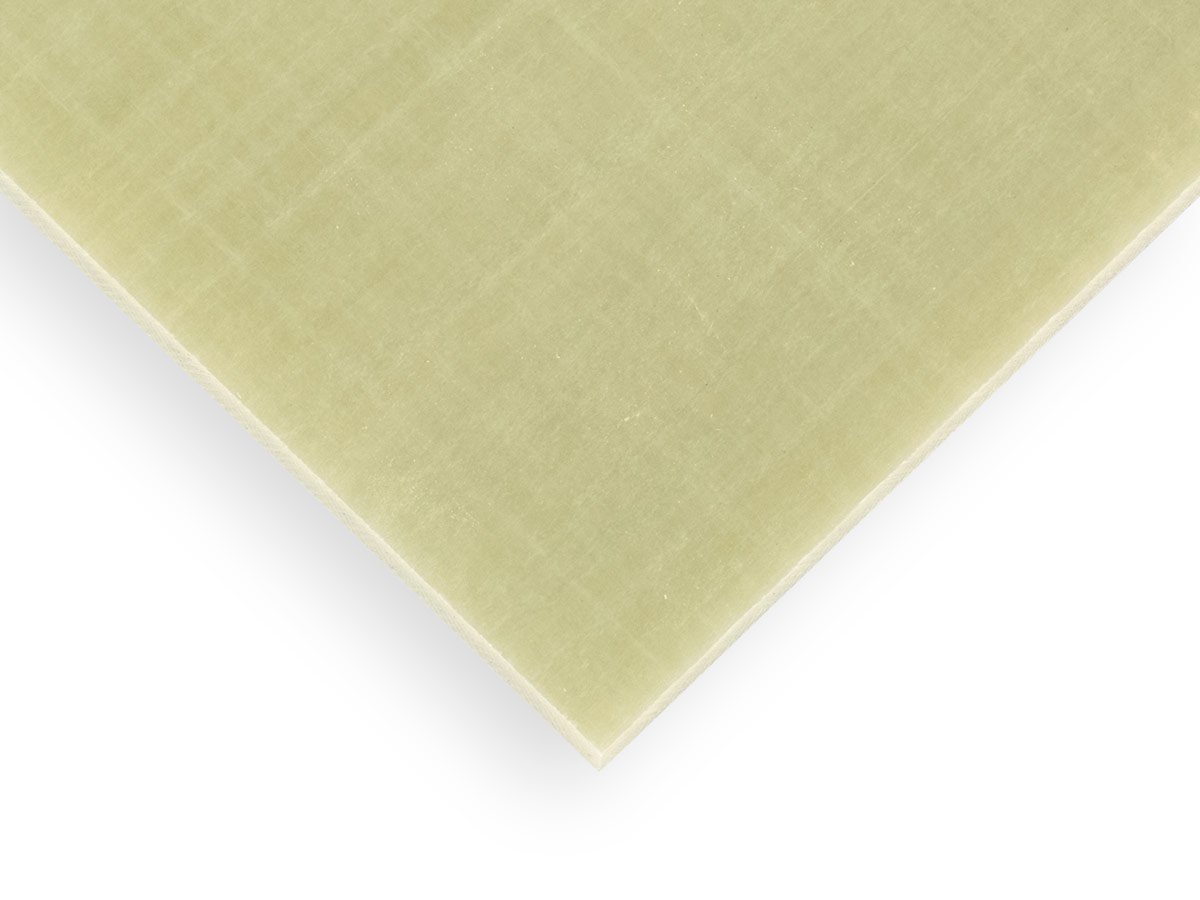
NorPLY™ 1002 is a cured glass-epoxy composite laminate engineered for components exposed to repeated flexing, vibration, and high-strain loading. Its continuous E-glass reinforcement uses a unique nonwoven, parallel-filament construction designed to minimize filament stress abrasion that can shorten fatigue life in conventional reinforced plastics.
For applications traditionally served by steel springs and other fatigue-loaded metal components, NorPLY™ 1002 combines excellent fatigue resistance with high strength-to-weight performance, impact resistance, and resistance to chemicals and corrosion. Its lower component weight and ability to store more energy than 1060 spring steel make it particularly well suited for vibratory springs, flexible couplings, and other dynamically loaded parts.
NorPLY™ 1002 was previously manufactured under names including ScotchPLY and CyPLY®. IAM-513, 517, 518, 521, and 525 are offered in unidirectional orientation.
Why Choose NorPLY™ 1002?
NorPLY™ 1002 is designed for buyers replacing fatigue-sensitive metal or conventional reinforced-plastic components. Its combination of continuous glass reinforcement and epoxy resin provides several advantages for demanding cyclic applications:
Excellent Fatigue Resistance:
Parallel continuous-glass filaments help distribute loads while reducing filament stress abrasion, supporting long service life in repeatedly flexed components.
High Strain Capability:
Suited to components that repeatedly deflect under load, including vibratory springs, shocks, struts, and flexible couplings.
High Strength-to-Weight Performance:
Provides structural strength at substantially lower component weight than steel. Lower moving mass can support lighter assemblies and alternative spring designs.
Energy Storage:
Offers greater energy storage capacity than 1060 spring steel. This is an important consideration for springs and other components that repeatedly store and release mechanical energy.
Environmental Resistance:
Resists corrosion, chemicals, and cleaning fluids and does not rust, making it suitable for equipment exposed to demanding operating environments.
NorPLY™ 1002 vs. Steel: Which Do You Need?
Material selection depends on the loading, geometry, environment, and fabrication requirements of the component.
Choose NorPLY™ 1002 when fatigue resistance, reduced moving mass, corrosion resistance, or high energy storage per unit weight is important. Replacing steel components with NorPLY™ may reduce component weight by approximately 10% to 60%, depending on part design.
Choose Steel when the application requires metal-specific characteristics such as isotropic mechanical behavior, conventional welding, or established metal fabrication and fastening methods. Component design should be evaluated rather than directly substituting NorPLY™ based on dimensions alone.
Fabrication & Machining
NorPLY™ 1002 can be machined into fatigue-resistant springs and structural components, but its continuous glass reinforcement requires appropriate composite-machining practices and tooling.
Note: Use suitable dust collection, ventilation, and personal protective equipment when machining glass-epoxy composites.
Watch: What is NorPLY™ 1002 Glass-Epoxy Composite Material?
Handling: Cut sheets may have sharp edges. We recommend wearing protective gloves when unpacking and handling this material to ensure safety.
Suitability: We take pride in the quality of our materials as they leave our facility. However, because every project is unique, we cannot account for how materials are modified, stored, or used after delivery. Please perform the necessary tests to ensure this material is right for your specific application and end-use conditions.
COMEM SH
Technical Performance
NorPLY™ 1002 uses unidirectional, continuous E-glass reinforcement to provide high strength and stiffness along the primary fiber direction. This directional construction is beneficial to fatigue-intensive components when the reinforcement is aligned with the principal loading and deflection.
Designed to withstand repeated loading and flexing, making NorPLY™ 1002 particularly useful where cyclic stresses can shorten the service life of conventional reinforced plastics or metal components.
Energy Storage:
Stores and releases mechanical energy efficiently during deflection and offers greater energy storage capacity than 1060 spring steel, supporting spring and vibratory-component designs.
Directional Reinforcement:
Continuous E-glass filaments provide strength and stiffness along the reinforcement direction. Fiber orientation should therefore be matched to the primary loads placed on the finished component.
Key Properties
High Strain Capability:
Supports applications involving substantial repeated elastic deflection, including flat springs and dynamically loaded structural components.
High Strength-to-Weight Performance:
Combines glass-fiber reinforcement with lower component mass than comparable steel designs, helping reduce moving weight while maintaining structural capability.
Impact Resistance:
Provides resistance to sudden mechanical loading, helping components tolerate impacts and shock loads encountered in industrial equipment.
Chemical & Corrosion Resistance:
Resists many chemicals and corrosive environments and cannot rust, making it useful where steel components may require additional corrosion protection.
Low Notch Sensitivity:
Helps reduce sensitivity to localized stress concentrations, an important consideration for parts subjected to repeated mechanical loading.
Common Industrial Applications
Vibratory Springs: Flat spring elements for shaker tables, feeders, conveyors, and other equipment that repeatedly cycles under load.
Flexible Couplings: Dynamically loaded coupling components that benefit from fatigue resistance, high strain capability, and corrosion resistance.
Shocks & Struts: Structural members subjected to repeated flexing or mechanical cycling where lower weight and fatigue resistance are design priorities.
Rail & Structural Components: Insulated rail joints, insulation spacers, dock shelter staves, and similar components requiring reinforced composite construction.
Furniture Springs: Lightweight composite spring elements designed for repeated deflection without the corrosion concerns associated with steel.
Engineering Limitations & Alternatives
NorPLY™ 1002 is optimized around fatigue resistance and directional composite reinforcement. Applications with substantially different thermal, electrical, structural, or fabrication requirements may be better served by another laminate or engineering material:
Directional Properties: NorPLY™ 1002 properties depend on fiber orientation, so unidirectional material should be engineered with the primary load aligned appropriately to the reinforcement. It should not be treated as an isotropic drop-in replacement for steel. Better Alternative: For applications requiring more balanced multidirectional glass-epoxy properties over unidirectional spring performance, consider G-10/FR4 glass-epoxy laminate.
Elevated-Temperature Service: Application temperature can affect epoxy-matrix mechanical performance, so sustained high-temperature service should be reviewed against the selected grade's published thermal data. Better Alternative: For non-spring applications primarily driven by elevated-temperature electrical and structural performance, consider G-11 glass-epoxy laminate.