As per our Shipping and Returns Policy, custom cuts and fabricated parts are non-returnable. If you need an over- or undersized item, note it under "Comments" during Checkout. Cut-to-size orders have an acceptable cut tolerance of 1/8" (0.125"), so clarify if the adjustment is to be made on the (+) or (-) side of the saw blade.Please review our full return and shipping policy here.
Measure Twice, Cut Once
Since custom cuts and fabricated parts are non-refundable, be very careful while measuring your dimensions. As each cut is nominal, even the slightest miscalculation could be costly.
How to Use a Measuring Tape
Extend your tape measure several inches to find the 1 and 2 inch markers. In between the inch markers you’ll find 16 equally spaced tick marks.
Measure by counting the increments beyond the nearest inch. As the increments decrease, so does the length of the mark. For example, 1/2" has a bigger mark than 1/4" which has a bigger mark than 1/8". The smallest mark follows at 1/16". Please be aware that some measuring tapes may have even smaller increments.
Features of a Measuring Tape: Sliding End Hook
The sliding end hook is designed for two different types of measurements. An outside measurement (where the hook of the tape hangs over an edge), requires the hook to slide out a bit to account for the thickness of the material. When making an inside measurement (where the hook will push up against a surface), the clip slides in, again, accounting for its thickness. The measuring tape self-adjusts to guarantee an accurate measurement (as far as the tape is concerned).
Sanitizing Acrylic and Polycarbonate Sheet [X]
Acrylic and Polycarbonate Sneeze Guards and like products require special care while cleaning and disinfecting. To maintain the optical clarity of sneeze guards and other acrylic or polycarbonate items, use an acrylic or polycarbonate safe cleaner like Novus Plastic Polish #1, Brillianize Plastic Cleaner, or a mild soap solution.
Please reference the following compatible cleaners when DISINFECTING acrylic and polycarbonate items. The use of commonly available commercial alcohol or ammonia-based disinfectants may cause crazing and damage.
The High-Impact Wear Solution for Sanitary & Industrial Environments
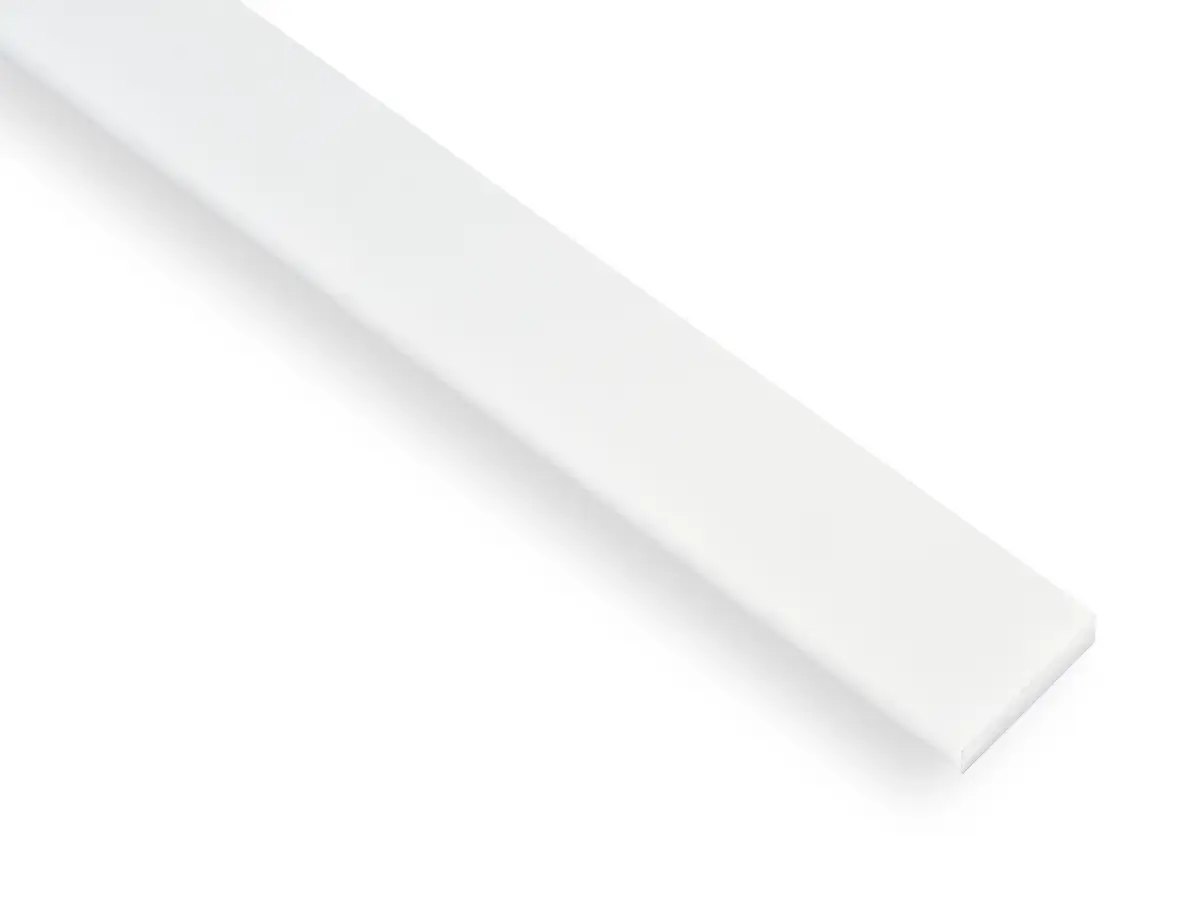
Natural HDPE Wear Strips are designed to protect your machinery from friction and impact. These Virgin Grade strips are the industrial standard for high-rigidity applications where moisture absorption must be eliminated. Engineered for durability, these custom cut-to-size strips provide a smooth sliding surface that prevents product marring and reduces downtime in automated lines.
As a food-safe material, these HDPE strips are the go-to choice for conveyor guide rails, pharmaceutical bottling lines, and cleanroom wear plates. They offer excellent chemical resistance to acids and harsh wash-down agents, ensuring long-term performance in sanitary environments where wood or metal components would fail.
Note on Surface Finish: This is an unmasked, industrial-grade plastic. Minor scuffs or surface scratches are normal and do not affect the material's mechanical wear properties or chemical resistance.
Why Choose Natural HDPE Wear Strips?
These strips are engineered for durability in demanding material handling environments. It is the correct choice if your project requires:
FDA, USDA & 3A Dairy Compliance: A non-porous, virgin material that meets NSF/ANSI Standard 51. It resists mold, mildew, and bacterial buildup, making it ideal for food contact.
High Impact Strength: Offers exceptional "No Break" impact resistance. Unlike brittle plastics, HDPE absorbs energy and resists cracking even in cold-storage environments down to -60°F.
Low Friction & Abrasion Resistance: Provides a smooth, self-lubricating surface that reduces motor drag on conveyor systems and prevents "chatter" in sliding applications.
Chemical & Moisture Immunity: Impervious to most common chemicals, solvents, and cleaning agents. It will not swell or rot when exposed to frequent high-pressure wash-downs.
Superior Rigidity: HDPE is stiffer than UHMW. These strips maintain their shape better under static loads, making them ideal for support rails and mounting bases.
HDPE vs. UHMW Wear Strips: Which Do You Need?
Both materials are excellent for reducing friction, but they excel in different roles:
Choose HDPE (This Strip) to maximize your budget in light-to-medium duty applications. It is significantly more rigid than UHMW, making it the superior choice for spacers, support rails, and applications where the material must not "bow" under static weight.
Choose UHMW for extreme high-speed sliding, high-abrasion environments (like sand or gravel), or applications requiring the absolute lowest coefficient of friction.
HDPE wear strips are non-abrasive and easy to customize on-site using common woodworking tools. They can be cut to length with standard saw blades, routed for beveled edges, and drilled for mechanical fastening. Note that due to its paraffin-like surface, HDPE cannot be bonded with adhesives; it should be mechanically fastened or heat-welded.
When you order from Interstate Plastics, you're accessing an expansive nationwide network of material expertise. We ensure our HDPE wear strips are cut to precise tolerances, ensuring your guide rails and protective surfaces are ready for immediate installation.
Watch: What is Natural High Density Polyethylene (HDPE)?
Handling: Cut sheets may have sharp edges. We recommend wearing protective gloves when unpacking and handling this material to ensure safety.
Suitability: We take pride in the quality of our materials as they leave our facility. However, because every project is unique, we cannot account for how materials are modified, stored, or used after delivery. Please perform the necessary tests to ensure this material is right for your specific application and end-use conditions.
HDPNE SHSTRIPS
Technical Performance
Natural HDPE Wear Strips are a semi-crystalline thermoplastic solution engineered for applications requiring high impact resistance, near-zero moisture absorption, and broad chemical immunity. With a low coefficient of friction (approx. 0.29)and a specific gravity of less than 1.0, these strips are lightweight yet offer the structural rigidity needed for non-marking guides. They provide the necessary "slip" for high-speed material handling without the premium cost of UHMW.
Hydrophobic Properties: Features a water absorption rate of less than 0.01%. These strips will not swell or degrade when submerged, making them ideal for underwater guides or frequent wash-down cycles.
Thermal Ductility: Exhibits "No Break" results in standard Izod impact tests. These wear components remain flexible and shatter-resistant in freezing environments down to -60°F.
Abrasion Resistance: Provides a durable wear surface that protects expensive metal machinery from scoring and galling, significantly extending the service life of conveyor beds and chutes.
Regulatory Compliance & Specifications
ASTM Standard: Meets ASTM D4976 (Group 2, Class 1, Grade 5) for polyethylene plastics, ensuring consistent mechanical performance across your production run.
RoHS & REACH Compliant: Free from heavy metals and Substances of Very High Concern (SVHC), making these strips safe for use in global supply chains and sensitive medical/electronic manufacturing environments.
Industrial Precision: Our wear strips are sourced from trusted manufacturers like Vycom or MCAM to ensure they remain flat and dimensionally stable after cutting or routing.
Key Properties for Wear Applications
FDA & USDA Compliant: Meets FDA 21 CFR 177.1520 and 3A Dairy standards. The non-porous surface allows for caustic cleaning agents without harboring bacteria or odors.
Machinability: Easily customized into complex profiles. Whether you need beveled edges, countersunk mounting holes, or snap-in geometries, HDPE machines cleanly without gumming.
Vibration Dampening: HDPE's density helps absorb mechanical noise and vibration, contributing to quieter operation in automated bottling and packaging lines.
High Dielectric Strength: Non-conductive properties make these strips excellent insulators for electrical component mounting and protective spacers.
Common Industrial Applications
Conveyor Systems: Side guide rails, neck guides for bottling, slider bed strips, and low-speed chain track liners.
Food & Beverage Processing: Pharmaceutical bottling guide rails, dairy processing chutes, and non-porous sliding surfaces for sanitary wash-down lines.
Material Handling: Skid runners for pallets, protective bumper strips for automated sorting rails, and friction-reducing strips for gravity flow flumes.
Assembly & Packaging: Non-marring support strips for glass and furniture assembly, and sacrificial wear plates for reciprocating linear motion.
Engineering Limitations & Alternatives
While Natural HDPE Wear Strips are versatile, specific environments may require specialized material grades:
High-Speed Sliding (Friction): For applications with extreme velocity or heat buildup from friction, HDPE may wear prematurely. Better Alternative: For high-abrasion wear strips or chain guides, choose UHMW Strips.
Outdoor UV Exposure: Natural HDPE is not UV-stabilized and may yellow or become brittle in direct sunlight over time. Better Alternative: For outdoor guide rails or marine hardware, choose HDPE Marine Board. For basic parts, choose Black HDPE.
Thermal Limits: HDPE has a continuous service temperature of ~160°F. Exposure to steam or high-heat processes may cause deformation. Better Alternative: For high-temperature wash-downs or sterilization, consider Polypropylene.
Adhesive Bonding: Like most polyolefins, HDPE cannot be glued with standard adhesives. Better Alternative: Use mechanical fasteners (bolts/screws) or Plastic Welding.
HDPE Wear Strips - Natural High Density Polyethylene Questions?