
Machinable Plastics: A Machinist's Guide
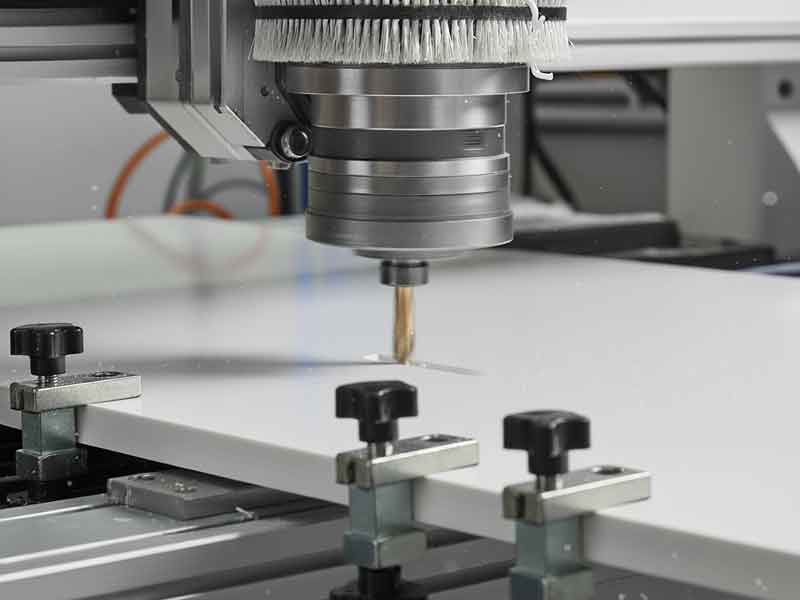 Machinable plastics for CNC include common and lower cost options like acetal, HDPE, ABS, rigid PVC, acrylic (PMMA), polycarbonate (PC), nylon, polypropylene, KYDEX/Boltaron, UHMW, and PTFE (Teflon). Although many plastics can be machined, these are the materials most often found in machine shops.
In this guide from Interstate Plastics, we explain when to choose each material and the shop-floor techniques you need—like tool geometry, heat management, and speeds & feeds—to maintain tight tolerances and achieve superior surface finishes on mills and routers.
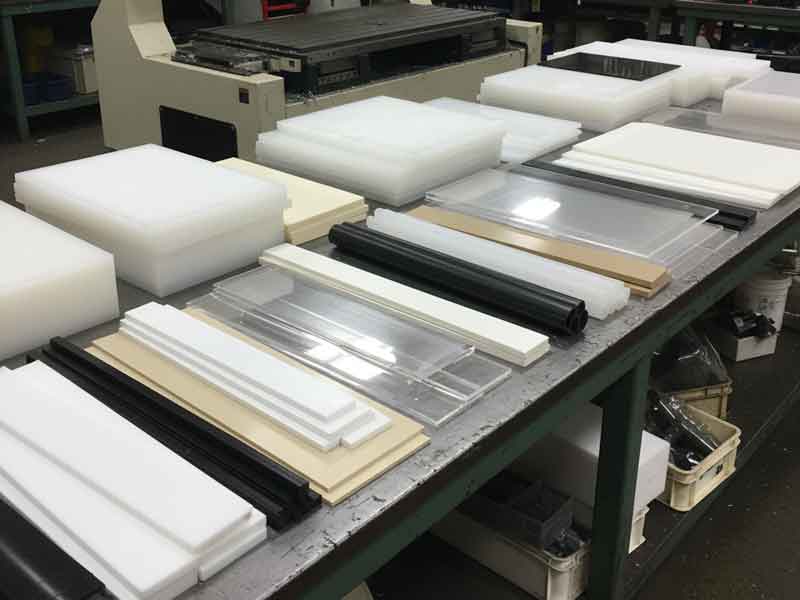 Use the links below to skip the guesswork. Materials are ordered by ease of machinability (easiest to hardest).
- Easy-to-Machine & Common Plastics: Quick Start
- Specialty & High-Performance Machinable Plastics: When to Use
- Machining Plastics vs. Metals: Key Differences for the Shop Floor
- Acetal & Delrin (POM) CNC Machining Tips
- HDPE CNC Machining: Fixturing & Finish
- ABS CNC Machining: Prevent Chip Welding
- Rigid PVC (Type I) CNC Machining: Dust & Chemical Notes
- Acrylic (PMMA/Plexiglass) CNC Machining: Optical Edge Quality
- Polycarbonate CNC Machining: Anneal & Stress Cracks
- Nylon (PA6/PA66) CNC Machining: Drying & Burr Control
- Polypropylene CNC Machining: Deburring & Finish
- KYDEX & Boltaron (Acrylic/PVC Sheet) CNC Routing: Settings & Edge Quality
- UHMW-PE CNC Machining: Workholding & Heat Control
- PTFE (Teflon) CNC Machining: Clamping & Creep
- PEEK CNC Machining: Heat, Tolerance & Tool Wear
- Ultem CNC Machining: Heat, Stability & Surface Finish
- Essential Safety & PPE for Plastic Machining
- Plastic Machining Pre-Flight Checklist
- Trademark Notes
- Getting Help: Material Selection and Machining Service
Easy-to-Machine & Common Plastics: Quick Start
For many applications, the optimal material is one of the common, cost-effective plastics found in nearly every machine shop. The following table helps you make an informed decision about what to buy, focusing on cost-effectiveness, ease of machining, and when to choose specific plastics, as well as common shop-floor challenges when working with plastics. Includes common shop plastics that aren't always easy to machine (e.g., UHMW, PTFE).
| Material | Relative Cost | Ease of Machining (1=Difficult, 10=Excellent) | When to Choose It (Key Properties) | Shop Watch-Outs (Common Problems) | Common Applications |
|---|---|---|---|---|---|
| Acetal (POM/Delrin) | $$ | 10 | Best for tight-tolerance, low-friction, high-stiffness parts. Use when you need excellent dimensional stability and natural lubricity. | Homopolymer acetal (Delrin) offers slightly higher mechanical strength than copolymer grades, but large cross-sections of Delrin can contain centerline porosity (voids). For parts requiring a porosity-free material (e.g., fluid or medical components), specify acetal copolymer. Copolymer shows little or no centerline porosity; specify a porosity-free grade when zero porosity is required. | Gears, bushings, bearings, electrical insulators, and food processing components. |
| HDPE | $ | 9 | Low-cost, all-purpose plastic. Use when you need excellent chemical, impact, and moisture resistance. | HDPE is less rigid than most engineering plastics, so thin-walled or sheet parts may deflect under tool pressure. This can cause vibrations (chatter) during fast cuts and negatively impact the surface finish. Using proper fixturing (e.g., a vacuum table for sheets) and moderate speeds can help mitigate this issue. | Chemical tanks, cutting boards, chute liners, and outdoor furniture. |
| ABS | $ | 8 | Good all-arounder with high impact strength and stiffness at low cost. Use when you need parts that are easy to glue and paint. | ABS has a low glass transition temperature, ~221°F (105 °C), at which it becomes flexible and rubbery. During machining, chips can soften and fuse to the cutter ("chip welding"), especially if tools overheat. Using sharp tools, operating at lower RPMs, and performing frequent chip removal (via air blast) helps prevent this. | Prototypes, electronic enclosures, "LEGO" plastic, consumer products, 3D printing. |
| Rigid PVC (Type I) | $ | 8 | Excellent chemical resistance—especially to acids and alkalis—and high rigidity with flame retardancy. Use when you need strong, chemically resistant components. | Avoid overheating PVC, as thermal degradation releases hydrogen chloride (HCl) gas. Provide local exhaust and protect machine ways from corrosive condensate. These fumes contain hydrochloric acid (HCl), which is highly corrosive to metals. To protect machine ways and operators, use proper dust extraction and avoid overheating the PVC (light cuts, sharp tools). While normal cutting shouldn't reach degradation temperatures, avoid heat buildup; if you smell pungent fumes or see browning, stop and improve chip evacuation/feeds. | Chemical tanks, valves, fittings, plumbing components, and scientific instrumentation. |
| Cast Acrylic (PMMA) | $$ | 7 | Best for optical clarity ("glass-like"). Use when you need good UV/weather resistance and polishable high-gloss edges. Cast acrylic has less tendency to melt/chip during machining. | Acrylic is brittle and notch-sensitive: sharp internal corners or aggressive toolpaths can cause cracks or chipping. It is also prone to stress crazing, which is characterized by fine cracks that appear when machined acrylic is exposed to solvents such as alcohol. (Avoid alcohols like IPA on stressed acrylic as it can cause stress crazing; clean with mild soap/water or the sheet maker's approved cleaner.) | Signage, displays, light pipes, machine guards, face shields. |
| Polycarbonate (PC) | $$ | 7 | "Bullet-resistant" toughness. Use when you need exceptional impact strength with clarity and higher heat resistance than acrylic. | Polycarbonate (PC) is an amorphous plastic that easily develops stress cracks after machining (often not visible immediately). Contact with certain coolants, oils, or solvents accelerates this "stress crazing." PC often benefits from stress-relief annealing before/after heavy machining, or when parts will be exposed to chemicals. Recommended stress relief cycle (batch, per Covestro): ~260°F (127°C) for ~15 min per 1/16 in (1.6 mm) wall thickness, then slow cool. This stress-relief heat treatment prevents unexpected cracks from occurring later. | Machine guards, safety goggles, electronic housings, and automotive components. |
| Nylon (PA6/PA66) | $$ | 6 | Best for toughness, wear, and impact resistance. Use when you need flexibility and good abrasion resistance. | Nylon readily absorbs humidity (typically up to ~2.5% by weight in normal ambient, ~7-8% at saturation). This absorbed moisture causes nylon parts to swell and drift out of tolerance over time. Additionally, nylon's toughness leads to poor chip breakage—it tends to cut in a gummy, continuous ribbon, making it challenging to get a clean finish. (Using extremely sharp, high rake tools and higher feed rates helps the chip to shear rather than tear.) | Rollers, wear pads, gears, cable ties, high-impact components. |
| Polypropylene (PP) | $ | 6 | Elite chemical resistance (especially to solvents) and lightweight. Use when you need near-zero moisture absorption. | Polypropylene is a soft, waxy polymer that is challenging to machine to a high finish. Cutting often produces frayed, stringy burrs ("fuzz") instead of clean edges. Achieving a smooth finish on PP typically requires extremely sharp cutters, high spindle speeds with high feed rates (to cut rather than rub), and careful deburring or even cryogenic deflashing for intricate parts. | Medical parts, lab equipment, chemical tanks, pump components. |
| KYDEX & Boltaron | $$ | 6 | Acrylic/PVC alloy sheet with high impact strength. Use when you need excellent thermoformability. | PVC-acrylic alloy sheet, like KYDEX and Boltaron, has a low melting point for a thermoplastic sheet. High router RPM or slow feed can overheat it, causing chips to melt and smear on the tool. The solution is to use sharp, high-clearance tools like O-flute bits and high feed rates to eject chips quickly. This minimizes heat buildup and prevents melty "globs" on edges. | Holsters, knife sheaths, aircraft interior components, and custom enclosures. |
| UHMW-PE | $$ | 4 | King of abrasion resistance. Use when you need extremely low friction and high impact strength (self-lubricating). Difficult to machine but common for wear parts. | UHMW-PE is notoriously difficult to machine (yet, it is very common in wear parts), as machinists often struggle to machine it due to its propensity to deform and generate heat. Like other polyethylenes, UHMW has a low melt point (~266°F/~130°C) and roughly 15-17× the thermal expansion of steel. If the cut is too slow or the tool rubs, the material will melt rather than cut, ruining the part (the cutting tool effectively becomes a melting tool). Use a moderate surface speed with high feed to maintain a consistent chip load and avoid rubbing/heat. On high-speed routers, high RPM can work only if feed is increased accordingly and chips are evacuated. | Conveyor guides, wear strips, chute liners, marine dock fenders, idler sprockets. |
| PTFE (Teflon) | $$$ | 3 | Lowest coefficient of friction and near-total chemical inertness. Use when you need a very wide operating temperature range. While not easy to machine, it is common for parts with very low friction and broad chemical resistance. | PTFE is extremely soft and pliable, and machinists often liken it to cutting a bar of soap. Standard vise jaws can deform it; even moderate cutting forces can cause it to deflect rather than cut. Additionally, PTFE exhibits cold flow (creep), meaning it will not maintain its shape under prolonged loads. Machining PTFE requires minimal clamping pressure (use soft jaws or a vacuum fixture) and very sharp tools. Expect to take light finishing passes to achieve accuracy, since the material can spring back after cutting. | Gaskets, seals, bushings, chemical-resistant liners, and high-frequency insulators. |
Specialty & High-Performance Machinable Plastics: When to Use
When an application's demands for heat, strength, or chemical resistance exceed the capabilities of common plastics, engineers turn to specialty and high-performance thermoplastics. These materials are often used to replace metal, offering significant weight savings and resistance to corrosion.
| Material | When to Use | Primary Applications | Machining Note |
|---|---|---|---|
| PEEK (Polyetheretherketone) | Use when you need extreme heat resistance (up to 500°F continuous), elite chemical resistance, and high strength. | Medical implants, aerospace components, semiconductor handling, and piston parts. | Machines well, but glass/carbon-filled grades are extremely abrasive and require carbide tooling. |
| PEI (Ultem) | Use when you need high heat resistance (340°F continuous), high dielectric strength, dimensional stability, and tolerance to repeated steam sterilization. | Medical devices, electrical connectors, semiconductor components, and aerospace parts. | Machines well to tight tolerances. Susceptible to stress crazing from some coolants. |
| PAI (Torlon) | Use when you need the highest strength and stiffness in a melt-processable plastic and excellent performance at up to 500°F. | High-performance gears, bearings, powertrain components, and hardware in extreme environments. | Very abrasive; requires carbide tooling. Post-machining curing (annealing) is often required. |
| PI (Vespel) | Use when you need operation from cryogenic to 550°F+, vacuum stability (low outgassing), and excellent wear resistance. | Aerospace components (replaces metal), semiconductor wafer handling, valve seats, and insulators. | Machines well, but is a very expensive material. Easier to machine than ceramics. |
| PPS (Ryton) | Use when you need 400°F+ heat resistance, excellent dimensional stability, and PEEK-like chemical resistance. | Medical components, membranes, and food processing equipment. | Machines well, but can be notch-sensitive. |
| PSU (Polysulfone) | Use when you need transparency with good chemical resistance and heat resistance (Tg ~374°F/~190°C). | Medical components, membranes, and food processing equipment. | Machines well, but can be notch-sensitive. |
| PPSU (Polyphenylsulfone) | Use when you need higher heat resistance (Tg ~428°F/~220°C) and superior chemical/impact strength versus PSU. | Medical sterilization trays, aircraft interiors, and low-pressure pipe fittings. | Similar to PSU, machines well. |
| PVDF (Kynar) | Use when you need a high-purity fluoropolymer with excellent chemical resistance, high strength, and abrasion resistance. | Chemical processing, high-purity fluid handling, semiconductor equipment, and linings. | Machines well. Stiffer than PTFE. |
| PCTFE (Kel-F) | Use when you need excellent dimensional stability, very low moisture uptake, and reliable cryogenic performance (down to -328°F/-200°C). | Cryogenic seals and gaskets, pharmaceutical packaging, and aerospace seals. | Machines well, but is harder and stronger than PTFE. |
| ECTFE, ETFE, PFA | Use when you need a PTFE-family fluoropolymer balancing chemical resistance, mechanical toughness, and melt-processability. | Linings, electrical insulation, seals. | Properties vary; generally harder to machine than PTFE but more stable. |
| PET (Ertalyte) | Use when you need high strength and stiffness (higher than PBT) with good wear resistance. | Food processing machinery parts, bearings, and electrical components. | Notch-sensitive; requires coolant during drilling to prevent heat cracking. |
| PBT | Use when you need PET-like properties with better impact resistance, lower moisture absorption, and improved chlorine resistance. | Food processing components, pump parts, and electrical insulators. | Good machinability, crystallizes rapidly. |
| Noryl (PPO/PS blend) | Use when you need excellent dimensional stability, very low moisture absorption, and high dielectric strength. | Electrical components, pump housings, scientific instruments, and semiconductor parts. | Easy to machine to tight tolerances. Many PPO/PS grades exhibit poor resistance to petroleum hydrocarbons; however, some PPE/PA grades (e.g., NORYL GTX) are specifically formulated for resistance to fuels and lubricating oils. |
| PETG | Use when you need good clarity and chemical resistance in an FDA-compliant material with good impact strength. (PETG can be food contact compliant depending on grade. Confirm the exact sheet/grade and regulatory listing before use.) | Food containers, medical packaging, and displays. | Primarily routed or thermoformed. PETG can be brittle on fine details after machining. Prone to melting. |
Machining Plastics vs. Metals: Key Differences for the Shop Floor
Coming from metal machining? Note these key differences that change setups and programs:
- Heat (vs. metal): Metals wick heat; plastics hold it—use strong chip evacuation and rough-then-finish after cool-down to hold size.
- Clamping (vs. metal): Metals tolerate force; many plastics creep—use broad, gentle support, soft jaws, or vacuum.
- Tool geometry (vs. metal): Metals accept neutral rake; plastics want razor-sharp edges with high positive rake and clearance to shear, not rub.
- Chips & fluids (vs. metal): Flood is common on metals; for plastics, favor air to move chips and confirm coolant compatibility, especially for polycarbonate (PC) and acrylic (PMMA).
Read the full Machining Plastic vs. Metal Guide for detailed techniques.
Acetal & Delrin (POM) CNC Machining Tips
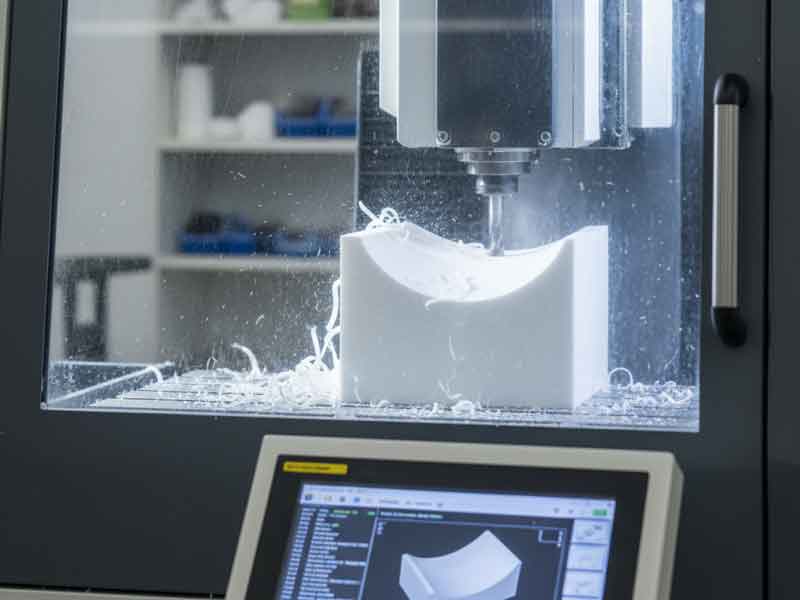 Why People Pick It: Acetal is widely regarded as the most machinable plastic, often called the "machinist's favorite". It is a high-strength, semi-crystalline thermoplastic specified for its high stiffness, excellent dimensional stability, low coefficient of friction, and good chemical resistance. It is a top choice for precision parts, replacing metal in applications like gears, bearings, bushings, and food-processing components.
Machining Behavior: Acetal machines beautifully, producing clean, predictable, and brittle chips that break easily. It requires very little force to cut and provides an excellent surface finish straight off the tool.
Machining Tips (Speeds & Feeds):
- Tooling: Use sharp HSS or carbide tools.
- Speeds & Feeds: Very high cutting speeds are possible, often in the 300-500 m/min (1000-1600 ft/min) range.
| Setup | RPM | IPT | IPM | DOC | WOC | Coolant/Air | Watch For | Fix |
|---|---|---|---|---|---|---|---|---|
| Router | 18000 | 0.01 | 180 | 1.0D | 0.6D | Air | Cosmetic finish needs | Add a light finish pass; maintain sharpness |
| Mill | 10200 | 0.006 | 122 | 1.0D | 0.6D | Air/mist | Chatter on thin walls | Reduce WOC; support part; finish pass |
| Starting values. Assumptions: Router = 1/4" single-flute O-flute; Mill = 3/8" 2-flute carbide. | ||||||||
- Coolant: Dry machining with an air blast is common. Coolant can be used to maximize surface finish and dimensional accuracy on high-speed production runs.
Common Machining Problem & Fix:
- Centerline Porosity
- Problem: Homopolymer acetal (Delrin) offers slightly higher mechanical strength than copolymer grades, but large cross-sections of Delrin can contain centerline porosity (voids).
- Fix: For parts requiring a porosity-free material (e.g. fluid or medical components), specify acetal copolymer, which shows little to no centerline porosity (specify porosity-free grade when zero porosity is required).
HDPE CNC Machining: Fixturing & Finish
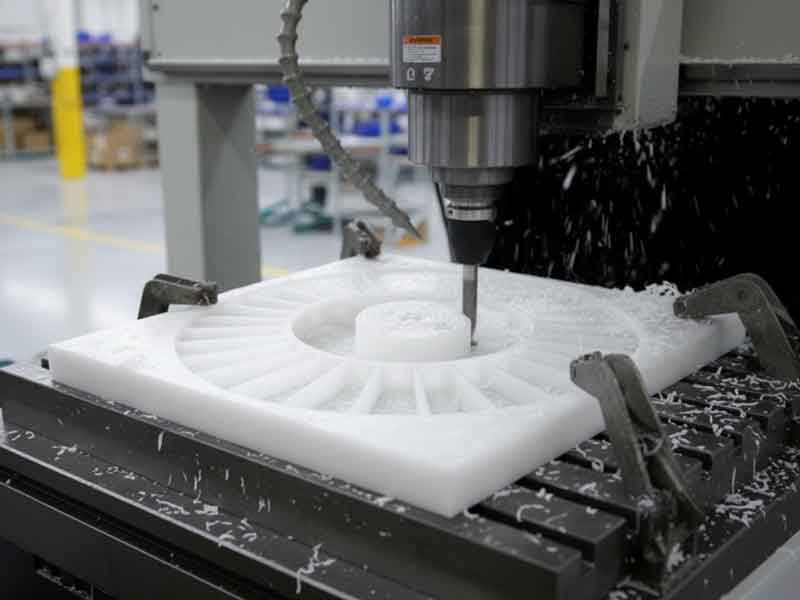 Why People Pick It: HDPE is a low-cost, versatile, all-purpose plastic. It is known for its excellent chemical resistance (especially to acids and bases), good impact strength, and near-zero moisture absorption. It is also easily fabricated and welded. It is used for chemical tanks, fabricated fittings, food cutting boards, and outdoor playground equipment.
Machining Behavior: HDPE is one of the easiest plastics to machine. It is soft, waxy, and very forgiving. It cuts cleanly with standard woodworking or metal tools. It produces continuous, stringy chips.
Machining Tips:
- Tooling: Standard HSS or carbide tools work well. Single or two-flute end mills are preferred for efficient chip evacuation.
- Speeds & Feeds: HDPE can be machined at very high speeds and feeds. The limiting factor is often the machine's spindle or gantry speed. High feed rates are recommended to produce a good chip and avoid rubbing.
| Setup | RPM | IPT | IPM | DOC | WOC | Coolant/Air | Watch For | Fix |
|---|---|---|---|---|---|---|---|---|
| Router | 20000 | 0.012 | 240 | 1.0D | 0.6D | Air | Rubbing, poor chip | Increase feed; sharp O—flute; clear chips |
| Mill | 9200 | 0.01 | 184 | 1.0D | 0.6D | Air | Edge roll—over | Light finish pass; climb mill; verify support |
| Starting values. Assumptions: Router = 1/4" single-flute O-flute; Mill = 3/8" 2-flute carbide. | ||||||||
- Coolant: Dry machining with an air blast is a common practice.
Common Machining Problem & Fix:
- Chatter and Vibration on Thin Parts
- Problem: HDPE is less rigid than most engineering plastics, so thin-walled or sheet parts may deflect under tool pressure. This can cause vibrations (chatter) during fast cuts and negatively impact the surface finish.
- Fix: Rigid workholding is key. Use a vacuum table or double-sided tape to secure thin sheets of material. Ensure the part is clamped securely without distortion. Use very sharp tools and climb milling to reduce cutting forces. If chatter occurs, try reducing the depth of cut while maintaining a high feed rate. Using proper fixturing and moderate speeds can help mitigate this issue.
ABS CNC Machining: Prevent Chip Welding
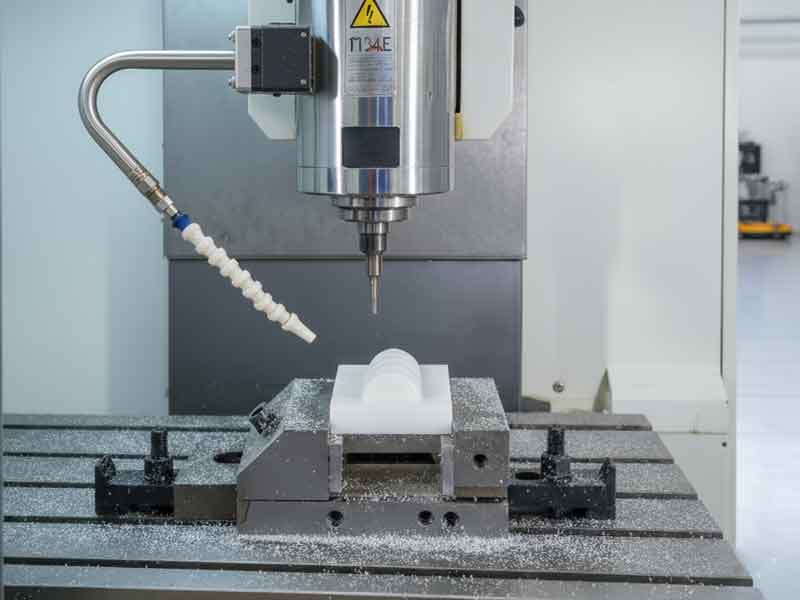 Why People Pick It: ABS is the classic "LEGO" plastic. It is an excellent, low-cost, all-around material known for its high impact strength, good stiffness, and ease of processing. Unlike many other plastics, it is very easy to glue, paint, and thermoform. It is a top choice for prototypes, electronic enclosures, and consumer goods.
Machining Behavior: ABS generally machines well, but it shares some of the "gummy" characteristics of Nylon. It has a low melting point and is very sensitive to heat buildup.
Machining Tips:
- Tooling: Use HSS or carbide. Single-flute, "O-flute" tools are highly recommended.
- Speeds & Feeds: High cutting speeds are effective (e.g., 700-1650 ft/min). A high feed rate is necessary to prevent rubbing and heat buildup.
| Setup | RPM | IPT | IPM | DOC | WOC | Coolant/Air | Watch For | Fix |
|---|---|---|---|---|---|---|---|---|
| Router | 15000 | 0.007 | 105 | 0.5D-0.75D | 0.5D | Air | Chip welding | Lower RPM; raise feed; single—flute; strong air |
| Mill | 7130 | 0.004 | 57 | 0.5D-0.75D | 0.5D | Air | Softening at edges | Reduce heat; shorter engagement; finish pass |
| Starting values. Assumptions: Router = 1/4" single-flute O-flute; Mill = 3/8" 2-flute carbide. | ||||||||
- Coolant: A strong air blast is essential to clear chips and cool the tool.
Common Machining Problem & Fix:
- Chip Welding (The "Blob Mill")
- Problem: ABS has a low glass transition temperature, ~221°F (105°C), at which it becomes flexible and rubbery. During machining, chips can soften and fuse to the cutter ("chip welding"), especially if tools overheat.
- Fix: Maximize chip evacuation. The primary cause is poor chip clearance. Use a single-flute, up-cut tool to provide the most possible space for the chip to escape. Using sharp tools, operating at lower RPMs, and performing frequent chip removal (via air blast) helps prevent this.
Rigid PVC (Type I) CNC Machining: Dust & Chemical Notes
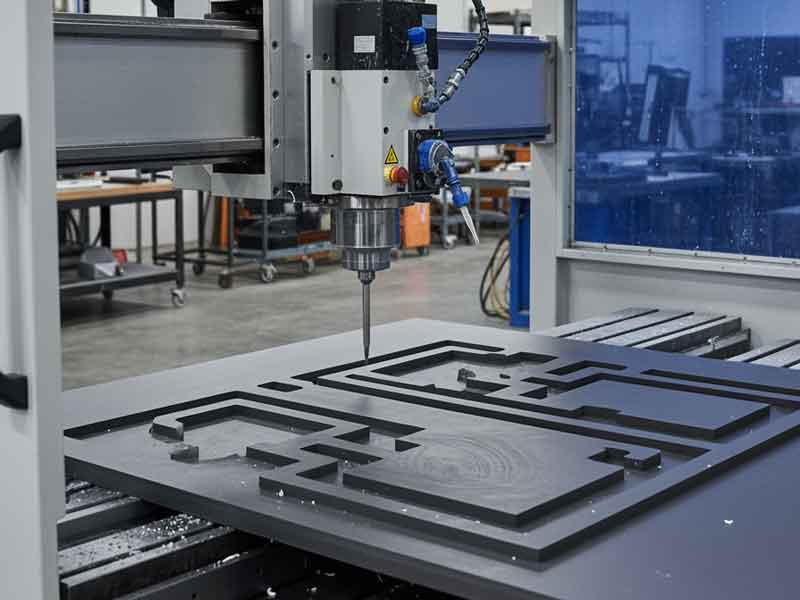 Why People Pick It: Rigid PVC (Polyvinyl Chloride) is an industrial workhorse chosen for its outstanding chemical resistance, especially to acids, alkalis, and other corrosive media. It is also rigid, strong, flame-retardant, and relatively low-cost. It is heavily used in chemical processing, plumbing, and electrical applications.
Machining Behavior: Type I Rigid PVC machines very well, producing clean chips and a good surface finish. It is harder and more rigid than polyolefins like HDPE or polypropylene.
Machining Tips:
- Tooling: Carbide-tipped tools are recommended for their longevity, though HSS also works well.
- Speeds & Feeds: Use moderate to high speeds. For milling, a speed range of 100-300 m/min (300-1000 ft/min) is suitable. For turning, 50-150 m/min (160-500 ft/min). Low spindle speeds (6,000-12,000 RPM) with moderate feeds (0.1-0.3 mm/tooth) can also be used to avoid burrs.
| Setup | RPM | IPT | IPM | DOC | WOC | Coolant/Air | Watch For | Fix |
|---|---|---|---|---|---|---|---|---|
| Router | 12000 | 0.007 | 84 | 0.5D | 0.5D | Air/mist | Heat & pungent fumes | Lower RPM; raise feed; extraction; clean machine |
| Mill | 3565 | 0.0045 | 32 | 0.5D | 0.5D | Air/mist | Discoloration | Reduce SFM; improve chip evacuation |
| Starting values. Assumptions: Router = 1/4" single-flute O-flute; Mill = 3/8" 2-flute carbide. | ||||||||
- Coolant: Pressurized air or a water-soluble mist is sufficient to clear chips and prevent overheating.
Common Machining Problem & Fix:
- Corrosive & Abrasive Dust
- Problem: Machining PVC can generate fine chips and thermal degradation releases hydrogen chloride (HCl) gas when overheated. These fumes contain HCl, which is highly corrosive to metals.
- Fix: To protect machine ways and operators, use proper dust extraction and avoid overheating the PVC (light cuts, sharp tools). Wipe down the machine surfaces with a rust-preventative oil after the job is complete. Monitor tool sharpness and use carbide tools for long production runs.
- Note: Do not cut PVC with a laser unless a total air evacuation and filter system is installed.
Acrylic (PMMA/Plexiglass) CNC Machining: Optical Edge Quality
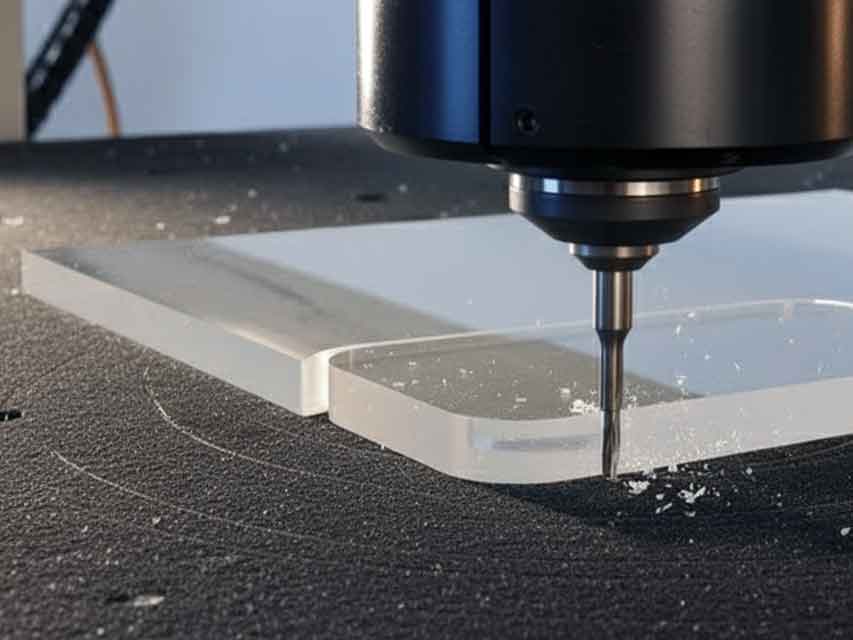 Why People Pick It: Acrylic is chosen for one primary reason: aesthetics. It offers glass-like optical clarity, excellent UV and weather resistance, and can be polished to a beautiful, high-gloss edge. It is used for signs, retail displays, light pipes, and transparent guards.
Cast Acrylic should always be specified for machining. Extruded acrylic has high internal stress and is much more prone to melting, chipping, and cracking.
Machining Behavior: Cast acrylic machines well, but is very brittle and notch-sensitive. It is highly prone to chipping and cracking, especially during drilling or when using the wrong tool. It has a low melting point and will melt instantly if the chip is not evacuated.
Machining Tips:
- View our Acrylic Fabrication & Machining Guide for more detailed information.
- Tooling: "O-flute" (single-flute, polished) bits are essential. These tools are designed specifically for acrylic, shearing the material cleanly and ejecting the chip rapidly.
- Strategy: Acrylic requires a "fast and fast" strategy. High RPM (10,000-18,000+ RPM) combined with high feed rates (e.g., 70-100+ IPM). This aggressive combination "flings" the chip out of the cut before it has time to melt, resulting in a clean, often "frosty" edge.
Speeds & Feeds:
| Setup | RPM | IPT | IPM | DOC | WOC | Coolant/Air | Watch For | Fix |
|---|---|---|---|---|---|---|---|---|
| Router | 16000 | 0.006 | 96 | 0.5D | 0.4D | Air | Melting/smear | Lower RPM; raise feed; clear chips |
| Mill | 6100 | 0.0035 | 43 | 0.5D | 0.4D | Air | Haze from rubbing | Increase chip load; fresh tool; light finish pass |
| Starting values. Assumptions: Router = 1/4" single-flute O-flute; Mill = 3/8" 2-flute carbide. | ||||||||
- Drilling: Use drill bits specifically ground for plastic (with a "dubbed" or zero-rake-angle point) to prevent the drill from "grabbing" and cracking the material. For deep holes, "peck drilling" (drilling in small increments) is necessary to clear chips and prevent melting.
Common Machining Problems & Fixes:
- Stress Crazing & Cracking
- Problem: Acrylic is brittle and notch-sensitive—sharp internal corners or aggressive toolpaths can cause cracks or chipping. It is also prone to stress crazing, which is characterized by fine cracks that appear when machined acrylic is exposed to solvents such as alcohol.
- Fix: Avoid cleaning acrylic parts with isopropanol to prevent stress crazing. Use only mild soap and water. Crazing is also caused by internal stress, so use razor-sharp tools and light finishing passes.
- Achieving a Polished Edge
- Problem: The machined edge has a "frosted" or "matte" appearance, not a clear, glass-like one.
- Fix: This is normal. A glass-like edge requires post-processing. The most common methods are flame polishing (passing a hydrogen-oxygen torch quickly over the edge to melt it smooth) or vapor polishing. A mechanical polish can be achieved by sanding with progressively finer grits of wet/dry sandpaper (e.g., 400, 600, 1000) and then using a buffing wheel with a plastic polishing compound.
Polycarbonate CNC Machining: Anneal & Stress Cracks
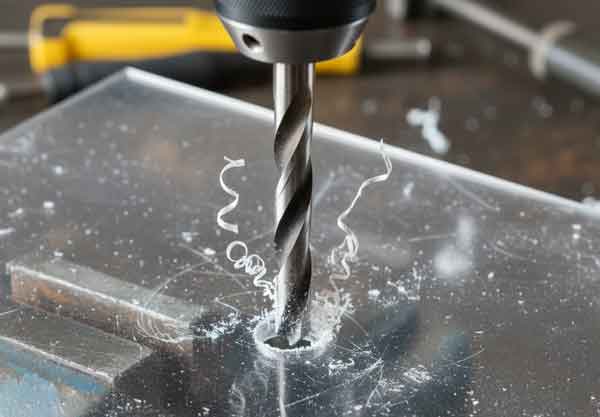 Why People Pick It: Polycarbonate is chosen for its "bullet-resistant" toughness. It has unparalleled impact strength, far exceeding acrylic, while also offering good optical clarity and a higher heat deflection temperature. It is the material of choice for machine guards, safety glasses, heavy-duty signage, and electronic housings.
Machining Behavior: Polycarbonate generally machines well, producing good chips. However, it is extremely notch-sensitive and highly susceptible to chemical-induced stress cracking.
Machining Tips:
View our Polycarbonate Fabrication Guide for more detailed information.
- Tooling: Use sharp carbide or HSS tools. Two-flute high-helix end mills are effective.
- Speeds & Feeds: Like acrylic, PC benefits from high speeds to evacuate chips and minimize heat. Use high spindle speeds (e.g., 6,500+ RPM) and very high feed rates (e.g., 100+ IPM).
| Setup | RPM | IPT | IPM | DOC | WOC | Coolant/Air | Watch For | Fix |
|---|---|---|---|---|---|---|---|---|
| Router | 13000 | 0.008 | 104 | 0.5D | 0.5D | Air (PC—safe) | Stress crazing | Avoid incompatible coolants; consider anneal |
| Mill | 5100 | 0.0045 | 46 | 0.5D | 0.4D | Air/mist | Dull—tool haze | Reduce RPM; fresh tool; light finish pass |
| Starting values. Assumptions: Router = 1/4" single-flute O-flute; Mill = 3/8" 2-flute carbide. | ||||||||
- Prove-out: Start 10-20% below your usual router RPM on scrap and step up the RPM in small increments while monitoring chip form and edge temperature. If chips smear or edges turn glossy, reduce the RPM and increase the feed to increase the chip load.
- Coolant: Avoid incompatible coolants that can cause stress cracking; use compressed air or non-aromatic, water-soluble coolants approved for PC. Anneal thick/tight-tolerance parts. Flood coolants are a primary cause of stress crazing and should be avoided.
Common Machining Problem & Fix:
- Delayed Stress Cracking (Crazing)
- Problem: Polycarbonate is an amorphous plastic that easily develops stress cracks after machining (often not visible immediately). Contact with certain coolants, oils, or solvents accelerates this "stress crazing."
- Fix: Annealing the stock before and/after machining is strongly recommended for tight-tolerance PC parts. This stress-relief heat treatment prevents later surprise cracks.
Nylon (PA6/PA66) CNC Machining: Drying & Burr Control
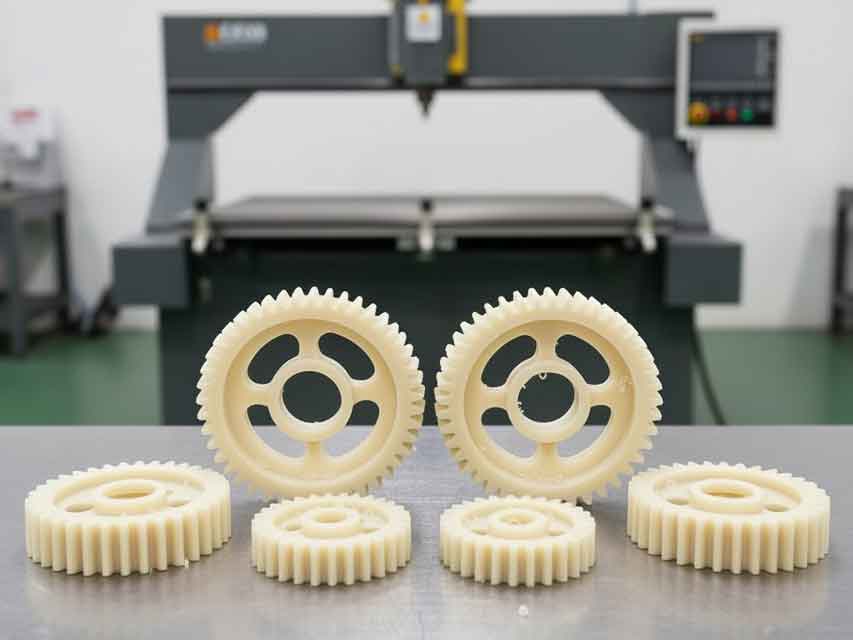 Why People Pick It: Nylon is the workhorse for toughness and wear. It is chosen for its exceptional impact resistance, flexibility, and high abrasion resistance, often out-wearing acetal in dry and abrasive environments. It is used for rollers, wear pads, cable ties, and under-hood automotive components.
Machining Behavior: Nylon is notoriously "gummy" and flexible. It tends to deform under the tool rather than cut cleanly. This produces long, stringy, continuous chips that wrap around the tool and chuck, requiring constant operator attention. It is difficult to get a clean finish, and burrs are a common problem.
Machining Tips:
- Tooling: Tool sharpness is non-negotiable. Tools must be razor-sharp with a high positive rake angle (15-30 degrees) and high clearance to slice the material, rather than pushing it. Polished HSS tools are often preferred as they can be ground to a sharper edge.
- Speeds & Feeds: Use high cutting speeds (200-300 m/min or 600-900 ft/min). High feed rates are necessary to create a thick chip and prevent rubbing.
| Setup | RPM | IPT | IPM | DOC | WOC | Coolant/Air | Watch For | Fix |
|---|---|---|---|---|---|---|---|---|
| Router | 12000 | 0.01 | 120 | 0.75D | 0.5D | Air/mist | Burrs/strings | Sharper tool; higher feed; climb finish |
| Mill | 7130 | 0.006 | 86 | 0.5D-0.75D | 0.5D | Air/mist | Heat/moisture shift | Dry/condition stock; measure after cool |
| Starting values. Assumptions: Router = 1/4" single-flute O-flute; Mill = 3/8" 2-flute carbide. | ||||||||
- Coolant: Dry machining is possible, but compressed air or a mist coolant is highly recommended to reduce heat and prevent chips from wrapping.
Common Machining Problems & Fixes:
- Callout 1: Moisture Absorption and Dimensional Instability
- Problem: Nylon readily absorbs humidity (up to ~2.5% by weight in normal ambient, ~7-8% at saturation). This absorbed moisture causes nylon parts to swell and drift out of tolerance over time.
- Fix: For high-precision applications, the raw material stock must be pre-dried in an oven before machining. After machining, parts should be sealed or conditioned to their expected service environment.
- Callout 2: Heavy Burrs and "Fuzz"
- Problem: Nylon's toughness leads to poor chip breakage—it tends to cut in a gummy, continuous ribbon, making it challenging to get a clean finish.
- Fix: Use climb milling to pull the chip away from the finished edge. Use "up-cut" spiral tools to direct the burr to the top face, which can be deburred later. A final, very light "finishing pass" (0.005-0.010 inches) with a fresh, sharp tool is essential. Using extremely sharp, high-rake tools and higher feed rates helps the chip to shear rather than tear.
Polypropylene CNC Machining: Deburring & Finish
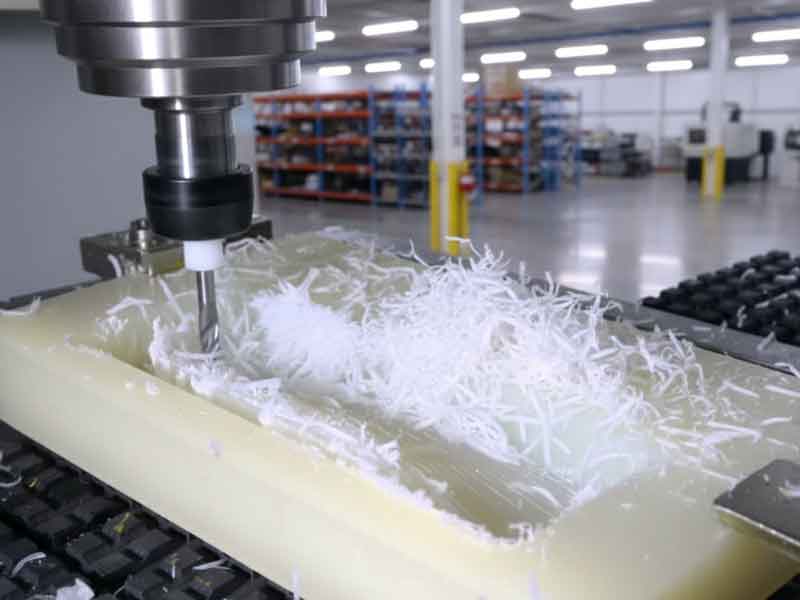 Why People Pick It: Polypropylene is selected for its elite chemical resistance, particularly against solvents, acids, and alkalis. It is very lightweight, has virtually zero moisture absorption (0.01%), and is weldable. This makes it a go-to material for laboratory equipment, medical components, and chemical tanks.
Machining Behavior: PP is soft, waxy, and "gummy," similar to HDPE but generally more difficult to get a clean finish. It tends to tear rather than shear, resulting in a "fuzzy" surface and heavy burrs.
Machining Tips:
- Tooling: Extremely sharp tools are critical. HSS or polished carbide tools are recommended.
- Speeds & Feeds: Maintain a high chip load (≈0.008-0.010 in/tooth) to prevent rubbing and heat. Example starting points for the setups below: Router (¼″ 1-flute O-flute) 18,000 RPM ≈ 180 IPM; Mill (⅜″ 2-flute carbide) 8,150 RPM ≈ 130 IPM. Adjust RPM and feed together to hold chip load; use air for chip evacuation.
| Setup | RPM | IPT | IPM | DOC | WOC | Coolant/Air | Watch For | Fix |
|---|---|---|---|---|---|---|---|---|
| Router | 18000 | 0.01 | 180 | 0.75D | 0.5D | Air | Fuzzing/stringing | Sharper tool; higher feed; light finish pass |
| Mill | 8150 | 0.008 | 130 | 0.75D | 0.5D | Air | Burrs | Increase chip load; mechanical deburr |
| Starting values. Assumptions: Router = 1/4" single-flute O-flute; Mill = 3/8" 2-flute carbide. | ||||||||
- Coolant: An air blast or cooling system is needed to manage heat.
Common Machining Problem & Fix:
- Poor Surface Finish and "Fuzz"
- Problem: Polypropylene is a soft, waxy polymer that is challenging to machine to a high finish. Cutting often produces frayed, stringy burrs ("fuzz") instead of clean edges.
- Fix: Achieving a smooth finish on PP typically requires extremely sharp cutters, high spindle speeds with high feed rates (to cut rather than rub), and careful deburring or even cryogenic deflashing for intricate parts. On a lathe, an insert with a "wiper" geometry can help "iron" the surface smooth as it cuts. A final, very light "spring pass" can also help shear off remaining fuzz.
KYDEX & Boltaron (Acrylic/PVC Sheet) CNC Routing: Settings & Edge Quality
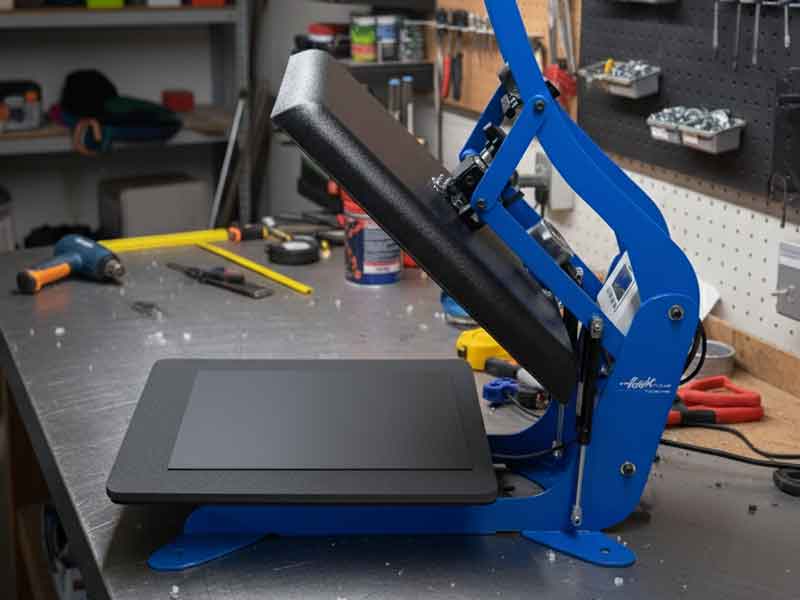 Why People Pick It: KYDEX and Boltaron are brand names for a family of thermoplastic alloy sheets, typically made from an acrylic/PVC blend. They are chosen for their high impact strength, chemical resistance, flame-retardant properties, and—most importantly—their excellent thermoforming characteristics. They are the industry standard for firearm holsters, knife sheaths, aircraft interior panels, and custom enclosures.
Machining Behavior: These materials are almost exclusively machined on CNC routers, not lathes. KYDEX and Boltaron (PVC-acrylic alloy sheets) have a relatively low melting point for a thermoplastic; high router RPM or slow feed can overheat them, causing chips to melt and smear on the tool.
Machining Tips:
- Tooling: "O-flute" (single-flute, up-cut) plastic-routing bits are essential. These tools are specifically designed to shear the plastic cleanly, providing maximum space for the hot chip to be ejected.
- Speeds & Feeds: Avoid excessively high RPMs and slow feed rates, as this combination guarantees melting. A balance of moderate RPM and a fast feed rate is ideal. Always use an air blast or dust collection to clear chips.
| Setup | RPM | IPT | IPM | DOC | WOC | Coolant/Air | Watch For | Fix |
|---|---|---|---|---|---|---|---|---|
| Router | 14000 | 0.008 | 112 | 0.5D | 0.5D | Air | Smearing | Keep feed high; single—flute; clear chips |
| Starting values. Assumptions: Router = 1/4" single-flute O-flute. If milling thicker blocks: Start around 6,000-8,000 RPM, 0.004-0.006 IPT (2-flute) → 50-100 IPM on a 3/8" carbide end mill, 0.25-0.5D DOC, ∼0.4D WOC, with air. If you see smear, lower RPM or increase feed; take a light finish pass. | ||||||||
- Cutting: Use a climb cut direction for a cleaner edge.
KYDEX vs. Boltaron: Which is Better?
The market is filled with conflicting, brand-loyal claims. Some sources claim Boltaron has superior heat and impact resistance, while others claim KYDEX has better heat tolerance. Both are brand names for various high-quality acrylic/PVC formulations. The properties depend entirely on the specific grade of sheet you buy, not the brand name.
To make an informed decision, compare the technical data sheets (TDS) for the specific grades. For example, a TDS for Boltaron 4335 (a common grade) lists a Heat Deflection Temperature (HDT) @ 264 psi of 161°F and an Izod Impact of 18 ft-lb/in. A TDS for KYDEX T (a common grade) lists an HDT @ 264 psi of 168°F and an Izod Impact of 15 ft-lbf/in. In this specific, data-driven comparison, KYDEX T has a slight advantage in heat, while Boltaron 4335 has a slight advantage in impact. However, other grades will vary. The correct takeaway is to stop comparing brands and start comparing data sheets to select the specific grade that meets your application's requirements. (Data per KYDEX® T TDS; Boltaron® 4335 TDS).
UHMW-PE CNC Machining: Workholding & Heat Control
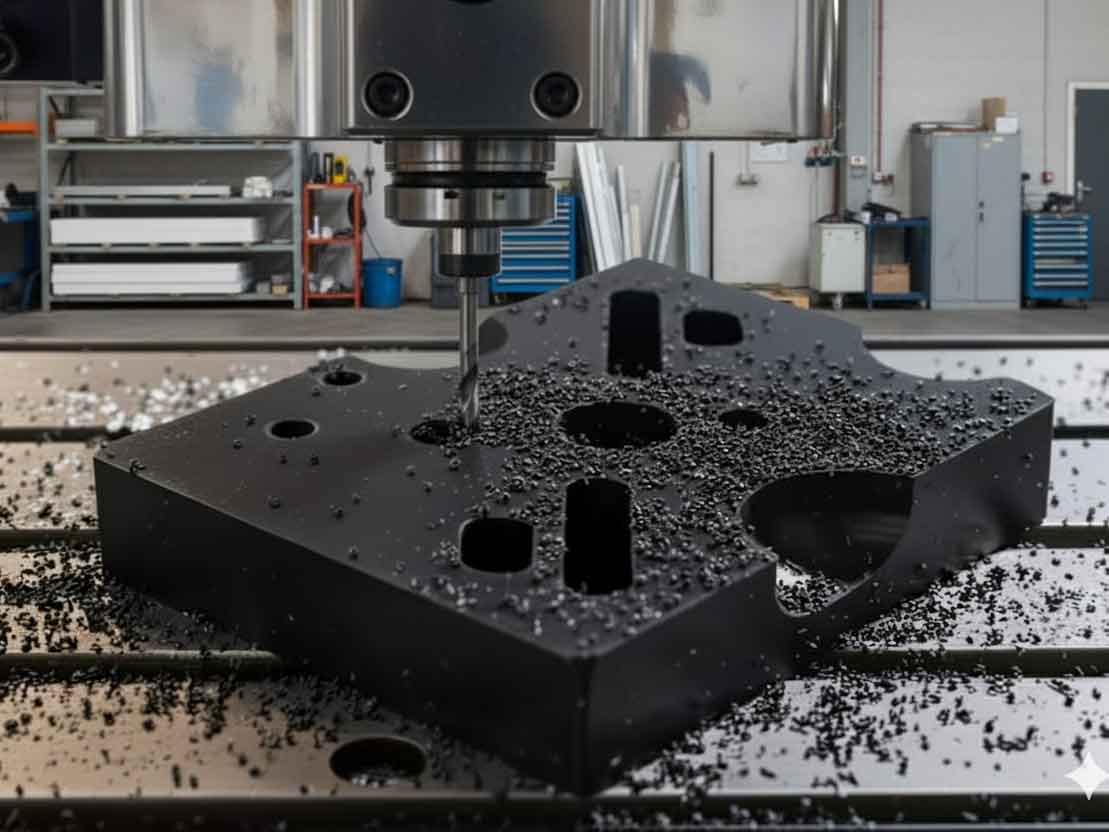 Why People Pick It: UHMW is the king of abrasion resistance. Its long molecular chains give it unmatched toughness, impact strength, and an extremely low coefficient of friction. It is often specified for high-wear applications where it runs dry against metal, such as conveyor chain guides, chute liners, wear strips, and marine dock fenders.
Machining Behavior: UHMW is notoriously difficult to machine. It is soft, waxy, and has a very low melting point. It has a tendency to "stretch," "push," or "deflect" away from the cutting tool rather than shear. This rubbing generates extreme frictional heat, leading to melting.
Machining Tips:
- Tooling: Use extremely sharp HSS tools with very high positive rake and clearance angles. "O-flute" (single-flute) tools are highly recommended as they provide maximum space for chip evacuation.
- Strategy: Use a moderate surface speed with high feed to maintain a consistent chip load and avoid rubbing/heat. On high-speed routers, high RPM can work only if feed is increased accordingly and chips are evacuated.
- Coolant: Flood coolant or a cold air blast is essential. The air blast also helps clear the "bird's nest" of chips that forms. Some petroleum-based fluids can promote stress cracking in amorphous plastics; use manufacturer-approved coolants and test them first.
Speeds & Feeds:
| Setup | RPM | IPT | IPM | DOC | WOC | Coolant/Air | Watch For | Fix |
|---|---|---|---|---|---|---|---|---|
| Router | 14000 | 0.016 | 224 | 0.5D | 0.4D | Air/flood | Melting/deflection | Lower RPM; raise feed; cool aggressively; support work |
| Mill | 6110 | 0.01 | 122 | 0.5D | 0.4D | Air/flood | Smeared surface | Increase chip load; reduce radial engagement |
| Starting values. Assumptions: Router = 1/4" single-flute O-flute; Mill = 3/8" 2-flute carbide. | ||||||||
Common Machining Problem & Fix:
- Catastrophic Melting and Tool Gumming
- Problem: UHMW-PE is notoriously difficult to machine—machinists often find it "incredibly hard to machine" due to its propensity to deform and heat up. Like other polyethylenes, UHMW has a low melt point (~266°F/~130°C) and roughly 15-17× the thermal expansion of steel. If the cut is too slow or the tool rubs, the material will melt rather than cut, ruining the part (the cutting tool effectively becomes a melting tool).
- Fix: Invert your machining parameters. If the material is melting, you are either spinning the tool too fast (RPM) or feeding too slow (IPM). Turn the spindle speed down and increase the feed rate up. Do not "baby" the cut with a light feed; this just causes rubbing and heat. Be aggressive with the chip load.
PTFE (Teflon) CNC Machining: Clamping & Creep
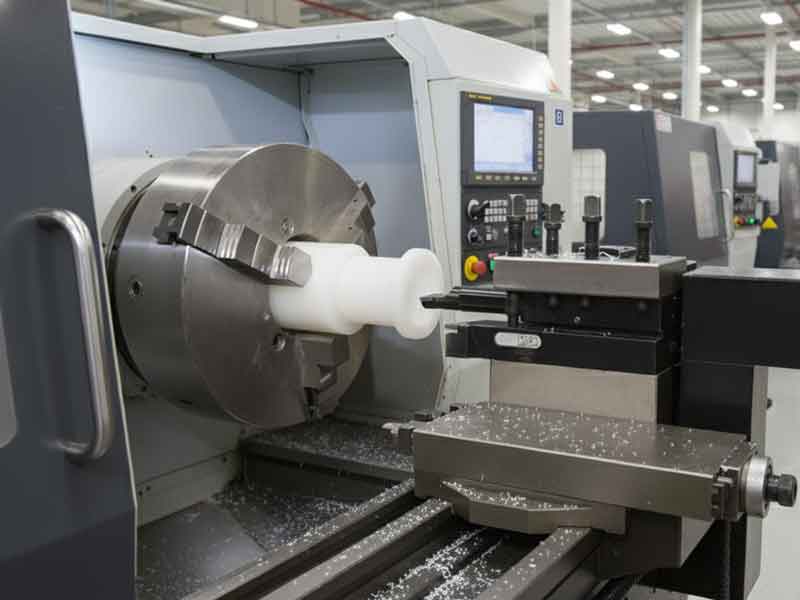 Why People Pick It: PTFE (Polytetrafluoroethylene) is a unique fluoropolymer chosen for a combination of three extreme properties: an incredibly low coefficient of friction (one of the "slipperiest" solids known), near-total chemical inertness, and a very wide operating temperature range (e.g., -328°F to +500°F / -200°C to +260°C). It is used for high-performance seals, gaskets, non-stick liners, lab equipment, and high-frequency electrical insulators.
Machining Behavior: PTFE is extremely soft and pliable—machinists often say "it's like cutting a bar of soap". Standard vise jaws will deform it; even moderate cutting forces can make it deflect rather than cut. Additionally, PTFE exhibits cold flow (creep), so it will not hold shape under long-term loads. Machining PTFE requires minimal clamping pressure (use soft jaws or a vacuum fixture) and very sharp tools. Expect to take light finishing passes to achieve accuracy, since the material can spring back after cutting.
Machining Tips:
- Tooling: Use exceptionally sharp HSS or carbide tools with a high positive rake and large clearance angles to ensure a clean shear.
- Speeds & Feeds: Use high cutting speeds (e.g., 500-1000 ft/min) with a low chip load of ~0.002-0.004 inches per tooth (2-flute ≈ 0.004-0.008 inches per revolution). This limits cutting forces and deflection. (For turning, target ~0.002-0.006 in/rev.)
| Setup | RPM | IPT | IPM | DOC | WOC | Coolant/Air | Watch For | Fix |
|---|---|---|---|---|---|---|---|---|
| Router | 10000 | 0.004 | 40 | 0.3D | 0.3D | Air | Deflection/feathered edges | Minimal clamping; sharp tools; light finishing cuts |
| Mill | 5100 | 0.0035 | 36 | 0.3D | 0.3D | Air | Deformation | Tiny WOC/DOC; multiple light passes |
| Starting values. Assumptions: Router = 1/4" single-flute O-flute; Mill = 3/8" 2-flute carbide. | ||||||||
- Coolant: Generally machined dry with an air blast.
Common Machining Problems & Fixes:
- Callout 1: Cold Flow and Clamping Distortion
- Problem: PTFE's defining challenge is "cold flow," or creep. The material will deform and "flow" away from any sustained pressure. If it is tightened in a standard vise, it will be crushed. The part will be machined, but when unclamped, it will spring back to a distorted, useless shape.
- Fix: Do not over-clamp. This is the #1 rule. The part must be supported, not crushed. Use soft jaws, collets, vacuum fixtures, or a very gentle, distributed clamping force.
- Callout 2: Dimensional Instability (Post-Machining)
- Problem: A machinist cuts a part to a precise dimension, and 24 hours later, it has "relaxed" or "creeped" to a different dimension.
- Fix: This is an inherent property of PTFE. For high-precision jobs, machine in stages. First, rough-machine the part, leaving stock for finishing. Then, let the part "relax" at a stable room temperature for at least 24 hours. Finally, perform the light, low-pressure finishing cuts to bring the part to its final dimension.
PEEK CNC Machining: Heat, Tolerance & Tool Wear
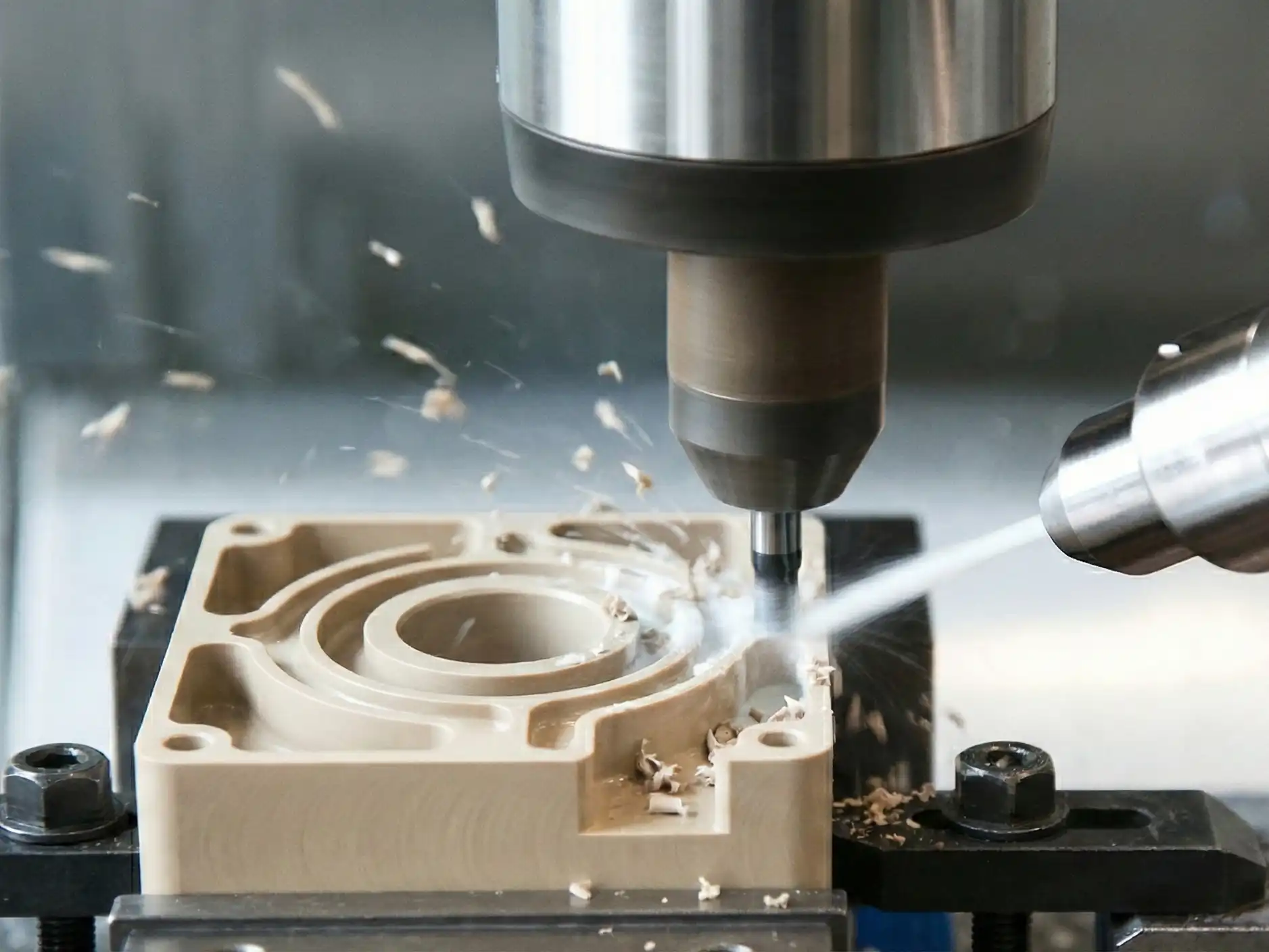 Why People Pick It: PEEK (polyetheretherketone) is a high-performance, semi-crystalline thermoplastic used when parts see high temperatures, aggressive chemicals, and continuous mechanical load. It holds tight tolerances, keeps its shape under heat, and resists creep better than most plastics. PEEK is frequently utilized for medical devices, aerospace hardware, semiconductor handling components, and piston or pump parts where metal replacement and weight reduction are priorities.
Machining Behavior: PEEK machines more like metal than most plastics, requiring higher tool pressure but producing compact chips and a clean finish. It doesn't shed heat well, so temperature control at the cutting edge is critical. Filled grades are very stiff and heat-resistant but abrasive on tools. With proper chip load and cooling, PEEK cuts predictably and holds tight tolerances.
Machining Tips:
- Tooling:
- Use sharp carbide as a baseline for unfilled PEEK; move to coated carbide or PCD/diamond-coated tools for glass- or carbon-filled grades to control wear.
- Avoid dull tools; rubbing will overheat the material, glaze the surface, and push the part out of size.
- Speeds & Feeds (Starting Points — Unfilled PEEK):
- For milling, starting in the ~400-600 ft/min range with ~0.002-0.006 in/tooth is reasonable for carbide tools; adjust for machine rigidity and part geometry. Treat these numbers as starting points and tune for your specific machine, tooling, and PEEK grade. On routers, avoid maxing out RPM with timid feeds—keep chip load up so you are cutting, not polishing. Step down or slow SFM for filled grades.
- Coolant & Heat Management:
- Strong air blast or mist is usually sufficient for unfilled PEEK and helps keep chips out of the cut; use plastic-safe coolants if you need extra temperature control.
- For long cycles, rough, let the part cool to room temperature, then take light finish passes to "reset" dimensions and avoid growth from heat soak.
| Setup | RPM | IPT | IPM | DOC | WOC | Coolant/Air | Watch For | Fix |
|---|---|---|---|---|---|---|---|---|
| Router | 9000 | 0.004 | 36 | 0.5D | 0.4D | Air/Mist | Heat at cutting edge; edge glazing | Drop SFM slightly; keep chip load up; use strong air or mist |
| Mill | 5100 | 0.003 | 31 | 0.5D | 0.25D | Air/Mist | Fast tool wear on filled grades | Use coated/PCD tools; shorten stick-out; reduce SFM and maintain feed |
| Starting values. Assumptions: Router = 1/4" single-flute O-flute; Mill = 3/8" 2-flute carbide. | ||||||||
Common Machining Problems & Fixes:
- Excessive Tool Wear on Filled Grades
- Problem: Glass- and carbon-filled PEEK can wear corners off end mills quickly, leading to chatter, poor finish, and size drift.
- Fix: Use coated carbide or PCD tools, shorten overhang, reduce SFM slightly, and keep chip load up so the edge is cutting cleanly rather than rubbing. Budget for more frequent tool changes on production runs.
- Heat Buildup, Glazing, or Dimensional Shift
- Problem: Rubbing passes, tiny stepovers, and "polishing" cuts trap heat at the cutting zone; parts can come off slightly oversized or move after they cool.
- Fix: Increase feed per tooth, avoid unnecessary spring passes, and use air or mist cooling. For tight-tolerance work, rough first, let the part cool, then take a light finish pass with a sharp tool and re-measure after the part returns to room temperature.
Ultem CNC Machining: Heat, Stability & Surface Finish
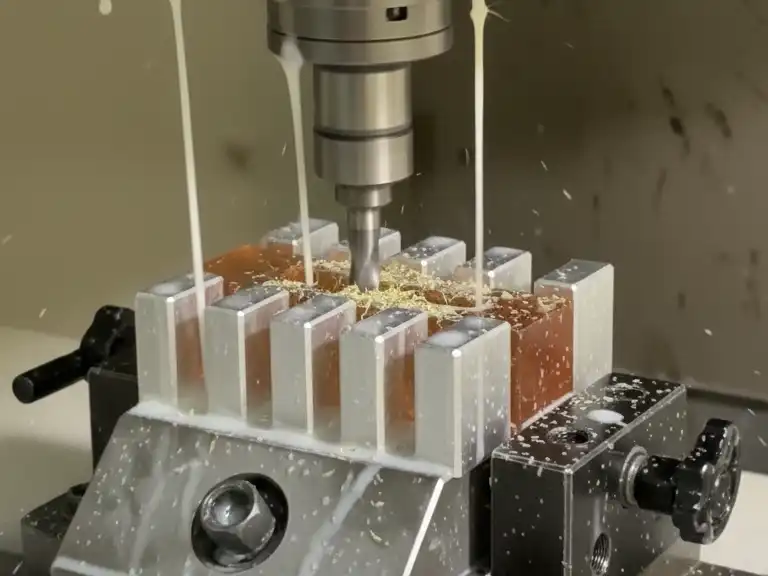 Why People Pick It: Ultem (PEI, polyetherimide) is an amorphous, high-temperature thermoplastic used when you need stiffness, electrical insulation, and dimensional stability up to 200°C. It holds size well, has good creep resistance, and offers strong chemical resistance to many acids, oils, and cleaning agents. Ultem is frequently used for electrical connectors, aerospace interiors and brackets, fluid handling components, and medical instruments where metal replacement, sterilization resistance, and weight reduction matter.
Machining Behavior: Ultem machines like a tough, slightly "gummy" plastic rather than a metal, with low thermal conductivity that keeps heat at the cutting edge and in the part, increasing the risk of softening, smearing, burrs, or a hazy surface if parameters aren't controlled. Unfilled Ultem is relatively easy to machine with sharp tools and an appropriate chip load, while glass-filled grades, such as Ultem 2300, are stiffer and more dimensionally stable but are also much more abrasive, which accelerates tool wear. Thin walls, sharp corners, and notched features require particular care, because if feed rates are too low or tools start to rub, you can see heat damage, chipping, or cracking instead of a clean cut.
Machining Tips:
- Tooling:
- Use sharp carbide as your baseline for unfilled Ultem.
- For glass-filled grades, consider upgrading to coated carbide or PCD/diamond-coated tools to effectively handle abrasion and extend edge life.
- Minimize tool stick-out and use rigid workholding; Ultem's elasticity can amplify chatter if the setup is weak.
- Avoid dull tools. Rubbing quickly generates heat, causes smearing, and will pull features out of tolerance.
- Speeds & Feeds (Starting Points — Unfilled Ultem/PEI):
- For unfilled Ultem/PEI, a good milling starting range is around 300-500 ft/min SFM with roughly 0.002-0.005 in/tooth on carbide tools, adjusting for your machine and tool size. On routers, avoid combining very high RPM with timid feeds; maintain a healthy chip load so you are cutting rather than melting the material. For glass- or mineral-filled Ultem, reduce the SFM from the starting values and maintain a solid chip load so that the cutting edge stays engaged and does not rub. Treat these as starting points and tune based on your machine, tool size, and Ultem grade.
- Coolant & Heat Management:
- Air blast or mist works well for most Ultem work and helps keep chips out of the cut; add vacuum extraction on routers if possible.
- Water-based, plastic-safe coolants are generally acceptable and help control temperature on long cycles (verify compatibility with your specific grade), avoid petroleum or aromatic coolants that can stress-crack amorphous plastics like PEI, and confirm any downstream cleanliness requirements.
- For tight-tolerance parts, rough first, let the part return to room temperature, then take light finish passes with a sharp tool. This minimizes drift from heat soak or internal stress relief.
| Setup | RPM | IPT | IPM | DOC | WOC | Coolant/Air | Watch For | Fix |
|---|---|---|---|---|---|---|---|---|
| Router | 9000 | 0.003 | 27 | 0.5D | 0.4D | Air/Mist | Edge smearing, long stringy chips | Keep chip load up; use strong air + vacuum; reduce SFM slightly if edges haze or melt |
| Mill | 4000 | 0.003 | 24 | 0.5D | 0.25D | Air/Mist | Burrs, softening on walls, early wear in filled grades | Drop SFM a bit, maintain feed; use coated/PCD tools for glass-filled; shorten stick-out |
| Starting values. Assumptions: Router = 1/4" single-flute O-flute; Mill = 3/8" 2-flute carbide. Reduce SFM and/or DOC for filled grades and very small tools. | ||||||||
Common Machining Problems & Fixes:
- Heat Softening, Smearing, or Burr Formation
- Problem: Ultem's low thermal conductivity and amorphous structure make it prone to local softening when tools rub or chip load is too light. Material can smear, edges may roll instead of shear, and the part can come off slightly out of size until it cools.
- Fix: Increase the feed per tooth so the tool is shearing rather than polishing. Avoid unnecessary spring passes and tiny stepovers that re-rub the surface. Use air or mist to clear chips and pull heat away from the cutting zone. For critical tolerances, rough the part, let it stabilize at room temperature, then finish with a sharp tool and re-measure after it cools.
- Excessive Tool Wear on Glass-Filled Ultem
- Problem: Glass-filled Ultem grades (e.g., Ultem 2300) are significantly more abrasive. Corners on end mills and drills can wear quickly, causing chatter, a poor surface finish, and tolerance drift during the run.
- Fix: Use coated carbide or PCD/diamond-coated tools for high-volume work, reduce SFM modestly while keeping chip load healthy to avoid rubbing, and shorten tool overhang with rigid fixturing to limit chatter as edges wear. For production, implement a tool-change schedule to ensure consistency in size and surface finish from part to part.
Essential Safety & PPE for Plastic Machining
- Eye/face: Safety glasses (side shields); face shield for high-ejection ops.
- Hands: Cut-resistant gloves for handling only, not at the spindle.
- Respiratory & ventilation: Local exhaust at source; respirator when fine dust or any fume is present.
- Hearing: Wear protection per machine sound levels.
- Chip/dust management: Continuous chip evacuation (vacuum/air blast) to prevent re-cutting and heat.
- Material cautions:
- PVC: Overheating may release HCl—use local exhaust; reduce heat (increase feed, reduce RPM); wipe down exposed metal surfaces after runs with a mild alkaline cleaner.
- Reinforced grades (GF/CF): Treat dust as abrasive; use enclosed extraction with fine filtration.
Plastic Machining Pre-Flight Checklist
- Identify grade/condition: Note fillers, FR ratings, and moisture-sensitive materials (e.g., Nylon).
- Tooling: Use sharp tools and correct flute geometry (O-flute for soft/ductile plastics).
- Program: Start with target chipload (avoid rubbing); conservative ramp/entry; verify coolant/air.
- Workholding: Support thin sheet; avoid over-clamping creep-prone materials (UHMW/PTFE).
- Post-op: Deburr with non-solvent methods; measure after cool-down; ventilate enclosure before opening on PVC jobs.
Trademark Notes
- Delrin and Vespel are trademarks of DuPont.
- KYDEX is a registered trademark of SEKISUI Polymer Innovations.
- Boltaron is a registered trademark of SIMONA AMERICA.
- Teflon is a trademark of The Chemours Company FC, LLC.
- Torlon is a registered trademark of Solvay Specialty Polymers USA, LLC. Current product information is published by Syensqo.
- Lexan is a trademark of SABIC.
- Makrolon is a trademark of Plaskolite.
Getting Help: Material Selection and Machining Service
Choosing the right plastic is the most critical step in any project. As this guide shows, material selection is a complex trade-off between mechanical properties, chemical resistance, cost, and machinability. Making the wrong choice can lead to failed parts, project delays, and costly scrap. The difference between a successful part and a failed one often comes down to expert-level knowledge. Whether you are facing acetal's centerline porosity in a fluid-handling part, need to guarantee dimensional tolerance in a nylon part, or are trying to prevent delayed stress-cracking in a critical polycarbonate guard, our engineering team can help.
Do not risk scrap on a complex job. Contact Interstate Plastics for expert material selection support. For parts that require perfection the first time, consider our full CNC machining services.
This guide was authored by Christopher Isar and reviewed for technical accuracy by Chris Clark. Values are typical and not specifications; always consult the current TDS/SDS for your exact material and grade.

About the Author
At Interstate Advanced Materials, Christopher Isar turns "it depends" into "do this." Since 2011, he's helped buyers choose plastics with confidence by focusing on what works on the shop floor and in the field, backed by IAPD Level 2 certification. If your project can't miss, Chris will guide you to cost-effective, real-world options. Contact Chris.